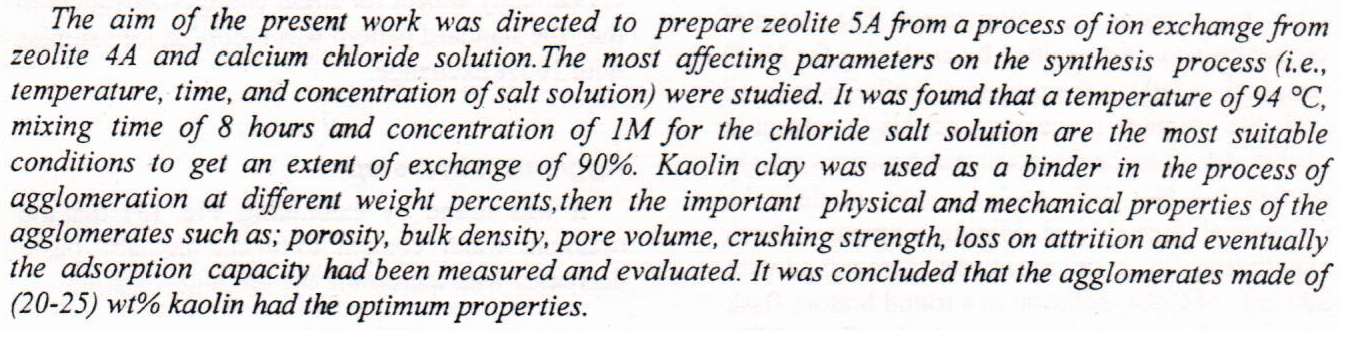
Preparation and Agglomeration of Zeolite 5A from Locally Available Raw Materials

The objective of the current research was to develop the posaconazole (PCZ) loaded NS into the carbopol 934 polymeric gel for prolonged drug release and improved topical delivery; seven different nanosponge formulations of PCZ were formulated using the emulsion solvent diffusion method using various amounts of polymer (ethylcellulose, EC). The aqueous and dispersed phases were prepared using polyvinyl alcohol (PVA) and dichloromethane. The prepared nanosponges (NS) were studied for particle size, structural appearance, and in vitro drug release. Furthermore, the selected formula was formulated as hydrogel and was evaluated for physical characteristics, drug content, and in-vitro drug release. Morphological studies revealed irregular
... Show More (11)
(11)
 (8)
(8)

 (1)
(1)
Manganese dioxide rotating cylinder electrode prepared by anodic deposition on a graphite substrate using MnSO4 solution in the presence of 0.918 M of H2SO4. The influence of different operational parameters (MnSO4 concentration, current density, time, and rotation speed) on the structure, and morphology of MnO2 deposit film was examined widely. The structure and crystal size determined by X-ray diffraction (XRD), the morphology examined by scanning electron microscopy (SEM) and atomic force microscopy (AFM) techniques. The γ-MnO2 obtained as the main product of the deposition process. It found that the four parameters have a significant influence on the structure, morphology, and roughness of the prepared MnO2 deposit. The crystal size in
... Show More
(21)
(17)

The economical and highly performed anode material is the critical factor affecting the efficiency of electro-oxidation toward organics. The present study aimed to detect the best conditions to prepare Mn-Co oxide composite anode for the electro-oxidation of phenol. Deposition of Mn-Co oxide onto graphite substrate was investigated at 25, 30, and 35 mA/cm2 to detect the best conditions for deposition. The structure and the crystal size of the Mn-Co oxide composite electrode were examined by using an X-Ray diffractometer (XRD), the morphological properties of the prepared electrode were studied by scanning electron microscopy (SEM) and Atomic force microscopy (AFM) techniques, and the chemical composition of the various
... Show More
Background: Restoration of the gingival margin of Class II cavities with composite resin continues to be problematic, especially where no enamel exists for bonding to the gingival margin. The aim of study is to evaluate the marginal leakage at enamel and cementum margin of class II MOD cavities using amalgam restoration and modern composite restorations Filtek™ P90, Filtek™ Z250 XT (Nano Hybrid Universal Restorative) and SDR bulk fill with different restoratives techniques. Materials and method: Eighty sound maxillary first premolar teeth were collected and divided into two main groups, enamel group and cementum group (40 teeth) for each group. The enamel group was prepared with standardized Class II MOD cavity with gingival margin (1 m
... Show MoreBackground: The main drawback of soft lining materials was that they debonded from the denture base after a certain period of usage. Therefore, the purpose of this research was to determine the impact of oxygen and argon plasma treatment on the shear bonding strength of soft liners to two different kinds of denture base materials: conventional acrylic resin and high impact acrylic resin. Materials and Methods: Heat cure conventional and high impact acrylic blocks (40 for each group) were prepared. A soft liner connected the final test specimen of two blocks of each acrylic material. Shear bond strength (SBS) was assessed using universal testing machine. Additional blocks were also prepared for analyzing Vickers microhardness, contact ang
... Show More
(15)
(4)
Background: Separation and deboning of artificial teeth from denture bases present a major clinical and labortory problem which affect both the patient and the dentist. The optimal bond strength of artificial teeth with denture base reinforced with nanofillers and flexible denture bases and the effect of thermo cycling should be evaluated. This study was conducted to evaluate and compare the shear bond strength of artificial teeth (acrylic and porcelain) with denture bases reinforced by 5% Zirconium oxide nanofillers and flexible bases under the effect of different surface treatments and thermo cycling and comparing the results with conventional water bath cured denture bases. Material and methods: Two types of artificial teeth; acrylic and
... Show MoreObjective: The aim of this study was to evaluate the effect of pumice, burning investment material
and black sand on the surface roughness of heat cure acrylic resin.
Methodology: Sixty specimens were prepared from pink heat cure acrylic resin, the specimens
where grouped into; 20 specimens which polished with pumice and water (control group); 20
specimens which polished with investment material (after burning it) and water; and 20 specimens
which polished with black sand and water. The average surface roughness of specimens after
polishing procedure had been determined by profilometer (surface roughness tester).
Results: Through the application of ANOVA and LSD tests, the result of this study showed that there
wa
(192)
(174)
Background: Radiopacity is one of the prerequisites for dental materials, especially for composite restorations. It's essential for easy detection of secondary dental caries as well as observation of the radiographic interface between the materials and tooth structure. The aim of this study to assess the difference in radiopacity of different resin composites using a digital x-ray system. Materials and methods: Ten specimens (6mm diameter and 1mm thickness) of three types of composite resins (Evetric, Estelite Sigma Quick,and G-aenial) were fabricated using Teflon mold. The radiopacity was assessed using dental radiography equipment in combination with a phosphor plate digital system and a grey scale value aluminum step wedge with thickness
... Show More