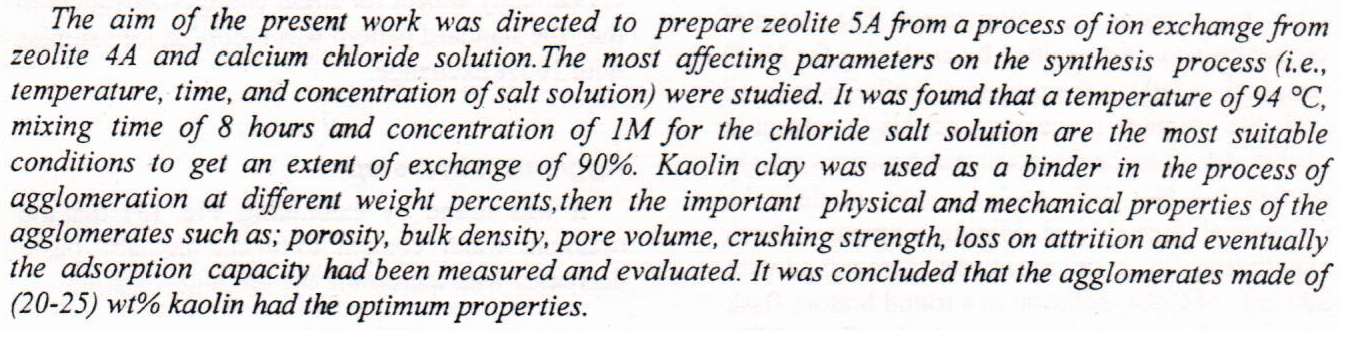
Preparation and Agglomeration of Zeolite 5A from Locally Available Raw Materials

This paper is devoted to investigate the effect of internal curing technique on the properties of self-compacting concrete. In this study, self-compacting concrete is produced by using limestone powder as partial replacement by weight of cement with percentage of (5%), sand is partially replaced by volume with saturated fine lightweight aggregate which is thermostone aggregate as internal curing material in three percentages of (5%, 10%, 15%) for self-compacting concrete, and the use of two external curing conditions which are water and air. The experimental work was divided into three parts: in the first part, the workability tests of fresh self-compacting concrete were conducted. The second part included conducting compressive str
... Show More (2)
(2)

Background: The aim of this study was to evaluate the effect of three types of light curing devices QTH, LED and Flashmax on the surface microhardness of three types of bulkfill composite resins; Filtek Bulkfill posterior composite ( 3M), Tetric Evo Ceram ( Ivoclar Vivadent) and Sonicfill composite ( Kerr) Materials and methods: Total number of 90 samples was prepared, 30 samples for each type of bulkfill composite, were divided into three main groups, group A: Filtek posterior bulkfil (3M), group B: Tetric Evo Ceram (Ivoclar Vivadent) and group C: contain Sonicfill composite (kerr). Which then divided into three subgroups (n= 10) (1) Samples cured by QTH system (2) Samples cured by LED system and (3) samples cured by Flashmax system the
... Show More


Objective: To evaluate the effect of mouth rinses (Biofresh and ZAK) on the surface micro hardness
of two light cure restorative material (Tetric ceram ivoclar-vivadent) and (3M Z 250) dental
composite.
Methodology: The microhardness values of (sixty) composite specimens were measured at the top
surfaces after 24 hours of immersion in different solutions (Biofresh, Zak mouth wash and distilled
water as control). Comparison done using descriptive statistics (mean, SD, SEM, minimum and
maximum values) and inferential statistics (ANOVA and LSD) test.
Results: The biofresh mouth rinse which has high alcohol containing has less effect on
microhardness of tetric ceram than the zak &distiled water , while the effect
Steel fiber aluminum matrix composites were prepared by atomization technique. Different air atomization conditions were considered; which were atomization pressure and distance between sample and nozzle. Tensile stress properties were studied. XRF and XRD techniques were used to study the primary compositions and the structure of the raw materials and the atomized products. The tensile results showed that the best reported tensile strength observed for an atomization pressure equal to 4 mbar and sample to nozzle distance equal to 12 cm. Young modulus results showed that the best result occurred with an air atomization pressure equal to 8 mbar and sample to nozzle distance equal to 16cm
 (58)
(53)
(58)
(53)
Solid dispersion (SD) is one of the most widely used methods to resolve issues accompanied by poorly soluble drugs. The present study was carried out to enhance the solubility and dissolution rate of Aceclofenac (ACE), a BCS class II drug with pH-dependent solubility, by the SD method. Effervescent assisted fusion technique (EFSD) using different hydrophilic carriers (mannitol, urea, Soluplus®, poloxamer 188, and poloxamer 407) in the presence of an effervescent base (sodium bicarbonate and citric acid) in different drug: carrier: effervescent base ratio and the conventional fusion technique (FSD) were used to prepare ACE SD. Solubility, dissolution rate, Fourier transformation infrared spectroscopy (FTIR), PowderX-ray diffraction
... Show More
(10)
(5)
Search Results at the International Journal of Science and Research (IJSR)
In this study, pure SnO2 Nanoparticles doped with Cu were synthesized by a chemical precipitation method. Using SnCl2.2H2O, CuCl2.2H2O as raw materials, the materials were annealed at 550°C for 3 hours in order to improve crystallization. The XRD results showed that the samples crystallized in the tetragonal rutile type SnO2 stage. As the average SnO2 crystal size is pure 9nm and varies with the change of Cu doping (0.5%, 1%, 1.5%, 2%, 2.5%, 3%),( 8.35, 8.36, 8.67, 9 ,7, 8.86)nm respectively an increase in crystal size to 2.5% decreases at this rate and that the crystal of SnO2 does not change with the introduction of Cu, and S
... Show More
(27)
(9)