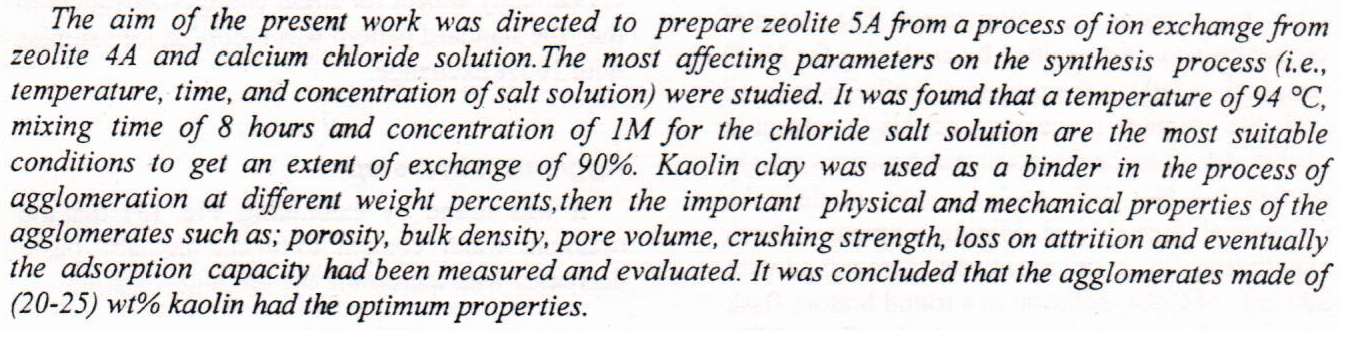
Preparation and Agglomeration of Zeolite 5A from Locally Available Raw Materials

 (11)
(11)
 (4)
(4)


Acetophenone sulfamethoxazole and 3-Nitrobenzophenone sulfamethoxazole were prepared from the reaction of sulfamethoxazole with two ketones. The prepared ligands were identified by (C.H.N) analysis and UV-VIS, FT-IR spectroscopic techniques. Metal complexes of the two ligands were prepared in an aqueous alcohol with Zn (II), Mn (II) and Cu (II) ions with a molar ratio1:1. The proposed general formula for the resulting complexes was [ML.CL2.H2O]H2O .The complexes were characterized by (C.H.N) technique , spectroscopic methods ,conductivity, atomic absorption ,magnetic susceptibility measurements and melting point. According to the results obtained, the suggested geometry is to be octahedral for all the complexes.
(2)
(1)
The objective of the present investigation was to enhance the solubility of practically insoluble mirtazapine by preparing nanosuspension, prepared by using solvent anti solvent technology. Mirtazapine is practically insoluble in water which act as antidepressant .It was prepared as nano particles in order to improve its solubility and dissolution rate. Twenty formulas were prepared and different stabilizing agents were used with different concentrations such as poly vinyl pyrrolidone (PVPK-90), poly vinyl alcohol (PVA), poloxamer 188 and poloxamer 407. The ratios of drug to stabilizers used to prepare the nanoparticles were 1: 1 and 1:2. The prepared nanoparticles were evaluated for
... Show More
(29)
(15)
The cost-effective removal of heavy metal ions represents a significant challenge in environmental science. In this study, we developed a straightforward and efficient reusable adsorbent by amalgamating chitosan and vermiculite (forming the CSVT composite), and comprehensively investigated its selective adsorption mechanism. Different techniques, such as Fourier-transform infrared spectroscopy (FTIR), zeta potential analysis, scanning electron microscopy (SEM), X-ray diffraction (XRD), and Brunauer, Emmett, Teller (BET) analysis were employed for this purpose. The prepared CSVT composite exhibited a larger surface area and higher mesoporosity increasing from 1.9 to 17.24 m2/g compared to pristine chitosan. The adsorption capabilities of the
... Show More
(56)
(54)

It was aimed to investigate the compressibility, compactibility, powder flow and tablet disintegration of a new excipient comprising magnesium (Mg) silicate co-processed (5%–85% w/w) onto chitin, microcrystalline cellulose (MCC) and starch as the hydrophilic polymers of interest. Initially, the mechanism of tablet disintegration was studied by measuring water infiltration rate, moisture sorption, swelling capacity and hydration ability. Moreover, the powders compression behavior was carried out by applying Kawakita model of compression analysis in addition to porosity and radial tensile strength measurements. In vitro drug release of compacts made of 400 mg ibuprofen and 300 mg of the hydrophilic polymers containing 30% w/w Mg silicat
... Show More
(11)
Polymeric hollow fiber membrane is produced by a physical process called wet or dry/wet phase inversion; a technique includes many steps and depends on different factors (starting from selecting materials, end with post-treatment of hollow fiber membrane locally manufactured). This review highlights the most significant factors that affect and control the characterization and structure of ultrafiltration hollow fiber membranes used in different applications.
Three different types of polymers (polysulfone PSF, polyethersulfone PES or polyvinyl chloride PVC) were considered to study morphology change and structure of hollow fiber membranes in this review. These hollow fiber membranes were manufactured with different pro
... Show More
Using an environmentally friendly chemical process, a novel nanocomposite consisting of reduced graphene oxide (rGO) and silver(I) oxide (Ag2O) nanoparticles was successfully synthesized in this work, and its optical properties along with photoelectric performance were investigated. Ag2O is a narrow-bandgap p-type semiconductor with strong visible light response but exhibits poor carrier separation and structural instability during exposure to radiation. In order to overcome shortcomings encountered with Ag2O, rGO was used as a conductive support to produce rGO@Ag2O nanocomposites with improved electronic interactions. Various characterization tests, including energy-dispersive X-ray spectroscopy (EDXS), field emission scanning electron mic
... Show More
A simple, accurate and sensitive spectrophotometric way is used to determine Bisacodyl in pure and pharmaceutical preparations. The proposed method depends on using 2,4-Dinitrophenylhydrazine as chromogenic reagent . The method was based on the oxidative coupling reaction of Bisacodyl with 2,4-Dinitrophenylhydrazine with Sodium periodate in the presence of sodium hydroxide as alkaline media to form red water soluble dye product , that has a maximum absorption at ?max 522nm . Beer ,s law is obeyed in the concentration of (2.00–20.00) ?g.ml -1 .The molar absorptivity is (6505) L.mol-1.cm-1,a sandall sensitivity of(0.0555) ?g.cm-2), correlation coefficient of (0.9970) , Limitof detection (LOD) (0.0312 ?g.ml-1), limit of Quantitation (LOQ) (
... Show More
(5)
(2)
Due to the advantages over other metallic materials, such as superior corrosion resistance, excellent biocompatibility, and favorable mechanical properties, titanium, its alloys and related composites, are frequently utilized in biomedical applications, particularly in orthopedics and dentistry. This work focuses on developing novel titanium-titanium diboride (TiB2; ceramic material) composites for dental implants where TiB2 additions were estimated to be 9 wt.%. In a steel mold, Ti-TiB2 composites were fabricated using a powder metallurgy technique and sintered for five hours at 1200 °C. Microstructural and chemical properties were analyzed by energy dispersive X-ray spectroscopy (EDX), scanning electron microscopy (SEM), and X-ra
... Show More
(3)
(3)
In this study three inorganic nano additives, namely; CaCO3, Al2O3 and SiO2 were used to prepare nanocomposites of unsaturated polyester in order to modify their mechanical properties, i.e. tensile strength, elongation, impact and hardness. The results indicated that all the three additives were effective to improve the mechanical properties up to 4% by weight. The effectiveness of them follows the order : CaCO3 > Al2O3 > SiO2 This is due to their particle size in which CaCO3 (13nm), Al2O3 (20-30nm) and SiO2 (15-20nm).