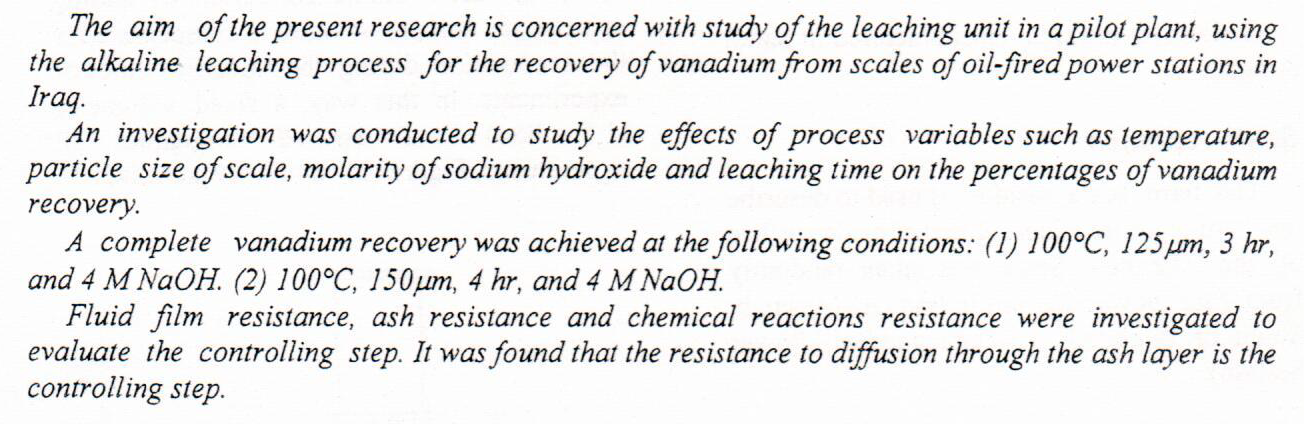
Recovery of Vanadium from Scale Residues of Oil-Fired Power Stations

This study aimed to extraction of essential oil from peppermint leaves by using hydro distillation methods. In the peppermint oil extraction with hydro distillation method is studied the effect of the extraction temperature to the yield of peppermint oil. Besides it also studied the kinetics during the extraction process. Then, 2nd -order mechanism was adopted in the model of hydro distillation for estimation many parameters such as the initial extraction rate, capacity of extraction and the constant rat of extraction with various temperature. The same model was also used to estimate the activation energy. The results showed a spontaneous process, since the Gibbs free energy had a value negative sign.
 (7)
(7)

Sewage pumping stations are considered an important part of any sewerage system. Pumps failure in these stations means that the pumps are unable to work at the design requirement (flow capacity and head) and that may cause sewer overflow and flooding leading to sewer deterioration. In this paper, two main sewage pumping stations in Baghdad city were selected as case studies, Al- Habibia and Al-Ghazali located on Zublin trunk sewer 3000 mm and Baghdad trunk sewer 1200-2100 respectively. This study focused mainly on the operation of main sewage pumping stations and their effect, both directly and indirectly, on changing hydraulic properties, which leads to an increase in the deterioration of sewage pipes. The hydraulic analysis was co
... Show MoreSustainability including renewable energy and green power, is one of the important feature in recent years due to environmental constraints and the emission of CO2 from fossil fuel. Pressure retarded osmosis (PRO) process is considered one of the effective technology for power generation. This study assessed the application of pressure retarded osmosis to produce power from Tigris River water in Baghdad City, Iraq. Spiral wound TFC membrane was tested in the PRO process with different variables. The effect of different types of draw solutions (MgCl2, NaCl, Sodium Formate, KCl, Sodium Acetate), applied pressure (0 – 7 bar), and draw solution concentration (0.08 and 0.4 M) were tested in this work. The flux, recovery, and power density for
... Show More (5)
(3)
(5)
(3)


The production of power using the process of pressure–retarded osmosis (PRO) has been studied both experimentally and theoretically for simulated sea water vs. river water and deionized water under two cases: the first is for simulated real conditions of sea water and river water and second under low brine solution concentration to examine the full profile of the power- pressure. The influence of concentration polarization (CP) on water flux has been examined as well.
In order to study the effect of inoculation with mycorrhiza and fertilization with plant residues on the growth of plants, we used two factors: the first two levels of mycorrhiza inoculation, Glumus mossea (0 and 10 g.pot-1) and the second factor, four levels of plant residues (10 g.pot-1) celery plant residues, 10 g pot-1 mint residues, and 10 g pot-1 black bean seed residues. Mychorrizal treatment (10 g pot-1) increased the number of mycorrhiza spores and the infection percentage of mycorrhizal by 917.44% and 13088.23%, respectively; celery treatment (10 g.pot-1) increased the chlorophyll index in the leaves and height of the chard plant by 31.34% and 94.04%, respectively; and black seed treatment (10 g.pot-1) increased the percen
... Show More
Bio-diesel is an attractive fuel fordiesel engines. The feedstock for bio-diesel production is usually vegetable oil, waste cooking oil, or animal fats. This work provides an overview concerning bio-diesel production. Also, this work focuses on the commercial production of biodiesel. The objective is to study the influence of these parameters on the yield of produced. The biodiesel production affecting by many parameters such s alcohol ratio (5%, 10%,15 %, 20%,25%,30%35% vol.), catalyst loading (5,10,15,20,25) g,temperature (45,50,55,60,65,70,75)°C,reaction time (0-6) h, mixing rate (400-1000) rpm. the maximum bio-diesel production yield (95%) was obtained using 20% methanol ratio and 15g biocatalyst at 60°C.
(2)
This study was aimed to estimate the influence of Conocarpus erectus L. residues, and some micronutrients on growth and production of potato. This research was conducted at one of the fields of the College of Agricultural Engineering Sciences - University of Baghdad. The experiment was implemented using factorial arrangement (4X3X3) within randomized complete block design with three replicates. Conocarpus fertilizer was represented the first factor with three levels (7.5, 15, 30 ton.ha-1), which symbolized (C2, C3, C4). Mineral fertilizer as recommended dose as a control, which symbolized (C1). The second factor was foliar spraying with three levels of iron (0, 100, 200 mg.L-1), which symbolized (F0, F1, F2). The third factor is fol
... Show More
(6)
(1)
Three isolates of P. aeruginosa were isolated from burnt patients. The ability of these isolates for adhesion and formation of slime layer were tested, the result showed that all isolates were able to adherence on the smooth surface. The sensitivity of P. aeruginosa isolates for antibiotics were tested , all isolates were sensitive to Gentamycin, Piperacillin and Amikacin Ciprofloxacin, and resist to Tetracyclin, Amoxicillin, Cephalexine , Ceftriaxone. Ciprofloxacin and Amikacin were found effective against P. aeruginosa isolates with MIC values of 3.8 μg/ ml for Ciprofloxacin and 0.244 μg/ ml for Amikacin The antibacterial effect of Different concentrations of Aloe
... Show More
(1)
(2)
(1)