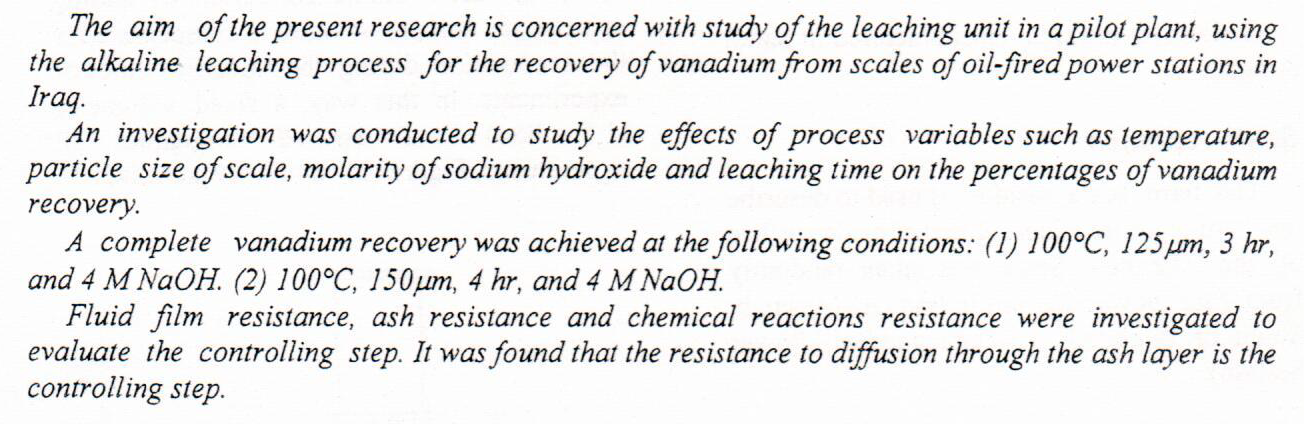
Recovery of Vanadium from Scale Residues of Oil-Fired Power Stations

This study includes using green or biosynthesis-friendly technology, which is effective in terms of low cost and low time and energy to prepare V2O5NPs nanoparticles from vanadium sulfate VSO4.H2O using aqueous extract of Punica Granatum at a concentration of 0.1M and with a basic medium PH= 8-12. The V2O5NPs nanoparticles were diagnosed using several techniques, such as FT-IR, UV-visible with energy gap Eg = 3.734eV, and the X-Ray diffraction XRD was calculated using the Debye Scherrer equation. It was discovered to be 34.39nm, Scanning Electron Microscope (SEM), Transmission Electron Microscopy TEM. The size, structure, and composition of synthetic V2O5NPs were determined using the (EDX) pattern, Atomic force microscopy AFM. The a
... Show More (10)
(10)
 (7)
(7)



This study includes using green or biosynthesis-friendly technology, which is effective in terms of low cost and low time and energy to prepare V2O5NPs nanoparticles from vanadium sulfate VSO4.H2O using aqueous extract of Punica Granatum at a concentration of 0.1M and with a basic medium PH= 8-12. The V2O5NPs nanoparticles were diagnosed using several techniques, such as FT-IR, UV-visible with energy gap Eg = 3.734eV, and the X-Ray diffraction XRD was calculated using the Debye Scherrer equation. It was discovered to be 34.39nm, Scanning Electron Microscope (SEM), Transmission Electron Microscopy TEM. The size, structure, and composition of synthetic V2O5
... Show More
(10)
(7)
This research has been prepared to isolate and diagnose one of the most important vegetable oils from the plant medical clove is the famous with Alaeugenol oil and used in many pharmaceuticals were the isolation process using a technique ultrasonic extraction and distillation technology simple
This work was conducted to study the extraction of eucalyptus oil from natural plants (Eucalyptus camadulensis leaves) by organic solvents. the effects of the main operating parameters were studied; type of solvent (n-hexane and ethanol), time to reach equilibrium, the temperature (45°C to 65°C) for n-hexane and (45°C to 75°C) for ethanol, solvent to solid ratio (5:1 to 8:1 (v/w)), agitation speed (0 to 900 rpm) and the particle size (0.5 to 2.5 cm) of fresh leaves to find the best processing conditions for the achieving maximum oil yield. The concentration of eucalyptus oil in solvent was measured by using UV-spectrophotometer. The results (for n-hexane) showed that the agitation speed of 900 rpm, temperature 65°C with solvent to soli
... Show MoreAn investigation was conducted effect of addition co- solvent on solvent extraction process for two types of a lubricating oil fraction (spindle) and (SAE-30) obtained from vacuum distillation unit of lube oil plant of Daura Refinery. In this study two types of co-solvents ( formamide and N-methyl, 2, pyrrolidone) were blended with furfural to extract aromatic hydrocarbons which are the undesirable materials in raw lubricating oil, in order to improve the viscosity index, viscosity and yield of produced lubricating oil. The studied operating condition are extraction temperature range from 70 to 110 °C for formamide and 80 to 120 °C for N-methyl, 2, pyrrolidone, solvent to oil ratio range from 1:1 to 2:1 (wt./wt.) for furfural with form
... Show MoreIn the present work advanced oxidation process, photo-Fenton (UV/H2O2/Fe+2) system, for the treatment of wastewater contaminated with oil was investigated. The reaction was influenced by the input concentration of hydrogen peroxide H2O2, the initial amount of the iron catalyst Fe+2, pH, temperature and the concentration of oil in the wastewater. The removal efficiency for the system UV/ H2O2/Fe+2 at the optimal conditions and dosage (H2O2 = 400mg/L, Fe+2 = 40mg/L, pH=3, temperature =30o C) for 1000mg/L load was found to be 72%.
(12)
A phytoremediation experiment was carried out with kerosene as a model for total petroleum hydrocarbons. A constructed wetland of barley was exposed to kerosene pollutants at varying concentrations (1, 2, and 3% v/v) in a subsurface flow (SSF) system. After a period of 42 days of exposure, it was found that the average ability to eliminate kerosene ranged from 56.5% to 61.2%, with the highest removal obtained at a kerosene concentration of 1% v/v. The analysis of kerosene at varying initial concentrations allowed the kinetics of kerosene to be fitted with the Grau model, which was closer than that with the zero order, first order, or second order kinetic models. The experimental study showed that the barley plant designed in a subsu
... Show More
(13)
(10)
A phytoremediation experiment was carried out with kerosene as a model for total petroleum hydrocarbons. A constructed wetland of barley was exposed to kerosene pollutants at varying concentrations (1, 2, and 3% v/v) in a subsurface flow (SSF) system. After a period of 42 days of exposure, it was found that the average ability to eliminate kerosene ranged from 56.5% to 61.2%, with the highest removal obtained at a kerosene concentration of 1% v/v. The analysis of kerosene at varying initial concentrations allowed the kinetics of kerosene to be fitted with the Grau model, which was closer than that with the zero order, first order, or second order kinetic models. The experimental study showed that the barley plant designed in a subsu
... Show More
(10)
Corrosion- induced damage in reinforced concrete structure such as bridges, parking garages, and buildings, and the related cost for maintaining them in a serviceable condition, is a source of major concern for the owners of these structures.
Fly ash produced from south Baghdad power plant with different concentrations (20, 25 and 30) % by weight from the cement ratio were used as a corrosion inhibitor as a weight ratio from the cement content.
The concrete batch ratio under study was (1:1.5:3) cement, sand and gravel respectively which is used in Iraq. All the raw materials used were locally manufactured.
Concrete slabs (250x250x70) mm dimensions were casted, using Poly-wood molds. Two steel bars were embedded in the central po
Biomedical signal such as ECG is extremely important in the diagnosis of patients and is commonly recorded with a noise. Many different kinds of noise exist in biomedical environment such as Power Line Interference Noise (PLIN). Adaptive filtering is selected to contend with these defects, the adaptive filters can adjust the filter coefficient with the given filter order. The objectives of this paper are: first an application of the Least Mean Square (LMS) algorithm, Second is an application of the Recursive Least Square (RLS) algorithm to remove the PLIN. The LMS and RLS algorithms of the adaptive filter were proposed to adapt the filter order and the filter coefficients simultaneously, the performance of existing LMS
... Show More