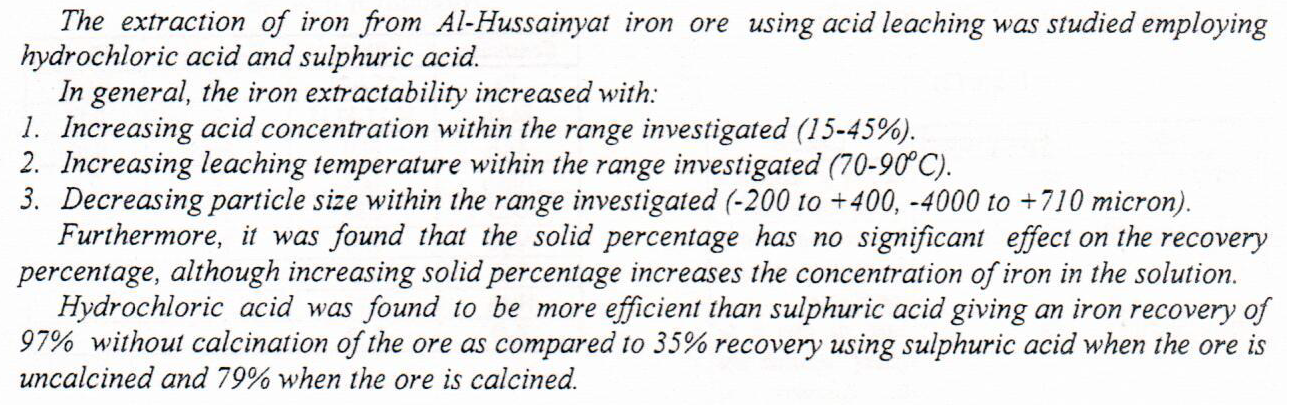
Extraction of Iron from Al-Hussainyat Iron Ore using Acid Leaching

Pectin is available in many plants and in this study, the peels of tomatoes and beet were used to be an economical source of pectin production instead of dumping it with waste or using it as animal feed. The pectin extracted from the peels using different solutions, namely citric acid (2 M), oxalic acid (2%) and hydrochloric acid (0.5 M) the outcome of the extraction methods, 7. 1%, 6% and 11% respectively for tomatoes peels, while the pectin of beet peels were 8%, 6.5%, and 8.3%, and the highest percentage obtained in the manner of hydrochloric acid adopted in the manufacture of yogurt.Yogurt was manufactured with four treatments, in the first treatment standard pectin was added and the second treatment in addition to the pectin extracted
... Show More
 (6)
(6)
 (4)
(4)

 (13)
(11)
(13)
(11)
The removal of fluoride ions from aqueous solution onto algal biomass as biosorbent in batch and continuous fluidized bed systems was studied. Batch system was used to study the effects of process parameters such as, pH (2-3.5), influent fluoride ions concentration (10- 50 mg/l), algal biomass dose (0–1.5 g/ 200 ml solution), to determine the best operating conditions. These conditions were pH=2.5, influent fluoride ions concentration= 10 mg/l, and algal biomass dose=3.5 mg/l. While, in continuous fluidized bed system, different operating conditions were used; flow rate (0.667- 0.800 l/min), bed depth (8-15 cm) corresponded to bed weight of (80- 150 g). The results show that the breakthrough time increases with the inc
... Show MoreThe efficiency evaluation of the railway lines performance is done through a set of indicators and criteria, the most important are transport density, the productivity of enrollee, passenger vehicle production, the productivity of freight wagon, and the productivity of locomotives. This study includes an attempt to calculate the most important of these indicators which transport density index from productivity during the four indicators, using artificial neural network technology. Two neural networks software are used in this study, (Simulnet) and (Neuframe), the results of second program has been adopted. Training results and test to the neural network data used in the study, which are obtained from the international in
... Show MoreThis research investigates the adsorption isotherm and adsorption kinetics of nitrogen from air using packed bed of Li-LSX zeolite to get medical oxygen. Experiments were carried out to estimate the produced oxygen purity under different operating conditions: input pressure of 0.5 – 2.5 bar, feed flow rate of air of 2 – 10 L.min-1 and packing height of 9-16 cm. The adsorption isotherm was studied at the best conditions of input pressure of 2.5 bar, the height of packing 16 cm, and flow rate 6 Lmin-1 at ambient temperature, at these conditions the highest purity of oxygen by this system 73.15 vol % of outlet gas was produced. Langmuir isotherm was the best models representing the experimental data., and the m
... Show More
(1)
(7)
(8)
This study investigates the possibility of removing ciprofloxacin (CIP) using three types of adsorbent based on green-prepared iron nanoparticles (Fe.NPs), copper nanoparticles (Cu. NPS), and silver nanoparticles (Ag. NPS) from synthesized aqueous solution. They were characterized using different analysis methods. According to the characterization findings, each prepared NPs has the shape of a sphere and with ranges in sizes from of 85, 47, and 32 nanometers and a surface area of 2.1913, 1.6562, and 1.2387 m2/g for Fe.NPs, Cu.NPs and Ag.NPs, respectively. The effects of various parameters such as pH, initial CIP concentration, temperature, NPs dosage, and time on CIP removal were investigated through batch experiments. The res
... Show More
(3)
(3)
(94)
(93)
PVC membrane sensor for the selective determination of Mefenamic acid (MFA) was constructed. The sensor is based on ion association of MFA with Dodecaphospho molybdic acid (PMA) and Dodeca–Tungstophosphoric acid(PTA) as ion pairs. Nitro benzene (NB) and di-butyl phthalate (DBPH) were used as plasticizing agents in PVC matrix membranes. The specification of sensor based on PMA showed a linear response of a concentration range 1.0 × 10⁻² –1.0 × 10⁻⁵ M, Nernstian slopes of 17.1-18.86 mV/ decade, detection limit of 7 × 10⁻⁵ -9.5 × 10 -7M, pH range 3 – 8 , with correlation coefficients lying between 0.9992 and 0.9976, respectively. By using the ionphore based on PTA gives a concentration range of 1.0 × 10⁻⁴ –1.0 × 10⁻⁵ M,
... Show More