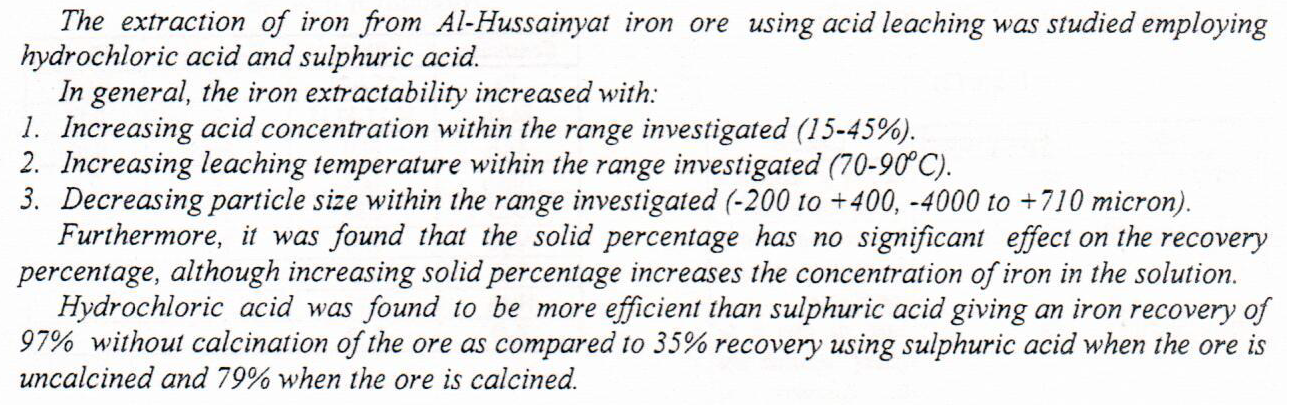
Extraction of Iron from Al-Hussainyat Iron Ore using Acid Leaching

 (1)
(1)
 (1)
(1)



A simple, environmental friendly and selective sample preparation technique employing porous membrane protected micro-solid phase extraction (μ-SPE) loaded with molecularly imprinted polymer (MIP) for the determination of ochratoxin A (OTA) is described. After the extraction, the analyte was desorbed using ultrasonication and was analyzed using high performance liquid chromatography. Under the optimized conditions, the detection limits of OTA for coffee, grape juice and urine were 0.06 ng g−1, 0.02 and 0.02 ng mL−1, respectively while the quantification limits were 0.19 ng g−1, 0.06 and 0.08 ng mL−1, respectively. The recoveries of OTA from coffee spiked at 1, 25 and 50 ng g−1, grape juice and urine samples at 1, 25 and 50 ng mL
... Show More
(110)
(96)
(3)
(1)
The subject of this research involves studying adsorption to removal herbicide Atlantis WG from aqueous solutions by bentonite clay. The equilibrium concentration have been determined spectra photometry by using UV-Vis spectrophotometer. The experimental equilibrium sorption data were analyzed by two widely, Langmuir and Freundlish isotherm models. The Langmuir model gave a better fit than Freundlich model The adsorption amount of (Atlantis WG) increased when the temperature and pH decreased. The thermodynamic parameters like ?G, ?H, and ?S have been calculated from the effect of temperature on adsorption process, is exothermic. The kinetic of adsorption process was studied depending on Lagergren ,Morris ? Weber and Rauschenberg equati
... Show More
Background: Medicinal plants that possess antimicrobial and antioxidant properties have garnered significant attention for their role in maintaining food quality, improving safety, and impeding spoilage. They also can aid in controlling food contamination risks and augmenting the nutritional value of foods. Objective: The study aimed to obtain botanical extracts possessing antimicrobial capabilities and use them to inhibit the growth of molds and yeasts. Additionally, these extracts are aimed at prolonging product shelf life by harnessing their antioxidant attributes. Methods: Several microorganisms, including E. coli and Pseudomonas, were subjected to testing. Ethanolic alcohol, chloroform, and essential oil extracts were prepared;
... Show More
(10)
(2)
The study aims to find out the effectiveness of using the Google classroom educational platform in teaching mathematics curricula from the viewpoint of teachers in the Governorate of Al Dhahirah, Sultanate of Oman. The researcher adopted the descriptive-analytical approach. To collect the needed data, a questionnaire of two dimensions was used. It includes (13) items to measure the effectiveness of using the Google classroom in teaching mathematics curricula from the teacher's point of view and includes (10) items to measure the difficulties of using the Google classroom in teaching mathematics curricula from the teachers' point of view. These tools were applied to (32) male and (31) female as the study sample. They represent mathematics
... Show More
(3)
(3)
The study was conducted over the period of Oct 2018 to Apr 2019 and is aimed for the detection and estimation of four hazardous Volatile Organic Compounds VOC (benzene, toluene, ethylbenzene, and xylene) so-called (BTEX) in samples collected from the produced water in the Al-Ahdab oil field in Iraq also to track their availability in the important natural water sources around the field. These compounds pose a risk to human health as well as environment. To avoid the laborious and tiresome conventional extraction methods, water samples were collected and concentrated using solid-phase extraction technique (SPE) which is a robust and cost-effective method of sample extraction with minimal exposure and handling of solvents and then to be analy
... Show More
(4)
Date stones were used as precursor for the preparation of activated carbons by chemical
activation with ferric chloride and zinc chloride. The effects of operating conditions represented
by the activation time, activation temperature, and impregnation ratio on the yield and adsorption
capacity towards methylene blue (MB) of prepared activated carbon by ferric chloride activation
(FAC) and zinc chloride activation (ZAC) were studied. For FAC, an optimum conditions of 1.25
h activation time, 700 °C activation temperature, and 1.5 impregnation ratio gave 185.15 mg/g
MB uptake and 47.08 % yield, while for ZAC, 240.77 mg/g MB uptake and 40.46 % yield were
obtained at the optimum conditions of 1.25 h activation time, 500
(7)