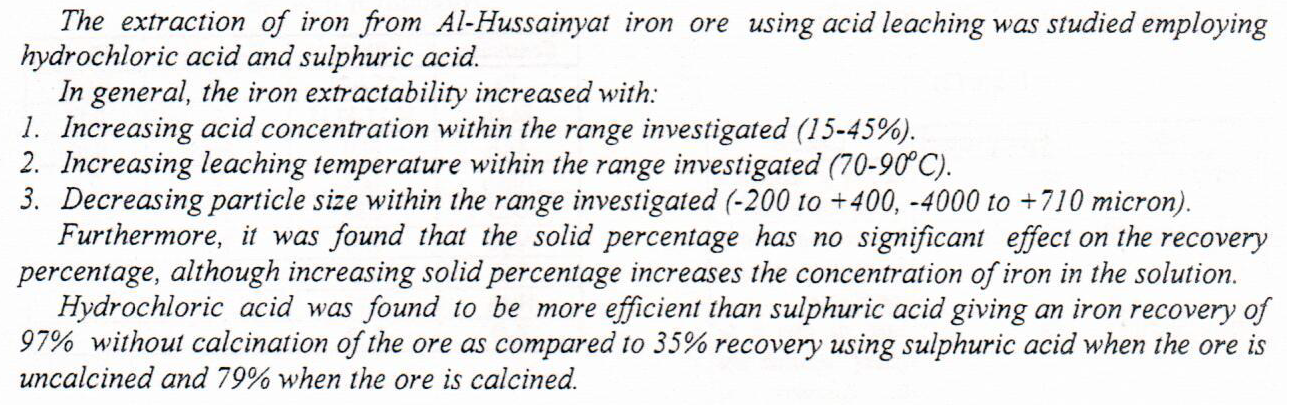
Extraction of Iron from Al-Hussainyat Iron Ore using Acid Leaching

 (2)
(2)
 (1)
(1)


Its well known that understanding human facial expressions is a key component in understanding emotions and finds broad applications in the field of human-computer interaction (HCI), has been a long-standing issue. In this paper, we shed light on the utilisation of a deep convolutional neural network (DCNN) for facial emotion recognition from videos using the TensorFlow machine-learning library from Google. This work was applied to ten emotions from the Amsterdam Dynamic Facial Expression Set-Bath Intensity Variations (ADFES-BIV) dataset and tested using two datasets.
(58)
(41)
(8)
(6)

Water scarcity is one of the most important problems facing humanity in various fields such as economics, industry, agriculture, and tourism. This may push people to use low-quality water like industrial-wastewater. The application of some chemical compounds to get rid of heavy metals such as cadmium is an environmentally harmful approach. It is well-known that heavy metals as cadmium may induce harmful problems when present in water and invade to soil, plants and food chain of a human being. In this case, man will be forced to use the low quality water in irrigation. Application of natural materials instead of chemicals to remove cadmium from polluted water is an environmental friendly approach. Attention was drawn in this research wor
... Show More
(8)
(4)
Cassava, a significant crop in Africa, Asia, and South America, is a staple food for millions. However, classifying cassava species using conventional color, texture, and shape features is inefficient, as cassava leaves exhibit similarities across different types, including toxic and non-toxic varieties. This research aims to overcome the limitations of traditional classification methods by employing deep learning techniques with pre-trained AlexNet as the feature extractor to accurately classify four types of cassava: Gajah, Manggu, Kapok, and Beracun. The dataset was collected from local farms in Lamongan Indonesia. To collect images with agricultural research experts, the dataset consists of 1,400 images, and each type of cassava has
... Show More
(10)
(5)
(45)
(35)
(3)
(2)
(3)
(2)
The aim of this study was to investigate the effect of operating variables on, the percentage of removed sludge (PSR) obtained during re-refining of 15W-40 Al-Durra spent lubricant by solvent extraction-flocculation treatment method. Binary solvents were used such as, Heavy Naphtha (H.N.): MEK (N:MEK), H.N. : n-Butanol (N:n-But), and H.N. : Iso-Butanol (N:Iso:But). The studied variables were mixing speed (300-900, rpm), mixing time (15-60, min), and operating temperature (2540, oC). This study showed that the studied operating variables have effects where, increasing the mixing time up to 45 min for H.N.: MEK, H.N.: n-Butanol and 30 min for H.N.: Iso-Butanol increased the PSR, after that percentage was decreased; increasing t
... Show MoreAn investigation was conducted to suggest relations for estimating yield and properties of the improved light lubricating oil fraction produced from furfural extraction process by using specified regression.
Mass transfer in mixer-settler has been studied. Mass transfer coefficient of continuous phase, mass transfer coefficient of dispersed phase and the overall mass transfer coefficient extraction of light lubes oil distillate fraction by furfural are calculated in addition to all physical properties of individual components and the extraction mixtures.
The effect of extraction variables were studied such as extraction temperature which ranges from 70 to 110°C and solvent to oil ratio which ranges from 1:1 to 4:1 (wt/wt
... Show More