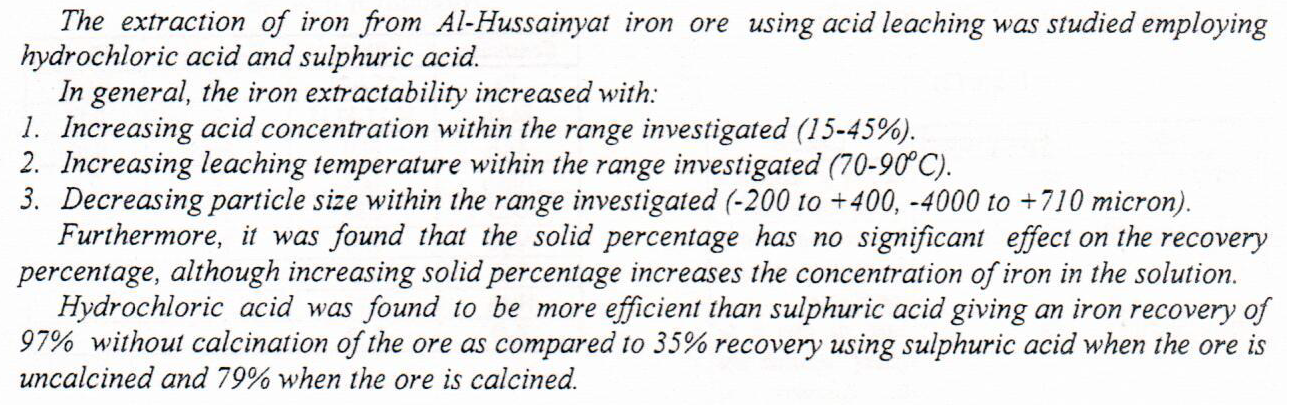
Extraction of Iron from Al-Hussainyat Iron Ore using Acid Leaching

Fatty Acid Methyl Ester (FAME) produced from biomass offers several advantages such as renewability and sustainability. The typical production process of FAME is accompanied by various impurities such as alcohol, soap, glycerol, and the spent catalyst. Therefore, the most challenging part of the FAME production is the purification process. In this work, a novel application of bulk liquid membrane (BLM) developed from conventional solvent extraction methods was investigated for the removal of glycerol from FAME. The extraction and stripping processes are combined into a single system, allowing for simultaneous solvent recovery whereby low-cost quaternary ammonium salt-glycerol-based deep eutectic solvent (DES) is used as the membrane phase.
... Show More (11)
(11)
 (10)
(10)



The removal of turbidity from produced water by chemical coagulation/flocculation method using locally available coagulants was investigated. Aluminum sulfate (alum) is selected as a primary coagulant, while calcium hydroxide (lime) is used as a coagulant aid. The performance of these coagulants was studied through jar test by comparing turbidity removal at different coagulant/ coagulants aid ratio, coagulant dose, water pH, and sedimentation time. In addition, an attempt has been made to examine the relationship between turbidity (NTU) and total suspended solids (mg/L) on the same samples of produced water. The best conditions for turbidity removal can be obtained at 75% alum+25% lime coagulant at coagulant dose of 80 m
... Show MoreParasitological investigation of piscivorous birds in Al-Hammar marsh south of Iraq during December-February 2004 and December 2005 were revealed that water birds infected with five nematode species, which belong to three different superfamilies, Desmidocercella numidica (Seurat, 1920) (Superfamily: Aproctoidea) from three piscivorous birds including Grey heron Ardea cinerea, Bittern Botaurusstellaris, and small white heron Ardeola ralloides; Avioserpens sp. 1 and Avioserpens sp. 2 (Superfamily: Dracunculoidea) from small bittern Ixobrychus minutus and black glossy ibis Plegadisfalcinellus respectively; Baruscapillaria sp. and Baruscapillarinae gen. sp. (Sup
... Show MoreThe water quality index is the most common mathematical way of monitoring water characteristics due to the reasons for the water parameters to identify the type of water and the validity of its use, whether for drinking, agricultural, or industrial purposes. The water arithmetic indicator method was used to evaluate the drinking water of the Al-Muthana project, where the design capacity was (40000) m3/day, and it consists of traditional units used to treat raw water. Based on the water parameters (Turb, TDS, TH, SO4, NO2, NO3, Cl, Mg, and Ca), the evaluation results were that the quality of drinking water is within the second category of the requirements of the WHO (86.658%) and the first category of the standard has not been met du
... Show More
(3)
The water quality index is the most common mathematical way of monitoring water characteristics due to the reasons for the water parameters to identify the type of water and the validity of its use, whether for drinking, agricultural, or industrial purposes. The water arithmetic indicator method was used to evaluate the drinking water of the Al-Muthana project, where the design capacity was (40000) m3/day, and it consists of traditional units used to treat raw water. Based on the water parameters (Turb, TDS, TH, SO4, NO2, NO3, Cl, Mg, and Ca), the evaluation results were that the quality of drinking water is within the second category of the requirements of the WHO (86.658%) and the first category of the standard has not
... Show More
(3)
The objective of this research work is to evaluate the quality of central concrete plant of Al-Rasheed Company by using Six Sigma approach which is a measure of quality that strives for near elimination of defects using the statistical methods to improve outputs that are critical to customers. The fundamental objective of Six Sigma methodology is the implementation of a measurement-based strategy that focuses on process improvement and variation reduction to reach delighting customers, and then suggesting an improvement system to improve the production of concrete in Al-Rasheed State Contracting Construction Company.
A field survey includes two parts (open and close questionnaire) that aimed to get the data and information required f
(37)
(31)
The temperature distributions are to be evaluated for the furnace of Al-Mussaib power plant. Monte Carlo simulation procedure is used to evaluate the radiation heat transfer inside the furnace, where the radiative transfer is the most important process occurring there. Weighted sum of gray-gases model is used to evaluate the radiative properties of the non gray gas in the enclosure. The energy balance equations are applied for each gas, and surface zones, and by solving these equations, both the temperature, and the heat flux are found.
Good degree of accuracy has been obtained, when comparing the results obtained by the simulation with the data of the designing company, and the data obtained by the zonal method. In
... Show MoreThe object of the presented study was to monitor the changes that had happened in the main features (water, vegetation, and soil) of Al-Hammar Marsh region. To fulfill this goal, different satellite images had been used in different times, MSS 1973, TM 1990, ETM+ 2000, 2002, and MODIS 2009, 2010. A new technique of the unsupervised classification called (Color Extracting Technique) was used to classify the satellite images. MATLAP programming used the technique and separated Al-Hammar Marsh from other water features (rivers, irrigated lands, etc.) when calculated the changes in the water content of the study region. ArcGIS 9.3 (arcMAP, arcToolbox) were used to achieve this work and calculate area of each class.
(2)
