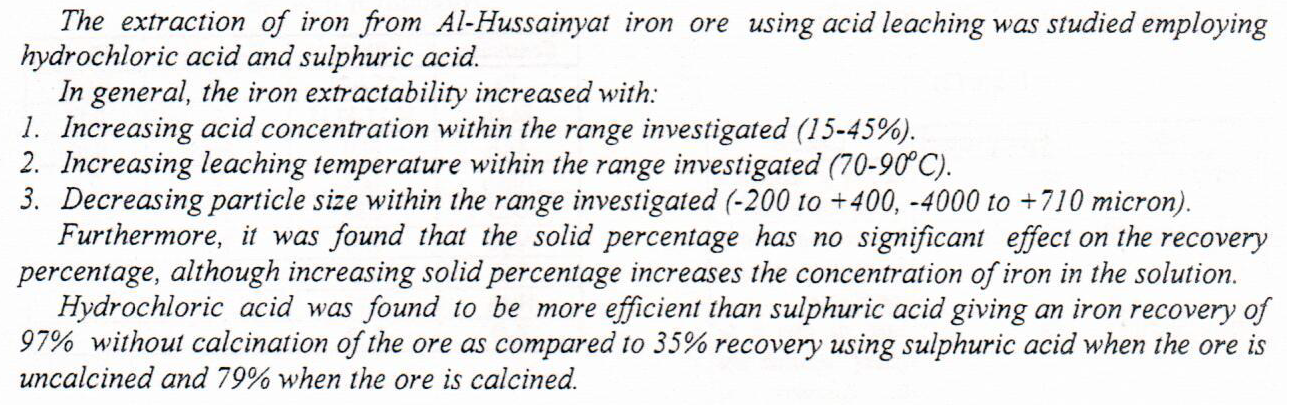
Extraction of Iron from Al-Hussainyat Iron Ore using Acid Leaching

The availability of low- cost adsorbent namely Al-Khriet ( a substance found in the legs of Typha Domingensis) as an agricultural waste material, for the removal of lead and cadmium from aqueous solution was investigated. In the batch tests experimental parameters were studied, including adsorbent dosage between (0.2-1) g, initial metal ions concentration between (50-200) ppm (single and binary) and contact time (1/2-6) h. The removal percentage of each ion onto Al-Khriet reached equilibrium in about 4 hours. The highest adsorption capacity was for lead (96%) while for cadmium it was (90%) with 50 ppm ions concentration, 1 g dosage of adsorbent and pH 5.5. Adsorption capacity in the binary mixture were reduce at about 8% for lead a
... Show MoreIn the present work studies were carried out to extract a cationic dye (Methylene Blue MB) from an aqueous solution using emulsion liquid membrane process (ELM). The organic phase (membrane phase) consists of Span 80 as emulsifier, sulfuric acid solution as stripping agent and hexane as diluent.
In this study, important factors influencing the extraction of methylene blue dye were studied. These factors include H2SO4 concentration in the stripping phase, agitation speed in the dye permeation stage, Initial dye concentration and diluent type.
More than (98%) of Methylene blue dye was extracted at the following conditions: H2SO4 concentration (1.25) M, agitation
... Show More (17)
(17)

 (3)
(3)

Many stone tools were found on a hill south of the Hor Al-Dalmaj which is located in the central part of the alluvial plain of Mesopotamia, between the Tigris and Euphrates Rivers. The types of rocks from which the studied stone tools were made are not found in the alluvial plain, because it consists of friable sand, silt, and clay. All existing sediments were precipitated in riverine environments such as point bar, over bank, and floodplain sediments. The collected stone tools were described with a magnifying glass (10 x) and a polarized microscope after they were thin sectioned. Microscopic analysis showed that these stone tools are made of sedimentary, volcanic igneous and metamorphic rocks, such as: sandstones, limestones, chert, con
... Show More
(1)
The foreguts of a total of 515 fish of Chondrostoma regium (Heckel, 1843) (locally: Bala’aot Malloky) were studied. These fish were collected from Tigris River at Salah Al-Deen Province (between Al-Hagag & Yathrib) for 20 months between March and October of the next year. Detritus, plant in origin materials (19.6%, 23.0% & 24.9%); green and blue green algae, mostly Cladophora, Cosmarium and Merismpedia sp. (17.1%, 12.9% & 12.2%) and diatoms, mostly Diatoma, Chanathes, Amphora and Cyulbella sp. (16.9%, 8.8% & 8.2%) were the main food categories taken by these fishes according to occurrence (O%), volumetric methods (V%) and ranking index (R%). Debris (not part of the diet) took 45.3% of the studied fish foreguts by volume. Detritus was also
... Show More
In this work the radioactive wastes in the Old Russian
Cemetery Al -Tuwaitha site were classified according to risks for
workers who are involved in the retrieval process. The exposure
assessment results expressed as estimates of radionuclide intakes by
inhalation and ingestion, exposure rates and duration for external
exposure pathways, and committed effective dose equivalents to
individuals from all relevant radionuclides and pathways. Results
showed the presence of natural radionuclides Ra-226, Th-234 and K-
40, as well as the produced radionuclide Cs-137 and Eu-152 in the
cemetery wells. The absorbed doses from the waste were classified to
two categories; exempt waste and low level waste according to
Adsorption of lead ions from wastewater by native agricultural waste, precisely tea waste. After the activation and carbonization of tea waste, there was a substantial improvement in surface area and other physical characteristics which include density, bulk density, and porosity. FTIR analysis indicates that the functional groups in tea waste adsorbent are aromatic and carboxylic. It can be concluded that the tea waste could be a good sorbent for the removal of Lead ions from wastewater. Different dosages of the adsorbents were used in the batch studies. A random series of experiments indicated a removal degree efficiency of lead reaching (95 %) at 5 ppm optimum concentration, with adsorbents R2 =97.75% for tea. Three mo
... Show More
(1)
(18)
(16)

In this study, novel Schiff base complexes with Zn(II) and Co(II) ions were successfully synthesized. The malonic acid dihydrazide was converted into the Schiff base ligand by combining it with 1-hydroxy-2-naphthaldehyde, and the last step required reacting it with the appropriate metal(II) chloride to produce pure target complexes. The generated complexes were thoroughly characterized using FTIR, 1H-NMR, 13C-NMR, GC-mass, and UV-Vis spectroscopies. In order to photo-stabilize polystyrene (PS) and reduce the photodegradation of its polymeric chains, these chemicals have been used in this work. The efficiency of the generated complexes as photo-stabilizers was evaluated using a variety of techniques, including FTIR, weight loss, visc
... Show MoreBidentate Schiff base ligand 3-(3,4-Dihydroxy-phenyl)-2-[(4-dimethylamino-benzylidene)-amino]-2-methyl-propionic acid was prepared and characterized by spectroscopic techniques studies and elemental analysis. The Cd(II), Ni(II), Cu(II), Co(II), Cr(III),and Fe(III) of mixed-ligand complexes were structural explicate through Moler conductance , [FT-IR, UV-Vis & AAS], chloride contents, , and magnetic susceptibility measurements. Octahedral geometries have been suggested for all complexes. The Schiff base and its complexes were tested against various bacterial species, two of {gram(G+) and gram(G-)} were shown weak to good activity against all bacteria.