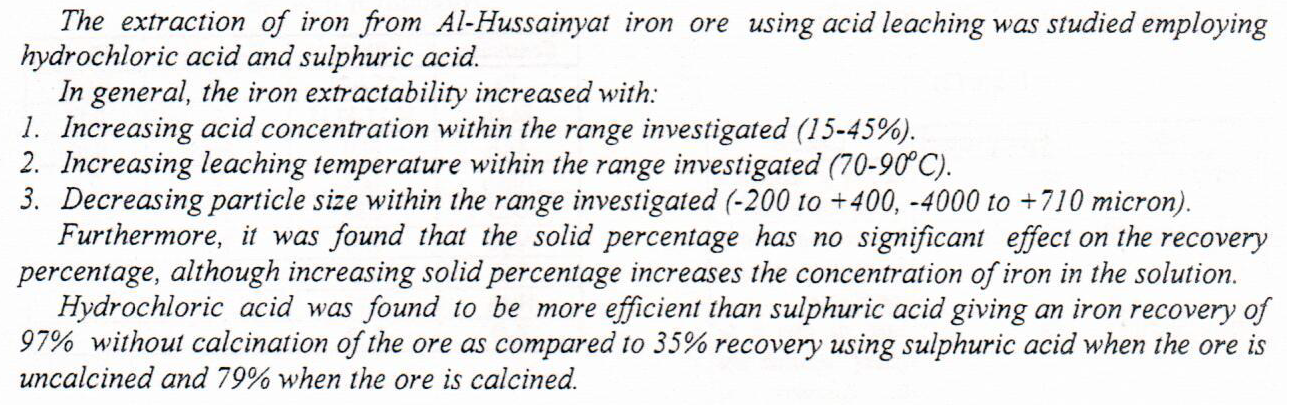
Extraction of Iron from Al-Hussainyat Iron Ore using Acid Leaching

Double hydrothermal method was used to prepare nano gamma alumina using aluminum nitrate nano hydrate and sodium aluminate as an aluminum source, CTAB (cetyltrimethylammonium bromide) as surfactant, and variable acids: weak acids like; citric, and acitic acids, and strong acids like; hydrochloric and nitric acids as a bridge between aluminum salts and surfactant. Different crystallization times 12, 24, 48, and 72 hrs were applied. All the batches were prepared at pH equals to 9. XRD diffraction technique was used to investigate the crystalline nano gamma alumina pure from surfactant. N2 adsorption-desorption (BET) was used to measure the surface area and pore volume of the prepared nano alumina, the average p
... Show MoreA water resources management for earthen canal/stream is introduced through creating a combination procedure between a field study and the scientific analytical concepts that distinguish the hydraulic problems on this type of stream with using the facilities that are available in HECRAS software; aiming to point the solutions of these problems. Al Mahawil stream is an earthen canal which is subjected to periodic changes in cross sections due to scour, deposition, and incorrect periodic dredging processes due to growth of the Ceratophyllum plants and weeds on the bed and banks of the stream; which affect the characteristics of the flow. This research aims to present a strategy of water resources management through a field study that conducte
... Show MoreIn this study, genetic algorithm was used to predict the reaction kinetics of Iraqi heavy naphtha catalytic reforming process located in Al-Doura refinery in Baghdad. One-dimensional steady state model was derived to describe commercial catalytic reforming unit consisting of four catalytic reforming reactors in series process.
The experimental information (Reformate composition and output temperature) for each four reactors collected at different operating conditions was used to predict the parameters of the proposed kinetic model. The kinetic model involving 24 components, 1 to 11 carbon atoms for paraffins and 6 to 11 carbon atom for naphthenes and aromatics with 71 reactions. The pre-exponential Arrhenius constants and a
... Show MoreIn this research, the performance of a two kind of membrane was examined to recovering the nutrients (protein and lactose) from the whey produced by the soft cheese industry in the General Company for Food Products inAbo-ghraab.Wheyare treated in two stages, the first including press whey into micron filter made of poly vinylidene difluoride (PVDF) standard plate type 800 kilo dalton, The membrane separates the whey to permeate which represent is the main nutrients and to remove the fat and microorganisms.The second stage is to isolate the protein by using ultra filter made of polyethylsulphone(PES)type plate with a measurement of 10,60 kilo dalton and the recovery of lactose in the form of permeate.
The results showed that the percen
This study aims to test ceramic waste's capacity to remove nickel from aqueous solutions through adsorption. Ceramic wastes were collected from the Refractories Manufacturing Plant in Ramadi. Through a series of lab tests, the reaction time (5, 10, 15, 20, 25, 30, 35, 40, 45, and 50 minutes, and Ni concentrations (20, 40, 60, and 80) were tested using ceramic wastes with a solid to liquid ratio of 2g/30ml. At a temperature of 30ºC, the pH, total dissolved solids (TDS), and electrical conductivity (EC) were all measured. The equilibrium time was set at 30 min. Thereafter, the sorption (%) somewhat increased positively with the Ni concentration. Freundlich's equation showed that the adsorption intensity is 1.1827 and the Freundlich c
... Show More (1)
(1)


In this study, the adsorption of Zn (NO3)2 is carried out by using surfaces of malvaparviflora. The validity of the adsorption is evaluated by using atomic absorption Spectrophotometry through determination the amount of adsorbed Zn (NO3)2. Various parameters such as PH, adsorbent weight and contact time are studied in terms of their effect on the reaction progress. Furthermore, Lagergren’s equation is used to determine adsorption kinetics. It is observed that high removal of Zn (NO3)2 is obtained at PH=2. High removal of Zn (NO3)2 is at the time equivalent of 60 min and reaches equilibrium,where 0.25gm is the best weight of adsorbant . For kinetics the reaction onto malvaparviflora follows pseudo first order Lagergren’s equation.
 (1)
(1)
The exploitation of obsolete recyclable resources including paper waste has the advantages of saving resources and environment protection. This study has been conducted to study utilizing paper waste to adsorb phenol which is one of the harmful organic compound byproducts deposited in the environment. The influence of different agitation methods, pH of the solution (3-11), initial phenol concentration (30-120ppm), adsorbent dose (0.5-2.5 g) and contact time (30-150 min) were studied. The highest phenol removal efficiency obtained was 86% with an adsorption capacity of 5.1 mg /g at optimization conditions (pH of 9, initial phenol concentration of 30 mg/L, an adsorbent dose of 2 g and contact time of 120min and at room temperature).
... Show More
(6)
In this study, the circulating fluidized bed was used to remove the Tetracycline from wastewater utilizing a pistachio shell coated with ZnO nanoparticles. Several parameters including, Tetracycline solution flowrate, initial static bed height, Tetracycline initial concentration and airflow rate were systematically examined to show their effect on the breakthrough curve and the required time to reach the adsorption capacity and thus draw the fully saturated curve of the adsorbent. Results showed that using ZnO nanoparticles will increase the adsorbent surface area and pores and as a result the adsorption increased, also the required time for adsorbent saturation increased and thus the removal efficiency may be achieved at mi
... Show More
(21)
Cadmium is one of the heavy metal found in the wastewater of many industries. The electrocoagulation offers many advantages for the removal of cadmium over other methods. So the removal of cadmium from wastewater by using electrocoagulation was studied to investigate the effect of operating parameters on the removal efficiency. The studied parameters were the initial pH, initial concentration, and applied voltage. The study experiments were conducted in a batch reactor with with two pairs of aluminum electrodes with dimension and 2mm in thick with 1.5 cm space between them. The optimum removal was obtained at pH =7, initial concentration = 50 mg/L, and applied voltage = 20 V and it was 90%.
(10)
The biochar prepared from sawdust raw material was applied in this study for the treatment of wastewater polluted with methyl orange dye. The effect of pH (2-11), initial concertation (50-250 mg/L) and time were studied. The isotherm of Langmuir, Frendluch and temkin models studied. The Langmuir model was the best to explain the adsorption process, maximum uptake was 136.67 mg/g at 25Co of methyl orange dye. Equilibrium reached after four hours of contact for most adsorbents.The values of thermodynamic parameters ∆G were negative at various temperatures, so the process spontaneous, while ∆H values were 16683 j/mol and ∆S values was 60.82 j/mol.k.
(15)