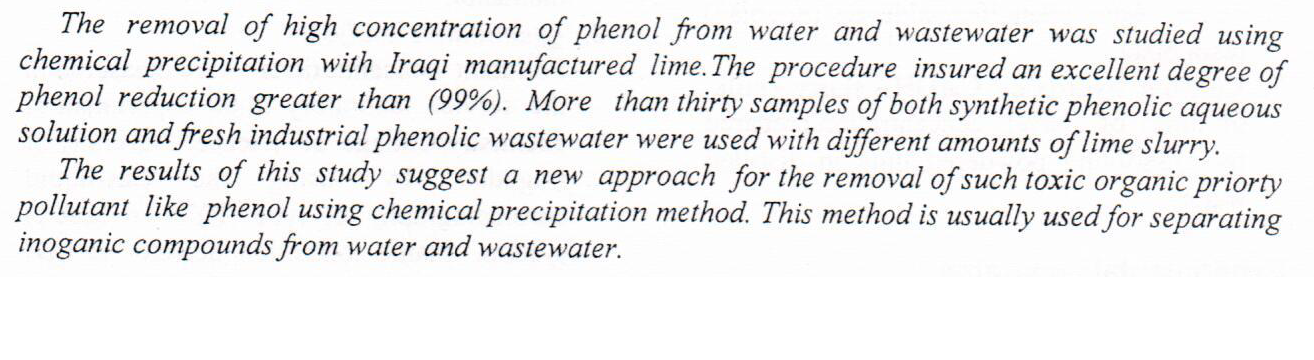
Removal of Phenol from Water and Wastewater by Chemical Precipitation with Lime

In this work, an enhanced Photonic Crystal Fiber (PCF) based on Surface Plasmon Resonance (SPR) sensor using a sided polished structure for the detection of toxic ions Arsenic in water was designed and implemented. The SPR curve can be obtained by polishing the side of the PCF after coating the Au film on the side of the polished area, the SPR curve can be obtained. The proposed sensor has a clear SPR effect, according to the findings of the experiments. The estimated signal to Noise Ratio (SNR), sensitivity (S), resolution (R), and Figures of merit (FOM) are approaching; the SNR is 0.0125, S is 11.11 μm/RIU, the resolution is 1.8x〖10〗^(-4), and the FOM is 13.88 for Single-mode Fiber- Photonic Crystal Fiber- single mode Fiber (SMF-P
... Show More (3)
(3)
 (6)
(6)


The research aims to learn spatial disparities tracts of agricultural crops in the
province of Maysan and their relationship (the salinity of the soil and the degree of chemical
interaction (PH)) The research is divided into an introduction and three Investigation eat first
section spatial disparities agricultural crops (cereals, vegetables, legumes and forage). The
comparison between the years of production in the province where the province has seen
varied spatial by hand and taking second section degrees of soil salinity and its impact on
agriculture, as well as the chemical reaction (PH) and its impact on agriculture The third
section has been used three technical techniques first linkage and the second simple an
The corrosion behavior of bare and chemical conversion coated (through anodizing) aluminum ASA 606 I in stagnant chromic acid solutions . Solutions of 2, 6 & J O wt. % Cr03 at 45°C, have been investigated using polarization technique. The anodizing experiments were conducted under fixed conditions of 35 minute exposure time and 30 volt supplied voltage. The most important feature achieved was the great difference in behavior between the anodic polarization curves for bare and anodized aluminum in different concentrations of chromic acid solutions.
SnS nanobelt thin films were deposited on glass substrates in acidic solution by chemical bath deposition (CBD) method. The belt-like morphologies of as-deposited SnS thin films were characterized by scanning electron microscope (SEM) and transmission electron microscopy (TEM). X-ray diffraction (XRD) and Raman measurements were carried out to confirm the crystal structures and phase purities of SnS nanobelt thin films. The morphologies and phase purities of SnS thin films were influenced greatly by the tin and sulfur precursors. The bandgaps of SnS nanobelts were determined to be 1.39–1.41 eV by UV–vis absorption and photoluminescence (PL) spectra. Current-voltage ((I-V)) and current-time ((I-T)) characteristics were studied to demon
... Show More
(28)
(26)
 (7)
(7)
Background The application of nanotechnology to biomedical surfaces is explained by the ability of cells to interact with nanometric features. The aim of this study was to consider the role of nanoscale topographic modification of CPTi dental implant using chemical etching method for the purpose of improving osseointegration. Materials and methods: Commercial pure titanium rod was machined into 20 dental implants. Each implant was machined in diameter about 3mm, length of 8mm (5mm was threaded part and 3mm was flat part). Implants were prepared and divided into 2 groups according to the types of surface modification method used: 1st group (10 implant) remained without nano surface modification (control), 2nd group include (10 implant) etche
... Show MoreJatropha L. is an exotic genus to Iraq and it has been cultivated in gardens for ornamental purposes because of the shiny red color of the flowers. The plant adapted to environmental conditions and succeeded in growing and blooming, which is why the species was interested to study. The species Jatropha integerrima Jacq. was examined and diagnosed for the first time in Iraq. Morphological and anatomical characteristics for leaves (considering that the variations are the most reliable and taxonomically important) were provided. The Phytochemical screening showed the presence of alkaloids, flavonoids, terpenes, tannins and saponins. The qualitative analysis by TLC indicated the presence of alkaloids and flavonoid that was detected by specia
... Show More
(9)