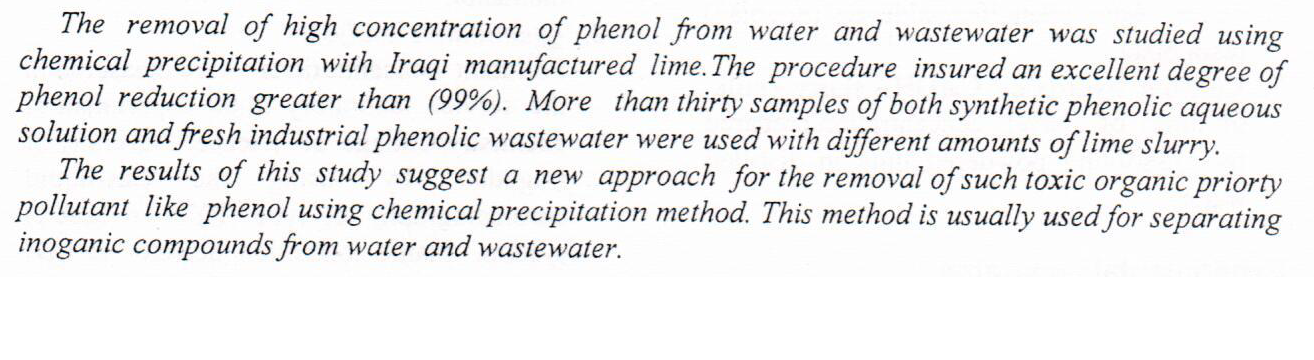
Removal of Phenol from Water and Wastewater by Chemical Precipitation with Lime

Coffee is the most essential drink today, aside from water, the high consumption of coffee and the byproducts of its soluble industries such as spent coffee grounds can have a negative effect on the environment as a source of toxic organic compounds. Therefore, caffeine removal from the spent coffee ground can be applied as a method to limit the effect of its production on the environment. The aim of this study is to determine the kinetics and thermodynamics parameters and develop models for both processes based on the process parameters by using traditional solid-liquid extraction and Ultrasound-assisted extraction methods. The processes were performed at a temperature range of 25 to 55 °C for traditional and ultrasound baths, and
... Show More (3)
(3)

 (7)
(9)
(7)
(9)

 (4)
(4)
Mature oil reservoirs surrounded with strong edge and bottom water drive aquifers experience pressure depletion and water coning/cresting. This laboratory research investigated the effects of bottom water drive and gas breakthrough on immiscible CO2-Assisted Gravity Drainage (CO2-AGD), focusing on substantial bottom water drive. The CO2-AGD method vertically separates the injected CO2 to formulate a gas cap and Oil. Visual experimental evaluation of CO2-AGD process performance was performed using a Hele-Shaw model. Water-wet sand was used for the experiments. The gas used for injection was pure CO2, and the “oleic” phase was n-decane with a negative spreading coefficient. The aqueous phase was deionized water. To evaluate the feasibilit
... Show More
(13)
(17)
Biodiesel define as the mono-alkyl esters of vegetable oil and animal fats is an alternative diesel fuel that is steadily gaining attention because the combustion of fossil fuels such as coal, oil and natural gas has been identify as a major cause of the increase in the concentration of carbon dioxide in the earth’s atmosphere and causing global warming.
The present work concerns with estimating the physical properties experimentally such as kinematic viscosity, density, flash point and carbon residue of biodiesel that produced by the esterification reaction of methanol and oleic acid with homogeneous catalysts H2SO4 in a lab-scale packed reactive distillation column using the best operating conditions of methanol to oleic acid 8:1,
Field trial was conducted with the aim of utilizing extract of allelopathic crop to reduce the use of synthetic herbicides in wheat fields. Sorghum extract at 12 L /ha, sunflower extract at 12 L /ha, combination of sorghum and sunflower extracts at 12 L /ha and chevalier at 25, 50 and 100% of recommended dose were applied alone or in combination with each other. Weed free and weedy check treatments were included for comparison. The experiment was conducted in a randomized complete block design with three replications. The results showed that the recommended dose of chevalier treatment recorded lowest means of weed density 15.7, 23.7, 25.3 and 27.9 weeds m-2and weeds dry weight 13.4, 16.4, 23.3 and 29.2 g m-2 and gave
... Show More
(4)
(1)
The present work involved preparation of new substituted and unsubstituted and poly imides (1-17) using reaction of acryloyl chloride with different amides (aliphatic ,aromatic) in the presence of a suitable solvent and amount tri ethyl amine (Et3N) with heating – the structure confirmation of all polymers were proved using FT-IR,1H-NMR,C13NMR and UV spectroscopy ,thermal analysis (TG) for some polymers confirmed their thermal stabilities . Other physical properties including softening and melting points, PH and solubility of the polymers were also measured
(1)
This work studied the electrical and thermal surface conductivity enhancement of polymethylmethacrylate (PMMA) clouded by double-walled carbon nanotubes (DWCNTs) and multi-walled carbon nanotube (MWCNTs) by using pulsed Nd:YAG laser. Variable input factors are considered as the laser energy (or the relevant power), pulse duration and pulse repetition rate. Results indicated that the DWCNTs increased the PMMA’s surface electrical conductivity from 10-15 S/m to 0.813×10³ S/m while the MWCNTs raised it to 0.14×10³ S/m. Hence, the DWCNTs achieved an increase of almost 6 times than that for the MWCNTs. Moreover, the former increased the thermal conductivity of the surface by 8 times and the later by 5 times.
The preparation and characterization of innovative nanocomposites based on zinc oxide nanorods (ZNR) encapsulated by graphene (Gr) nanosheets and decorated with silver (Ag), and cupper (Cu) nanoparticles (NP) were studied. The prepared nanocomposites (ZNR@Gr/Cu-Ag) were examined by different techniques including Field Emission Scanning Electron Microscope (FESEM), Transmission electron microscopy (TEM), Atomic force microscopy (AFM), UV-Vis spectrophotometer and fluorescence spectroscopy. The results showed that the ZNR has been good cover by five layers of graphene and decorated with Ag and Cu NPs with particles size of about 10-15 nm. The ZNR@Gr/Cu-Ag nanocomposites exhibit high absorption behavior in ultraviolet (UV) region of sp
... Show More
The new tridentate Schiff base ligand (HL)namely 2-{[1-(3-amino-phenyl)-ethylidene]-hydrazono methyl}- phenol containing (N N O)as donors atoms was prepared in two steps:Step (1): By the reaction of 3- aminoacetophenone with hydrazine monohydrate under reflux in methanol and drops of glacial acetic acid gave the intermediate compound 3-(1- hydrazono ethyl)-phenol amine.Step (2): By the reaction of 3-(1-hydrazono ethyl)-phenol amine with salicyaldehyde under reflux in methanol, gave the ligand (HL).The prepared ligand was characterized by I.R, U.V-Vis,1H- 13C NMR spectra and melting point and reacted with some metal ions under reflux in methanol with (1:1) ratio gave complexes of the general formula: [MClL]. Where: M= Mn(II), Fe(II), Co(II),
... Show More