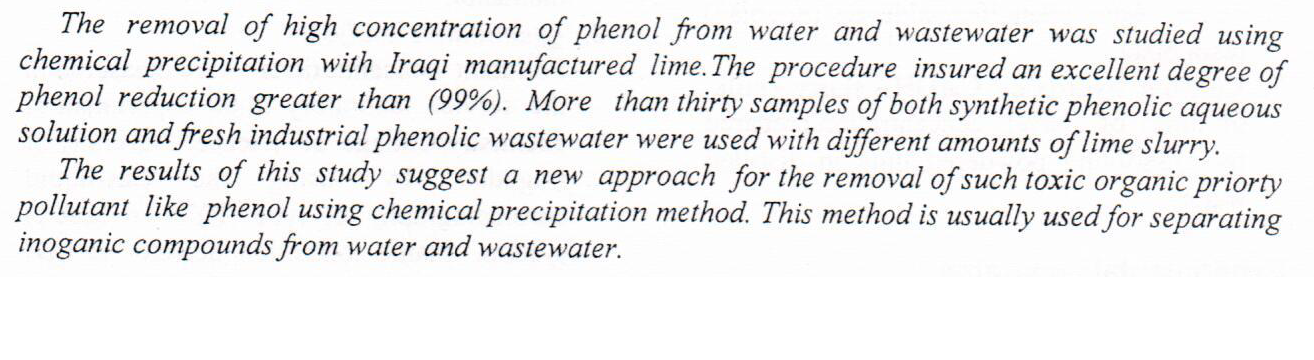
Removal of Phenol from Water and Wastewater by Chemical Precipitation with Lime

Electrodeposition of metal oxides on graphite electrodes can improve their ability to remove organic substances. In this work, multicomponent oxides of Mn, Co, and Ni were electrochemically deposited on both the anode and cathode of graphite electrodes to enhance their performance in removing phenol. Formation of the deposit was achieved within 2 h in current densities of 20, 25, 30, and 35 mA/cm2 for better composite properties. The deposited layer was characterized by testing the surface structure, morphology, composition, and roughness. X-ray diffraction (XRD), scanning electron microscopy (SEM), energy dispersive X-ray (EDX), and Atomic force microscopy (AFM) techniques facilitated these tests. The composite electrodes have synthesized
... Show More (10)
(10)
 (7)
(7)


A new bio-electrochemical system was proposed for simultaneous removal of organic matters and salinity from actual domestic wastewater and synthetically prepared saline water, respectively. The performance of a three-chambered microbial osmotic fuel cell (MOFC) provided with forward osmosis (FO) membrane and cation exchange membrane (CEM) was evaluated with respect to the chemical oxygen demand (COD) removal from wastewater, electricity generation, and desalination of saline water. The MOFC wasinoculated with activated sludge and fueled with actual domestic wastewater. Results revealed that maximum removal efficiency of COD from wastewater, TDS removal efficiency from saline water, power density, and current density were
... Show More
(17)
(10)

This study aimed to assess the efficiency of Nerium oleander in removing three different metals (Cd, Cu, and Ni) from simulated wastewater using horizontal subsurface flow constructed wetland (HSSF-CW) system. The HSSF-CW pilot scale was operated at two hydraulic retention times (HRTs) of 4 and 7 days, filled with a substrate layer of sand and gravel. The results indicated that the HSSF-CW had high removal efficiency of Cd and Cu. A higher HRT (7 days) resulted in greater removal efficiency reaching up to (99.3% Cd, 99.5% Cu, 86.3% Ni) compared to 4 days. The substrate played a significant role in removal of metals due to adsorption and precipitation. The N. oleander plant also showed a good tolerance to the uptake of Cd, Cu, and Ni ions fr
... Show More
(21)
This study aimed to assess the efficiency of Nerium oleander in removing three different metals (Cd, Cu, and Ni) from simulated wastewater using horizontal subsurface flow constructed wetland (HSSF-CW) system. The HSSF-CW pilot scale was operated at two hydraulic retention times (HRTs) of 4 and 7 days, filled with a substrate layer of sand and gravel. The results indicated that the HSSF-CW had high removal efficiency of Cd and Cu. A higher HRT (7 days) resulted in greater removal efficiency reaching up to (99.3% Cd, 99.5% Cu, 86.3% Ni) compared to 4 days. The substrate played a significant role in removal of metals due to adsorption and precipitation. The N. oleander plant also showed a good tolerance to the uptake of Cd, Cu, and Ni ions fr
... Show More
(23)
(21)
Electrochemical oxidation in the presence of sodium chloride used for removal of phenol and any other organic by products formed during the electrolysis by using MnO2/graphite electrode. The performance of the electrode was evaluated in terms fraction of phenol and the formed organic by products removed during the electrolysis process. The results showed that the electrochemical oxidation process was very effective in the removal of phenol and the other organics, where the removal percentage of phenol was 97.33%, and the final value of TOC was 6.985 ppm after 4 hours and by using a speed of rotation of the MnO2 electrode equal to 200 rpm.
(6)
(3)
In this paper, split-plate airlift electrochemical reactor as an apparatus with new configuration for wastewater treatment was provided. Two aluminum plates were fixed inside the reactor and present two functions; first it works as split plates for internal loop generation of the airlift system (the zone between the two plates acts as riser while the other two zones act as downcomer) and second it works as two electrodes for electrocoagulation process. Simulated wastewater contaminated with zinc ions was used to test the performance of this apparatus for zinc removal by studying the effect of different experimental variables such as initial concentration of zinc (50-800 ppm), electrical current density (2.67-21.4 mA/cm2), init
... Show MoreThe electrospun nanofibers membranes have gained considerable interest in water filtration applications. In this work, the fabrication and characterization of the electrospun polyacrylonitrile-based nonwoven nanofibers membrane are reported. Then, the membrane's performance and antifouling properties were evaluated in removing emulsified oil using a cross flow filtration system. The membranes were fabricated with different polyacrylonitrile (PAN) concentrations (8, 11, and 14 wt. %) in N, N-Dimethylformamide (DMF) solvent resulted in various average fiber sizes, porosity, contact angle, permeability, oil rejection, and antifouling properties. Analyses of surface morphology of the fabricated membranes before and after oil removal revealed
... Show More
(21)
(11)
(8)
(8)