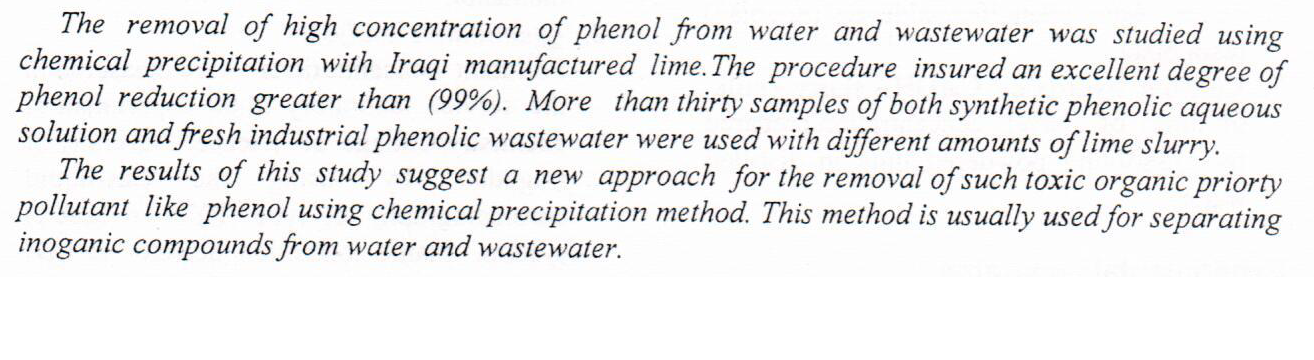
Removal of Phenol from Water and Wastewater by Chemical Precipitation with Lime

Water scarcity is one of the most important problems facing humanity in various fields such as economics, industry, agriculture, and tourism. This may push people to use low-quality water like industrial-wastewater. The application of some chemical compounds to get rid of heavy metals such as cadmium is an environmentally harmful approach. It is well-known that heavy metals as cadmium may induce harmful problems when present in water and invade to soil, plants and food chain of a human being. In this case, man will be forced to use the low quality water in irrigation. Application of natural materials instead of chemicals to remove cadmium from polluted water is an environmental friendly approach. Attention was drawn in this research wor
... Show More (8)
(8)
 (4)
(4)



Soaking dentures with disinfection solutions is an effective way of keeping dentures in a healthy status; however, immersions in these solutions have a negative effect on the bond strength of denture base and denture teeth. The aim of this study was to evaluate the bond strength between denture acrylic teeth and heat-cured Poly (methyl methacrylate) denture base material (with and without nano silica) after disinfection with different chemical disinfectants for a simulated period of six months. One hundred specimens of maxillary central incisors attached to PMMA were divided into two groups; 50 specimens of PMMA without nano silica and 50 specimens of PMMA reinforced with 5 wt% of nano silica. Specimens of each group were immersed in five i
... Show MoreIn this study, the use of non-thermal plasma theory to remove toxic gases emitted from a vehicle was experimentally investigated. A non-thermal plasma reactor was constructed in the form of a cylindrical tube made of Pyrex glass. Two stainless steel rods were placed inside the tube to generate electric discharge and plasma condition, by connecting with a high voltage power supply (up to 40 kV). The reactor was used to remove the contaminants of a 1.25-liter 4-cylinder engine at ambient conditions. Several tests have been carried out for a ranging speed from 750 to 4,500 rpm of the engine and varying voltages from 0 to 32 kV. The gases entering the reactor were examined by a gas analyzer and the gases concentration ratio
... Show More
(4)
(18)
(16)
(29)
(24)
(45)
We demonstrate a behavior of laser pulse grows through fiber laser inside and output cavity with a soliton fiber laser based on the multi-wall carbon nanotube saturable absorber (SA), we investigate the effects of a saturable absorber parameter on the mode-locking of a realistic Erbium fiber ring laser. Generalized nonlinear Schrodinger equation including the nonlinear effects as gain dispersion, second anomalous group velocity dispersion (GVD), self phase modulation (SPM), and two photon absorption used to describe pulse evolution. An analytical method has been used to understand and to quantify the role of the SA parameter on the propagation dynamics of pulse laser. We compute the chirp, power, width and phase of the soliton for range
... Show More
Aluminum oxide (ALO) was grafted by acrylic acid monomer (AlO-AM) and then, it was polymerized to produce alumina grafted poly(acrylic acid) (AlO-AP). The prepared AlO-AM and AlO-AP were characterized by Fourier-transform infrared, differential scanning calorimetry , thermogravemetric analyzer and particle size distribution. Adsorption equilibrium isotherms, adsorption kinetics and thermodynamic studies of the batch adsorption process were used to examine the fundamental adsorption properties of phenol (P) and p-chlorophenol (PCP). The experimental equilibrium adsorption data were analyzed by three widely used two-parameters Langmuir, Freundlich and DubininRadushkevich isotherms. The maximum P and PCP adsorption capacities based on t
... Show More
(10)
Catalytic wet air oxidation of aqueous phenol solution was studied in a pilot plant trickle bed reactor using copperoxide catalyst supported on alumina and silica. Catalysts were prepared by impregnating method. Effect of feed solutionpH (5.9, 7.3, and 9.2), gas flow rate (20%, 50%, 80%, and 100%), WHSV (1, 2, and 3 h-1), temperature (120°C, 140°C,and 160°C), oxygen partial pressure (6, 9, 12 bar), and initial phenol concentration (1, 2, and 4 g/l).Generally, theperformance of the catalysts was better when the pH of feed solution was increased. The catalysts deactivation is relatedto the dissolution of the metal oxides from the catalyst surface due to the acidic conditions. Phenol oxidation reactionwas strongly affected by WHSV,
... Show More
(2)