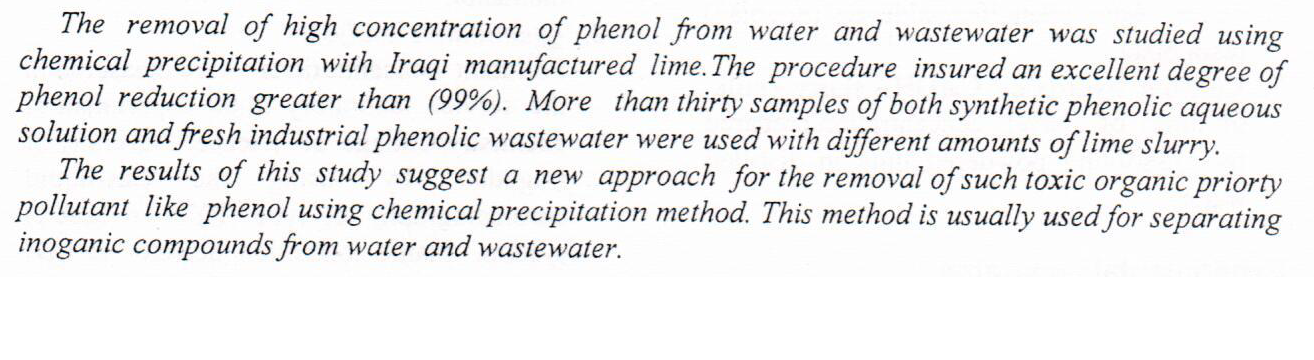
Removal of Phenol from Water and Wastewater by Chemical Precipitation with Lime

 (8)
(8)
 (8)
(8)


 (88)
(83)
(88)
(83)
Considerable amounts of domestic and industrial wastewater that should be treated before reuse are discharged into the environment annually. Electrocoagulation is an electrochemical technology in which electrical current is conducted through electrodes, it is mainly used to remove several types of wastewater pollutants, such as dyes, toxic materials, oil content, chemical oxygen demand, and salinity, individually or in combination with other processes. Electrocoagulation technology used in hybrid systems along with other technologies for wastewater treatment are reviewed in this work, and the articles reviewed herein were published from 2018 to 2021. Electrocoagulation is widely employed in integrated systems with other electrochemical tech
... Show More
(88)
(83)
Bacteria strain H8, which produces high amount of exopolysaccharide (EPS), was isolated from soil, and identified as strain of Azotobacter chrococcum by its biochemical /physiological characteristics, EPS was extracted, partially purified and used as bioflocculant. The biochemical analysis of the partially purified EPS revealed that it was an alginate. analysis of EPS by Fourier transform infrared spectrometry (FTIR) show that the -OH groups present in bioflocculant are clearly seen at 3433.06 cm-1, the peaks attributed to the -CH3 groups present at 2916.17 cm-1 , and some distinct peaks such as carboxyl group showed strong absorption bands at 1604.66 cm-1, 1411.80 cm-1 and 1303.79 cm-1 indicate the chemical structure of alginate. The effe
... Show MorePulsed laser ablation in liquid (PLAL) has become an increasingly important technique for metals production and metal oxides nanoparticles (NPs) and others. This technique has its many advantages compared with other conventional techniques (physical and chemical). This work was devoted for production of zirconia (ZrO2) nanoparticles via PLAL technique from a solid zirconium target immersed in a wet environment in order to study the effect of this environment on the optical properties and structure of ZrO2 nanoparticles. The solutions which used for this purpose is distilled water (D.W). The produces NPs were characterized by mean of many tests such as UV-visible (UV-Vis.), transmission electron microscope (TEM) and Z-Potential. The UV-Vis.
... Show More
(4)
Two samples of (Ag NPs-zeolite) nanocomposite thin films have been prepared by easy hydrothermal method for 4 hours and 8 hours inside the hydrothermal autoclave at temperatures of 100°C. The two samples were used in a photoelectrochemical cell as a photocatalyst inside a cell consisting of three electrodes: the working electrode photoanode (AgNPs-zeolite), platinum as a cathode electrode, and Ag/AgCl as a reference electrode, to study the performance of AgNPs-zeolite under dark current and 473 nm laser light for water splitting. The results show the high performance of an eight-hour sample with high crystallinity compared with a four-hour sample as a reliable photocatalyst to generate hydrogen for renewable energies.
This work was conducted to study the oxidation of phenol in aqueous solution using copper based catalyst with zinc as promoter and different carrier, i.e. γ-Alumina and silica. These catalysts were prepared by impregnation method.
The effect of catalyst composition, pH (5.6-9), phenol to catalyst concentration ratio (2-0.5), air feed rate (30-50) ml/s, stirring speed (400-800) rpm, and temperature (80-100) °C were examined in order to find the best conditions for phenol conversion.
The best operating conditions which lead to maximum phenol conversion (73.1%) are : 7.5 pH, 4/6 phenol to catalyst concentration, 40 ml/s air feed rate, 600 rpm stirring speed, and 100 °C reaction temperature. The reaction involved an induction period
This study examined the adsorption behavior of anionic dye (orange G) from aqueous solution onto the raw and activated a mixture of illite, kaolinite and chlorite clays from area of Zorbatiya (east of Iraq).The chemical treatment involved alkali and acid activation. The alkali activation obtained by treated the raw clay (RC) with 5M NaOH (ACSO) and the acid activation founded by treated it with 0.25M HCl (ACH) and 0.25M (ACS). The thermal treatment carried out by calcination the produce activated clay at 750oC for acid activation and 105oC for alkali activation. Batch
... Show MoreThe present work describes the adsorption of Ba2+ and Mg2+ions from aqueous solutions by activated alumina in single and binary system using batch adsorption. The effect of different parameters such as amount of alumina, concentration of metal ions, pH of solution, contact time and agitation speed on the adsorption process was studied. The optimum adsorbent dosage was found to be 0.5 g and 1.5 g for removal of Ba2+ and Mg2+, respectively. The optimum pH, contact time and agitation speed, were found to be pH 6, 2h and 300 rpm, respectively, for removal of both metal ions. The equilibrium data were analyzed by Langmuir and Freundlich isotherm models and the data fitted well to both isotherm modes as indicated by higher correlation of deter
... Show More