Removal of Phenol from Water and Wastewater by Chemical Precipitation with Lime
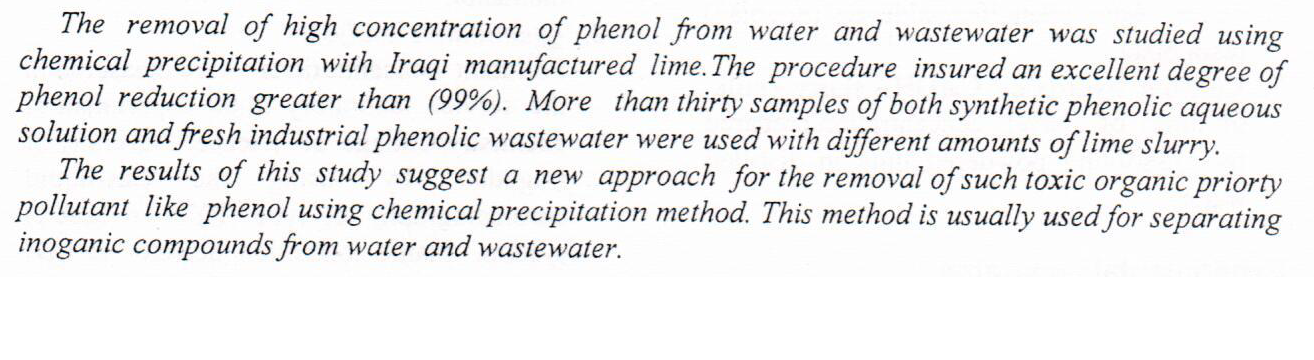

 (2)
(2)

This study investigated a novel application of forward osmosis using different types of draw solutions for oilfield produced water treatment from the East Baghdad oilfield affiliated to the Midland Oil Company (Iraq). Magnesium chloride (MgCl2) and magnesium sulfate (MgSO4) were used as draw solutions in forward osmosis process to evaluate their effectiveness. Experiments were conducted in a laboratory scale forward osmosis system with cellulose triacetate hollow fiber membrane. In this work, sodium chloride solution was used as a feed solution with a concentration of 76 g/L (same concentration as the East Baghdad oilfield produced water) and the applied external pressure on the feed solution side was 2 bar. The impact of draw solution (DS)
... Show MoreTotal dissolved solids are at the top of the parameters list of water quality that requires investigations for planning and management, especially for irrigation and drinking purposes. If the quality of water is sufficiently predictable, then appropriate management is possible. In the current study, Multiple Linear Regression (MLR) and Artificial Neural Network (ANN) models were used as indicators of water quality and for the prediction of Total Dissolved Solids (TDS) along the Tigris River, in Baghdad city. To build these models five water parameters were selected from the intakes of four water treatment plants on the Tigris River, for the period between 2013 and 2017. The selected water parameters were Total Dissolved Solids (TDS
... Show MoreBackground: Small cardamom or green cardamom is the dried fruit of the tall perennial herbaceous plant, Elettaria cardamomum Maton belonging to the family Zingiberaceae. The major use of small cardamom on world wide is for domestic culinary purpose and in medicine. This study was conducted to test the effect of small cardamom extracts on Mutans streptococci and Candida Albicans in comparison to 0.2% chlorhexidine gluconate and de-ionized water in vivo. Materials and Methods: Mutans streptococci and Candid Albicans were isolated, purified and diagnosed according to morphological characteristic and biochemical test. In this experiments, the effect of control agents and small cardamom extracts as a mouth rinses was tested on the saliva
... Show MoreIntroduction and Aim: Klebsiella pneumoniae is a Gram-negative bacterium responsible for a wide range of infections, including respiratory tract infections (RTIs). This research was aimed to study the antibacterial and anti-biofilm effect of AgNPs produced by Gram positive and negative bacteria on RTIs associated with K. pneumoniae. Materials and Methods: The biofilm formation of K. pneumoniae was determined by tube method qualitatively from select bacterial species characterized by UV-Visible spectroscopy. The antibacterial susceptibility of the bacteria AgNPs was tested for their antibacterial and antibiofilm activity on a clinical isolate of K. pneumoniae. Results: K. pneumoniae isolated from RTIs were strong biofilm prod
... Show More (5)
(2)
(5)
(2)

Introduction and Aim: Klebsiella pneumoniae is a Gram-negative bacterium responsible for a wide range of infections, including respiratory tract infections (RTIs). This research was aimed to study the antibacterial and antibiofilm effect of AgNPs produced by Gram positive and negative bacteria on RTIs associated with K. pneumoniae. Materials and Methods: The biofilm formation of K. pneumoniae was determined by tube method qualitatively from select bacterial species characterized by UV-Visible spectroscopy. The antibacterial susceptibility of the bacteria AgNPs was tested for their antibacterial and antibiofilm activity on a clinical isolate of K. pneumoniae. Results: K. pneumoniae isolated from RTIs were strong biofilm producers. The ant
... Show MoreRates of zinc consumption during cathodic protection of a copper pipeline carrying saline water were measured by the loss in weight technique. The study of sacrificial anode cathodic protection of short copper tube using zinc strip extended axially in the pipe revealed that : (i) The increase of zinc consumption with time of exposure (1-3 h's) at different flow rates (turbulent flow) (300-600 l/hr) while the temperature , solution concentration and the pH were fixed at 20ºC, 3.5%wt NaCl, and pH=8 respectively in absence and presence of bacteria.(ii)Increase of zinc consumption with flow rates (300-600 l/hr) at different temperatures (10-40ºC) while solution concentration and time of exposure were fixed at 3.5 %wt NaCl and 3hr's respective
... Show MoreRates of zinc consumption during cathodic protection of a copper pipeline carrying saline water were measured by the loss in weight technique. The study of sacrificial anode cathodic protection of short copper tube using zinc strip extended axially in the pipe revealed that : (i) The increase of zinc consumption with time of exposure (1-3 h's) at different flow rates (turbulent flow) (300-600 l/hr) while the temperature , solution concentration and the pH were fixed at 20ºC, 3.5%wt NaCl, and pH=8 respectively in absence and presence of bacteria.(ii)Increase of zinc consumption with flow rates (300-600 l/hr) at different temperatures (10-40ºC) while solution concentration and time of exposure were fixed at 3.5 %wt NaCl and 3hr's respect
... Show More