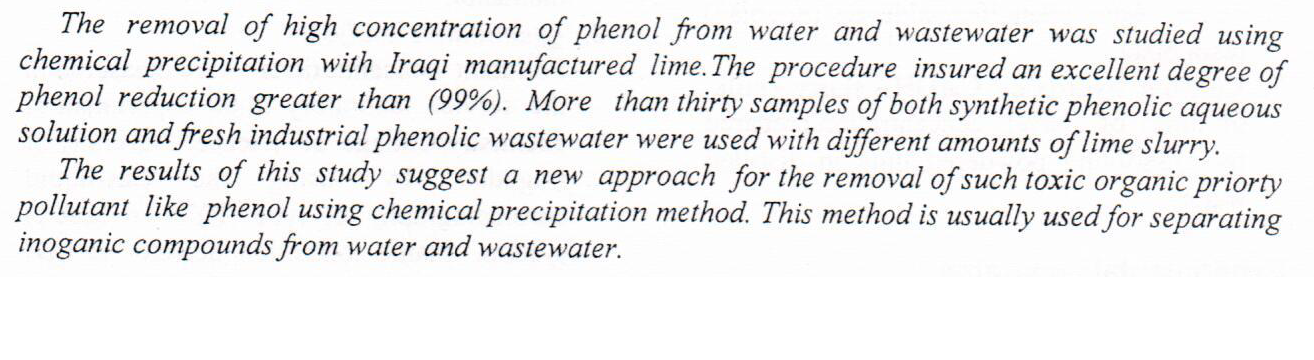
Removal of Phenol from Water and Wastewater by Chemical Precipitation with Lime

Background: the aim of this study was to assess the 2-year pulp survival of deep carious lesions in teeth excavated using a self-limiting protocol in a single-blind randomized controlled clinical trial. Methods: At baseline, 101 teeth with deep carious lesions in 86 patients were excavated randomly using self-limiting or control protocols. Standardized clinical examination and periapical radiographs of teeth were performed after 1- and 2-year follow-ups (REC 14/LO/0880). Results: During the 2-year period of the study, 24 teeth failed (16 and 8 at T12 and T24, respectively). Final analysis shows that 39/63 (61.9%) of teeth were deemed successful (16/33 (48.4%) and 23/30 (76.6%) in the control and experimental groups, respectively wit
... Show More (8)
(8)
 (11)
(11)


 (1)
(1)
One of the most important parameters determining structural members' durability and strength is the fire flame's influence and hazard. Some engineers have advocated using advanced analytical models to predict fire spread impact within a compartment and considering finite element models of structural components to estimate the temperatures within a component using heat transfer analysis. This paper presented a numerical simulation for a reinforced concrete beam’s structural response in a case containing Water Absorbing Polymer Spheres (WAPS) subjected to fire flame effect. The commercial finite element package ABAQUS was considered. The relevant geometrical and material parameters of the reinforced concrete beam model at elevated t
... Show MoreOne of the most important parameters determining structural members' durability and strength is the fire flame's influence and hazard. Some engineers have advocated using advanced analytical models to predict fire spread impact within a compartment and considering finite element models of structural components to estimate the temperatures within a component using heat transfer analysis. This paper presented a numerical simulation for a reinforced concrete beam’s structural response in a case containing Water Absorbing Polymer Spheres (WAPS) subjected to fire flame effect. The commercial finite element package ABAQUS was considered. The relevant geometrical and material parameters of the reinforced concrete beam model a
... Show More
(3)
One of the most important parameters determining structural members' durability and strength is the fire flame's influence and hazard. Some engineers have advocated using advanced analytical models to predict fire spread impact within a compartment and considering finite element models of structural components to estimate the temperatures within a component using heat transfer analysis. This paper presented a numerical simulation for a reinforced concrete beam’s structural response in a case containing Water Absorbing Polymer Spheres (WAPS) subjected to fire flame effect. The commercial finite element package ABAQUS was considered. The relevant geometrical and material parameters of the reinforced concrete beam model at elevated t
... Show MoreKinetic and mechanism studies of the oxidation of oxalic acid by Cerium sulphate have been carried out in acid medium sulphuric acid. The uv- vis. Spectrophotometric technique was used to follow up the reaction and the selected wavelength to be followed was 320 nm. The kinetic study showed that the order of reaction is first order in Ce(IV) and fractional in oxalic acid. The effect of using different concentration of sulphuric acid on the rate of the reaction has been studied a and it was found that the rate decreased with increasing the acid concentration. Classical organic tests was used to identify the product of the oxidation reaction, the product was just bubbles of CO2.
Kinetic and mechanism studies of the oxidation of oxalic acid by Cerium sulphate have been carried out in acid medium sulphuric acid. The uv- vis. Spectrophotometric technique was used to follow up the reaction and the selected wavelength to be followed was 320 nm. The kinetic study showed that the order of reaction is first order in Ce(IV) and fractional in oxalic acid. The effect of using different concentration of sulphuric acid on the rate of the reaction has been studied a and it was found that the rate decreased with increasing the acid concentration. Classical organic tests was used to identify the product of the oxidation reaction, the product was just bubbles of CO2.
(2)