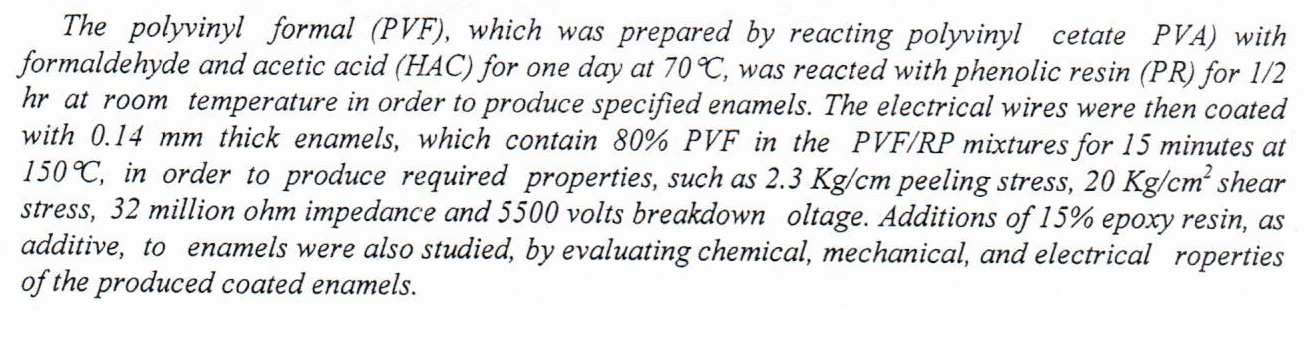
Copper Wires Coated with Enamel

Copper, and its, alloys and composites (being the matrix), are broadly used in the electronic as well as bearing materials due to the excellent thermal and electrical conductivities it has.
In this study, powder metallurgy technique was used for the production of copper graphite composite with three volume perc ent of graphite. Processing parameters selected is (900) °C sintering temperature and (90) minutes holding time for samples that were heated in an inert atmosphere (argon gas). Wear test results showed a pronounced improvement in wear resistance as the percent of graphite increased which acts as solid lubricant (where wear rate was decreased by about 88% as compared with pure Cu). Microhardness and
... Show More (7)
(7)

Copper nanoparticles (CuNPs) were prepared with different diameters by sonoelectrodeposition technique using Electrodeposition process coupled with high-power ultrasound horn (Sonoelectrodeposition). The particle diameter of the CuNPs was adjusted by varying CuSO4 solution acidity (pH) and current density. The morphology and structure of the CuNPs were examined by X-ray diffraction (XRD) and Scanning Electron Microscopy (SEM). It was found that the size of the produced copper nanoparticles ranged between 22 to 77 nm, where the diameter of CuNPs increases with reduction the solution acidity from 0.5 to 1.5 pH and increasing the current density of the deposition from 100 to 400 nm. Finally the produced CuNPs were pressed to fabricate disc
... Show More
This paper reports a fiber Bragg grating (FBG) as a biosensor. The FBGs were etched using a chemical agent,namely,hydrofluoric acid (HF). This implies the removal of some part of the cladding layer. Consequently, the evanescent field propagating out of the core will be closer to the environment and become more sensitive to the change in the surrounding. The proposed FBG sensor was utilized to detect toxic heavy metal ions aqueous medium namely, copper ions (Cu2+). Two FBG sensors were etched with 20 and 40 μm diameters and fabricated. The sensors were studied towards Cu2+ with different concentrations using wavelength shift as a result of the interaction between the evanescent field and copper ions. The FBG sensors showed
... Show More
(1)
Mass transfer was examined at a stationary rectangular copper electrode (cathode) by using the reduction of cupric ions as the electrochemical reaction. The influence of electrolyte temperature (25, 45, and 65 oC), and cupric ions concentration (4, 8, and 12 mM) on mass transfer coefficient were investigated by using limiting current technique. The mass transfer coefficient and hence the Sherwood number was correlated as Sh =
The Corrosion protection effectiveness of Alimina(Al2O3,50nm)and Zinc oxide (ZnO,30nm) nanoparticales were studied on carbon steel and 316 stainless steel alloys in saline water (3.5%NaCl)at four temperatures: (20,30,40,50 OC)using three electrodes potentiostat. An average corrosion protection efficiencies of 65 %and 80% was achieved using Al2O3 NP's on carbon steel and stainless steel samples respectively, and it seems that no effect of rising temperature on the performances of the coated layers. While ZnO NP'S showed protection efficiency around 65% for the two alloys and little effected by temperature rising on the performanes of the coated layers. The morphology of the coated spesiemses was examined by Atomic force microscope.
(2)
Many attempts have been made to modify the surface of orthodontic micro-implants and prevent the development of microbes by coating them with antimicrobial nanoparticles (NPs). The purpose of the present study was to evaluate the cytotoxicity of different NPs, namely, TiO2 and zinc oxide (ZnO) NPs, that are used to coat titanium orthodontic micro-implants.
Thirty orthodontic micro-implants were included in this study. Those were divided into three groups: control group without coating, TiO2-coated orthodontic micro-implants, and TiO2- and ZnO-coated orthodontic micro-implants. Scann

The presence of antibiotic residues such as ciprofloxacin (CIPR) in an aqueous environment is dangerous when their concentrations exceed the allowable. Therefore, eliminating these residues from the wastewater becomes an essential issue to prevent their harm. In this work, the potential of efficient adsorption of ciprofloxacin antibiotics was studied using eco-friendly ZSM-5 nanocrystals‑carbon composite (NZC). An inexpensive effective natural binder made of the sucrose-citric acid mixture was used for preparing NZC. The characterization methods revealed the successful preparation of NZC with a favorable surface area of 103.739 m2/g, and unique morphology and functional groups. Investigating the ability of NZC for adsorbing CIPR antibioti
... Show More
(59)
Introduction: We aimed to assess the impact of adhesive and wires types on the tensile bond strength of fixed lingual retainers. Methods: A total of 160 intact bovine teeth were collected, cleaned, stored in 25% sodium hypochlorite, and randomly assigned to two groups based on the adhesive type: a two-step adhesive and a one-step adhesive. Each group was further divided into four subgroups based on the type of lingual retainer wire, which included (A) 8-strand braided stainless steel wire, (B) three-strand titanium retainer wire, (C) stainless steel chain, and (D) fiber-reinforced retainer. A tensile bond strength test was conducted using a universal testing machine at a controlled speed of 10 mm/min. Result: The 8-strand braided stainles
... Show More (2)
(3)
(2)
(3)

Background: One common undesirable side effect of orthodontic treatment with fixed appliances is the development of incipient caries lesions around brackets, particularly in patients with poor oral hygiene. Different methods have been used to prevent demineralization; the recent effort to improve the resistance against the demineralization is by the application of lasers. Materials and method: Thirty human premolars extracted for orthodontic purposes were used to test the effect of two energy level of ER-YAG laser on enamel resistance to demineralization. The brackets were bonded on the teeth and all the labial surface excluding 2 mm area gingival to the brackets were painted with acid resistance varnish. Three groups were generated. The fi
... Show More