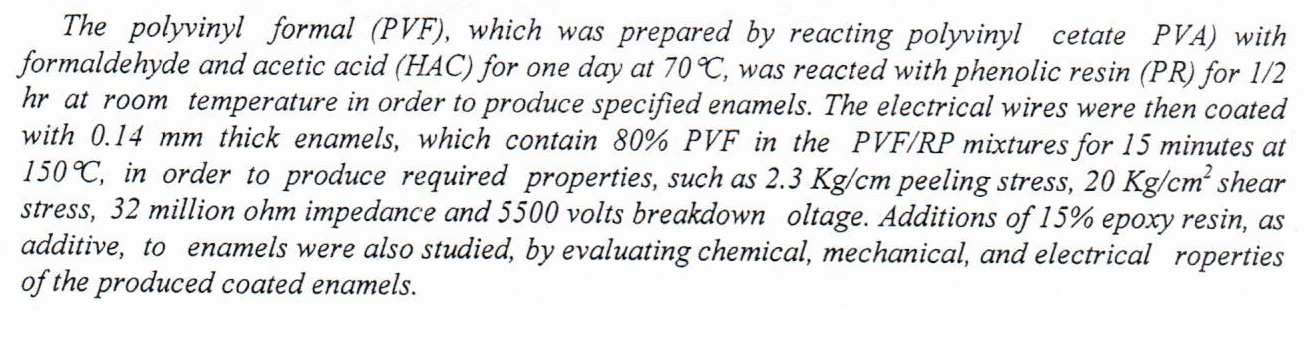
Copper Wires Coated with Enamel

Thin films of CdS:Cu were deposited onto glass substrate temperature 400 °c. The optieal properties have been studied for Cds doped with (1,3, 8) wt% of Cu before and after Gamma irradiation. It was found that the irradiation caused an ( Frenkel defects) where the atom is displaced from its original site leaving vacancy and forming on interstitial atom. It was found the irradiation caused an absorption edge shifting towards long wavelength as a result of the increasing of Cu concentration.
The corrosion behavior of copper and carbon steel in 1M concentration of hydrochloric acid (HCl) and sulphuric acid (H2SO4) has been studied. The corrosion inhibition of copper and carbon steel in 1M concentration of hydrochloric acid (HCl) and sulphuric acid (H2SO4) by Ciprofloxacin has been investigated. Specimens were exposed in the acidic media for 7 hours and corrosion rates evaluated by using the weight loss method. The effect of temperature (from 283 ºK to 333 ºK), pH (from 1to 6), inhibitor concentration (10-4 to 10-2) has been studied. It was observed that sulphuric acid environment was most corrosive to the metals because of its oxidizing nature, followed by hydrochloric acid. The rate of metal dissolution increased with incre
... Show More (2)
(2)

 (30)
(29)
(30)
(29)


In this work, an experimental research on a low voltage DC magnetron plasma sputtering (0-650) volt is used for coating gold on a glass substrate at a constant pressure of argon gas 0.2 mbar and deposition time of 30 seconds. We focused on the effects of operating conditions for the system such as, electrode separation and sputtering current on coated samples under the influence of magnetic flux. Electron temperature and electrons and ions densities are determined by a cylindrical single Langmuir probe. The results show the sensitivity of electrode separation lead to change the plasma parameters. Furthermore, the surface morphology of gold coated samples at different electrode separation and sputtering current were studied by atomic forc
... Show More
(3)
(17)
(17)
Wet granulation method was used instead of conventional pan coating or fluidized –bed coating technique to prepare enteric-coated diclofenac sodium granules, using ethanolic solution of EudragitTM L100 as coating, binding and granulating agent .Addition of PEG400 or di-n-butyl phthalate as a plasticizer was found to improve the enteric property of the coat.
Part of the resulted granules was filled in hard gelatin capsules (size 0), while the other part was compressed into tablets with and without disintegrant.
The release profile of these two dosage forms in 0.1N HCl (pH 1.2)for 2 hours, and in phosphate buffer (pH 6.8) for 45 minutes as well as the release kinetic were compared with that of the en
... Show More
(41)
(23)
(9)
(9)