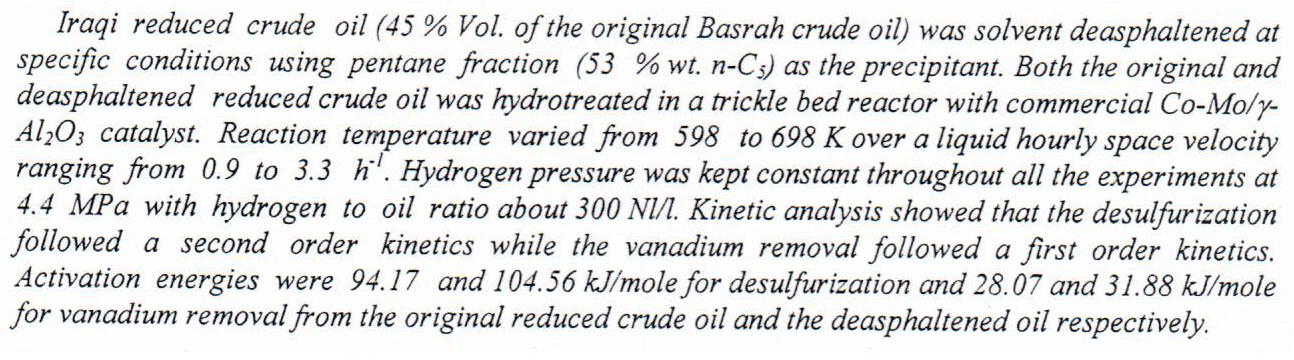
The Effect of Asphaltenes Removal on the Kinetics of Iraqi Reduced Crude Oil Hydrotreating

The efficiency of attapulgite liners as anti-seepage for crude oil is examined. Consideration is given to the potential use of raw attapulgite and mixture attapulgite with prairie hay and coconut husk as liners to prevent crude oil seepage. Attapulgite clay used in this study was brought from Injana formation /Western Desert of Iraq. Two types of Crude oil brought from Iraqi oil fields were used in experiments; heavy crude oil from East-Baghdad oil field and light crude oil from Nassiriya oil field. Initially the basic properties of attapulgite and crude oils were determined. The attapulgite clay was subjected to mineralogical, chemical and scanning electron microscope analyses. Raw Attapulgite 150µm, 75µm, and 53µm were tested
... Show More (2)
(2)
 (1)
(1)


Two different oxidative desulfurization strategies based on oxidation/adsorption or oxidation/extraction were evaluated for the desulfurization of AL-Ahdab (AHD) sour crude oil (3.9wt% sulfur content). In the oxidation process, a homogenous oxidizing agent comprising of hydrogen peroxide and formic acid was used. Activated carbons were used as sorbent/catalyst in the oxidation/adsorption process while acetonitrile was used as an extraction solvent in the oxidation/extraction process. For the oxidation/adsorption scheme, the experimental results indicated that the oxidation desulfurization efficiency was enhanced on using activated carbon as catalyst/sorbent. The effects of the operating conditions (contact time, temperat
... Show More
(2)
(2)
The inhibition effect of crude juice of green and black olive on cancer cell line (RD) in vitro has been studied by depending on micro titration system . Eleven different concentration starting from (916-960) mg/ml of crude juice respectively ,for three periods of exposure(24-48-72)hours. The resulted showed that the inhibition effect dependent on type of olive fruit juice ,concentration of dose ,time of exposure and the high concentration of both type of olive juice increased the growth of cell line while other concentration caused decrease in different rates ,moreover the black juice was more effective than green and 48 hours' time exposure was the best for inhibition.
The house flies Musca domestica )Diptera:musidae) are the primary carrier of many pathogens such as cholera, typhoid, anthrax, and others. The use of chemical pesticides as a basic method of control leads to many problems at the environmental and health level. The use of safe alternatives to chemical pesticides has become an urgent necessity. The research aims to find biological alternatives that are environment-friendly and non-pathogenic to humans in controlling house flies through the possibility of extracting and diagnosing some secondary metabolites produced by the fungus Metarhizium anisopliae and testing their effects on the second larval stage of house flies using different treatment methods that include
... Show More
(5)
(4)
A phytoremediation experiment was carried out with kerosene as a model for total petroleum hydrocarbons. A constructed wetland of barley was exposed to kerosene pollutants at varying concentrations (1, 2, and 3% v/v) in a subsurface flow (SSF) system. After a period of 42 days of exposure, it was found that the average ability to eliminate kerosene ranged from 56.5% to 61.2%, with the highest removal obtained at a kerosene concentration of 1% v/v. The analysis of kerosene at varying initial concentrations allowed the kinetics of kerosene to be fitted with the Grau model, which was closer than that with the zero order, first order, or second order kinetic models. The experimental study showed that the barley plant designed in a subsu
... Show More
(10)
A phytoremediation experiment was carried out with kerosene as a model for total petroleum hydrocarbons. A constructed wetland of barley was exposed to kerosene pollutants at varying concentrations (1, 2, and 3% v/v) in a subsurface flow (SSF) system. After a period of 42 days of exposure, it was found that the average ability to eliminate kerosene ranged from 56.5% to 61.2%, with the highest removal obtained at a kerosene concentration of 1% v/v. The analysis of kerosene at varying initial concentrations allowed the kinetics of kerosene to be fitted with the Grau model, which was closer than that with the zero order, first order, or second order kinetic models. The experimental study showed that the barley plant designed in a subsu
... Show More
(14)
(10)

Nanomaterials have an excellent potential for improving the rheological and tribological properties of lubricating oil. In this study, oleic acid was used to surface-modify nanoparticles to enhance the dispersion and stability of Nanofluid. The surface modification was conducted for inorganic nanoparticles (NPs) TiO₂ and CuO with oleic acid (OA) surfactant, where oleic acid could render the surface of TiO2-CuO hydrophobic. Fourier transform infrared spectroscopy (FTIR), and Scanning electron microscopy (SEM) were used to characterize the surface modification of NPs. The main objective of this study was to investigate the influence of adding modified TiO₂-CuO NPs with weight ratio 1:1 on thermal-physical propertie
... Show More
(1)