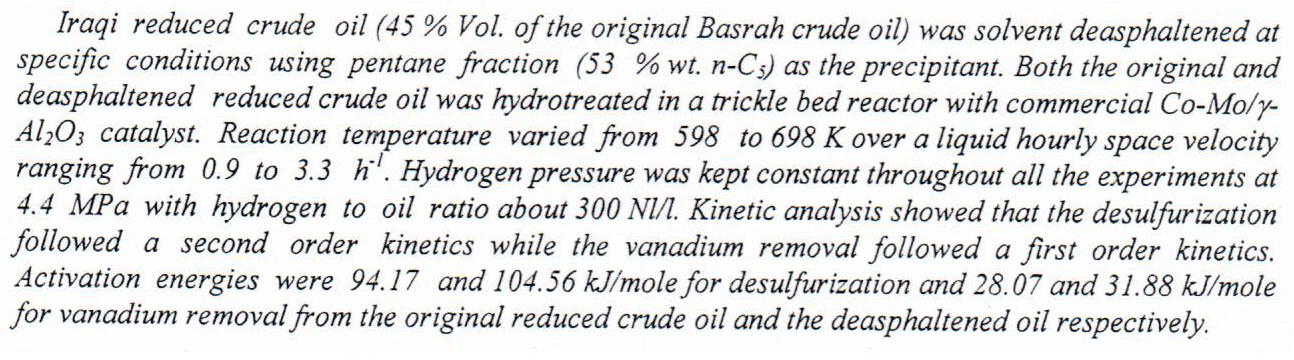
The Effect of Asphaltenes Removal on the Kinetics of Iraqi Reduced Crude Oil Hydrotreating

The aquatic crude extract of Silybum marianum dry grains prepared by melting them in distil water by the method of soak and shake. The effect of Silybum marianum crude extract studied in vitro on three tumor cell line the Hep-2, AMN-3 and RD for 24, 48 and 72 hours of exposure, and one cell line of normal cells REF for 72 hr exposure. The results showed that the prescence of toxic effect of the aquatic crude extract on the cell lines of Hep-2, AMN-3 and RD at 10 and 100 µg/ ml upto the higher concentrations when they exposed to the extract for 48 hr. as compared with the control treatment, and when the exposure period increased to 72 hr. the toxic effect started at low concentrations (5 and 10 µg/ ml) as compared with the control g
... Show More
Make a search on the vegetative parts of the plant local horse guilt of some elements in the Haj Omran area in northern Iraq has included recognition of certain nutrients
This work deals with the production of light fuel cuts of (gasoline, kerosene and gas oil) by catalytic cracking treatment of secondary product mater (heavy vacuum gas oil) which was produced from the vacuum distillation unit in any petroleum refinery. The objective of this research was to study the effect of the catalyst -to- oil ratio parameter on catalytic cracking process of heavy vacuum gas oil feed at constant temperature (450 °C). The first step of this treatment was, catalytic cracking of this material by constructed batch reactor occupied with auxiliary control devices, at selective range of the catalyst –to- oil ratio parameter ( 2, 2.5, 3 and 3.5) respectively. The conversion of heavy vacuum gas
... Show More
Asphaltene is one of the fractions of the crude oil which is soluble in aromatics such as benzene or toluene and insoluble in alkane such as n-heptane, n-pentane or petroleum ether (mixture of alkane compounds). Asphaltene precipitation is one of the most common problems that sometimes occurs in both oil recovery and refinery processes as a result of changing in pressure, oil composition, or temperature. Therefore the stability of asphaltene in the crude oil must be studied to show the tendency of it for precipitating asphaltene to prevent it (Asphaltene precipitation and deposition problem) and eliminate the burden of high treatment costs.
In the present study, saturate, aromatic, resin and asphaltene (SAR
... Show More (6)
(6)
 (31)
(27)
(31)
(27)


An experiment was conducted to study how SAE 50 engine oil contaminated with diesel fuel affects engine performance. The engine oil was contaminated with diesel fuel at concentrations of 0%, 1%, and 3%. The following performance characteristics were studied: brake-specific fuel consumption, brake thermal efficiency, friction power, and exhaust gas temperature. Each treatment was tested three times. The three treatments (0%, 1%, and 3%) were analyzed statistically with a one-way ANOVA model at the 5% probability level to determine if the three treatments produced significant differences in engine performance. The statistical results showed that there were significant differences in engine performance metrics among the three treatments. The 3
... Show MoreThe kinetics of nickel removal from aqueous solutions using a bio-electrochemical reactor with a packed bed rotating cylinder cathode was investigated. The effects of applied voltage, initial nickel concentration, the rotation speed of the cathode, and pH on the reaction rate constant (k) were studied. The results showed that the cathodic deposition occurred under mass transfer control for all values of the applied voltage used in this research. Accordingly, the relationship between concentration and time can be represented by a first-order equation. The rate constant was found to be dependent on the applied voltage, initial nickel concentration, pH, and rotation speed. It was increased as the applied voltage increased and decreased as t
... Show More
(1)
This work was conducted to study the treatment of industrial waste water, and more particularly those in the General Company of Electrical Industries.This waste water, has zinc ion with maximum concentration in solution of 90 ppm.
The reuse of such effluent can be made possible via appropriate treatments, such as chemical coagulation, Na2S is used as coagulant.
The parameters that influenced the waste water treatment are: temperature, pH, dose of coagulant and settling time.
It was found that the best condition for zinc removal, within the range of operation used ,were a temperature of 20C a pH value of 13 , a coagulant dose of 15 g Na2S /400ml solution and a settling time of 7 days. Under these conditions the zinc concentrat
In this paper, two types of iron oxide nanomaterial (Fe3O4) and nanocomposite (T-Fe3O4) were created from the bio-waste mass of tangerine peel. These two materials were utilized for adsorption tests to remove cefixime (CFX) from an aqueous solution. Before the adsorption application, both adsorbents have been characterized by various characterizations such as XRD, FTIR, VSM, TEM, and FESEM. The mesoporous nano-crystalline structure of Fe3O4 and T-Fe3O4 nanocomposite with less than 100-nm diameter is confirmed. The adsorption of the obtained adsorbents was evaluated for CFX removal by adjusting several operation parameters to optimize the removal. The optimal conditions for CFX removal were found to be an initial concentration of 40 and 50 m
... Show More
(17)
An investigation was conducted for dewaxing of lubricating oil fraction by urea to reduce the pour point.In this study mixture of 45 % methyl ethyl ketone (MEK) and 55 % toluene was used as a solvent. The studied variables are mixing time (10-70 min), solvent to oil volume ratio (0.5:1- 2:1), urea to wax weight ratio (2- 6) and constant mixing speed 1500 rpm. By analysis of the experimental results, the best operating conditions achieved are mixing time 40 min, solvent/oil 2:1 volume ratio, and urea/wax 4:1 weight ratio. At these conditions the pour point of the lubricating oil decreases from 24 ° C to -13 °C.