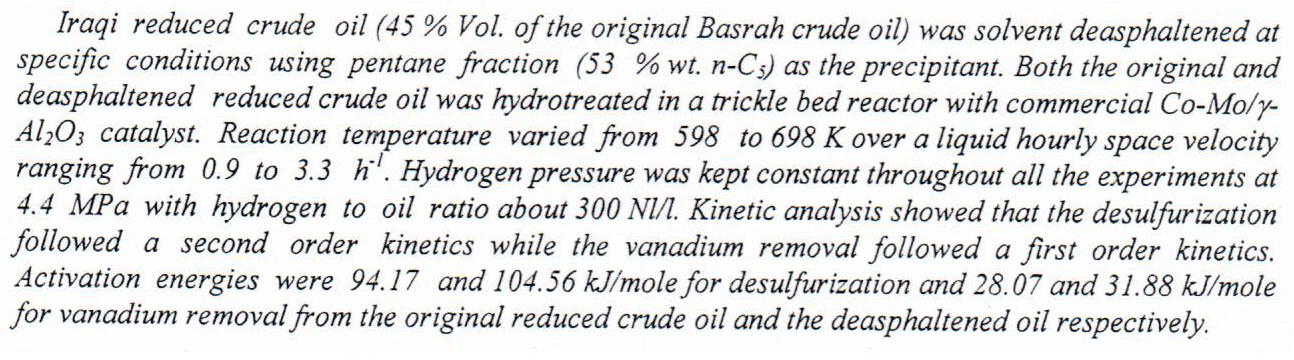
The Effect of Asphaltenes Removal on the Kinetics of Iraqi Reduced Crude Oil Hydrotreating

The research aim to measure the impact of the Industry specialization of the auditors on the quality in audit in Iraqi auditing firms, as well as measuring the factors of Industry specialization in the Iraqi audit companies by measuring the market shares of Iraqi audit firms that audit the companies listed on the Iraqi Stock Exchange For 2010 to 2016, by surveying the opinions of (35) Audit firm on the impact of the Industry specialization of auditing firms in audit quality factors, The effect of the variables was revealed through the use of the survey form Distributed to Iraqi audit companies, The industry speci
... Show More
The study involves removing of [Alizarin Red S (ARS) and Alizarin yellow R (AYR)] by using Iraqi Siliceous Rocks Powder (SRP). Adsorption isotherms were studied and the factors which influence it, such as temperature and salt effect. Adsorption isotherms of (ARS) were found to be comparable to Temkin equation. Adsorption isotherms of (AYR) were found to be comparable to Freundlich equation. The adsorption process on this surface was studied at different temperatures. The results showed that the adsorption of (ARS,AYR) on surface increased with increasing temperature (Endothermic process). According to the above results the thermodynamic functions (ΔH, ΔG, ΔS) were calculated. The adsorption quantity increasing for (ARS, AYR) with increas
... Show MoreThe aim of this study was to determine the influence of feeding diets containing different levels of sesame seeds and oil on the egg quality of laying quail. A total of 120, 10 weeks old, were randomly assigned to 1 of 5 dietary groups and fed for 12 weeks diets containing 0% sesame seeds + 0% sesame oil (control group; C) or 0.5% sesame oil (T1), 1% sesame oil (T2), 1% sesame seeds (T3), and 2% sesame seeds (T4).The study was terminated when the birds were 22 weeks of age. Egg quality characteristics involved in the present study were egg weight, yolk diameter, yolk height, yolk weight, albumen height, albumen weight,Haugh unit, shell weight, shell thickness, shell percentage, yolk percentage, and albumen percentage. The addition of sesame
... Show MoreIn the present research, the chemical washing method has been selected using three chelating agents: citric acid, acetic acid and Ethylene Diamine Tetraacetic Acid (EDTA) to remove 137Cs from two different contaminated soil samples were classified as fine and coarse grained. The factors that affecting removal efficiency such as type of soil, mixing ratio and molarity have been investigated. The results revealed that no correlation relation was found between removal efficiency and the studied factors. The results also showed that conventional chemical washing method was not effective in removing 137Cs and that there are further studies still need to achieve this objective.
Field experiment was conducted during 2007 in the experimental field of crop science Department/ Collage of Agriculture/ University of Baghdad, in order to identify the mechanism of compensation of cotton plant of Lashata Variety, with different levels of fruiting form removal in various time intervals and the effect of this factor on yield component. We use complete randomized block design with three replications. To compare the treatments: (control), 50% bud removal for one, two and three successive weeks, and 100% bud removal for one, two and three successive weeks, 50% flower removal for one, two and three successive weeks and 100% flower removal for one, two and three successive weeks, 50% boll removal for one, two and three successive
... Show More (8)
(8)
Corncob is an agricultural biomass waste that was widely investigated as an adsorbent of contaminants after transforming it into activated carbon. In this research carbonization and chemical activation processes were achieved to synthesize corncob-activated carbon (CAC). Many pretreatment steps including crushing, grinding, and drying to obtain corncob powder were performed before the carbonization step. The carbonization of corncob powder has occurred in the absence of air at a temperature of 500 °C. The chemical activation was accomplished by using HCl as an acidic activation agent. Fourier transform infrared spectroscopy (FT-IR), scanning electron microscopy (SEM), X-ray diffraction (XRD), and Brunauer–Emmett–Teller (BET) facilitate
... Show More (6)
(7)
(6)
(7)


In this study two types of extraction solvents were used to extract the undesirable polyaromatics, the first solvent was furfural which was used today in the Iraqi refineries and the second was NMP (N-methyl-2-pyrrolidone).
The studied effecting variables of extraction are extraction temperature ranged from 70 to 110°C and solvent to oil ratio in the range from 1:1 to 4:1.
The results of this investigation show that the viscosity index of mixed-medium lubricating oil fraction increases with increasing extraction temperature and reaches 107.82 for NMP extraction at extraction temperature 110°C and solvent to oil ratio 4:1, while the viscosity index reaches to 101 for furfural extraction at the same extraction temperature and same
The study aims to measure the impact of reporting on value creation on the earnings quality of the economic unit by presenting and discussing the conceptual aspects of the value creation process through multi-capital and the importance of reporting it in Iraqi private banks in addition to presenting and analyzing the concept of profit quality and its measurement models. Therefore, the checklist prepared for this purpose was used based on previous studies related to the subject in order to determine the level of reporting of the research sample banks by analyzing the content of the annual reports of those banks as well as adopting the Tobin's Q scale to measure the value of the economic unit and then using some statistical models to
... Show More