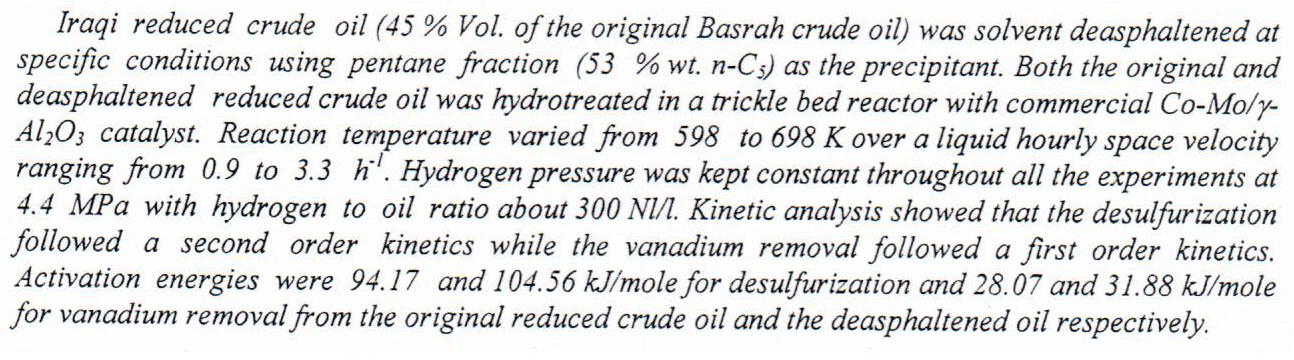
The Effect of Asphaltenes Removal on the Kinetics of Iraqi Reduced Crude Oil Hydrotreating

 (5)
(5)
 (3)
(3)



Background: Wounds are any disruption to the normal anatomic structure of tissue which leads to the loss of epithelial continuity with or without a loss of underlying connective tissue, as well as the anatomic and functional integrity of the living tissue . Wound healing is a complex process with overlapping phases haemostasis, inflammation, proliferation and maturation/matrix Remodeling. Each phase of wound healing requires different management strategies, and inappropriate treatment can delay wound healing. The aim of wound treatment is a rapid wound closure and re-establish tissue function,chia seeds oil are widely used herbal medicines because of their anti-inflammatory and antioxidant capacity as they considerd agood source of polyunsa
... Show More
(3)
(3)
(4)
Iraqi oil crudes have some of the physical and chemical characteristics that distinguish it from other types of oil crudes in the world. Some of these features such us molecular composition, rheological, viscosity and emulsions are studied carefully by researchers. In this work, a comparative study of the linear and the non-linear optical properties for typical heavy and light crude oils of Iraqi origin was studied utilizing Z-scan technique. The He -Ne laser of wavelength 632.8 nm had been used for this purpose. These samples were collected from Basra and Kut oil fields. The values of the non-linear refractive index (n2), non-linear absorption coefficient (β), and third-order electrical susceptibility (χ3) were e
... Show More
The experiment was conducted at the plant tissue culture laboratory of the Department of Horticulture and Garden Engineering College of Agricultural Engineering Sciences, University of Baghdad, in order to study the effect of some growth regulators on propagation an stimulation production of volatile oil compounds of rosemary plant Rosmarinus officinlis using two vegetative parts (apical and lateral buds). Factorial experiment was implemented in completely randomized design with twenty replications. The results indicated that culturing the apical meristem on the medium Murashige and Skoog (MS) media with 0.5 mg.l-1 (BA) with 0.1 mg.l-1 of NAA gave the highest response rate of 100%. As for the doubling stage, the levels of BAA and IAA (Indol
... Show MoreA Laboratory study was conducted in quality control department ,state company for food stuff trading ministry of trade (2005-2006) on sunflower oil imported to Iraq from different origins included 12 trade marks, Complete random design was used with four replication .The purpose of the study is to know the origins effect on fatty acid percent and study the simple correlation between them, the result showed Turkish origin for trademark (Narin) was superior in Palmitic and Stearic fatty acid (10.41,3.29%).While Omanian origin for trademark Alsafwa was superior in Oleic(35.09%) and Syrian origin for trade mark Alnahraen was superior in Linoleic fatty acid percent 66.53% whereas Egyptian origin for trademark Alasel was superior in the percent
... Show More
Experimental tests were carried to control lost circulation in the Khabaz oil field using different types of LCMs including Nano-materials. A closed-loop circulation system was built to simulate the process of lost circulation into formations. Two dolomite plugs were used from different depths of the formation of Azkand in Khabaz oil field. The experimentations were carried out to study the effect of different types of LCMs, cross-linked copolymer (FLOSORB CE 300 S), SiO2 NP, and Fe2O3 NP, on mud volume losses as a function of time.
The rheological measurements of the nanoparticles-reference mud system showed that both of the SiO2 NP and Fe2O3 NP w
... Show More
(4)
Sixty albino female mice were used in this experiment to study the possible effect of the crude alcoholic extract of the celery leaves on their fertility. These animals were randomly and equally divided into three experimental groups (20 females/group). The first and second groups were orally given a daily dose of 500 and 1000 mg/kg body weight, respectively, of the crude alcoholic extract, while the third group (control) was similarly treated, at the same time, with 0.1 ml/gm body weight of physiological saline for comparison. The treatment, however, lasted for 25 consecutive days. On day 26, after treatment was stopped, the life body weight of all animals was recorded before sacrificing the animals. Thereafter blood
... Show More