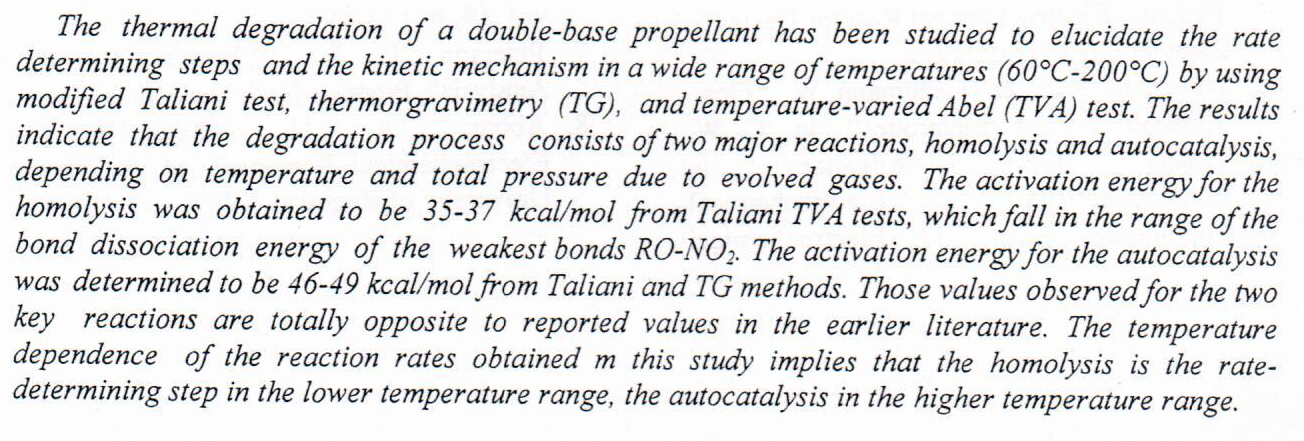
Kinetic Mechanism on Thermal Degradation of a Nitrate Ester Propellant

 (8)
(8)
 (6)
(6)


 (4)
(5)
(4)
(5)
Excess heat significantly reduces the efficiency and lifespan of electrical and optoelectronic devices. While passive radiative cooling is becoming more common, achieving active thermal control without physical reconfiguration remains challenging. Unlike conventional static absorbers, we propose a broadband plasmonic solar absorber designed to regulate energy absorption in the near-infrared (NIR) region without modifying the geometrical parameters. The design utilizes a coaxial cylindrical metal-insulator-metal (MIM) configuration, combining refractory copper (Cu), silicon dioxide (SiO2), and a trilayer graphene (Gr) that allows electrical tuning in a broadband solar absorber. Simulation results show a maximum broadband absorption efficienc
... Show More
Autorías: Muhammad Hamza Shihab, Nuha Mohsin Dhahi. Localización: Revista iberoamericana de psicología del ejercicio y el deporte. Nº. 4, 2022. Artículo de Revista en Dialnet.
(20)
The specifications of lubricating oil are fundamentally the final product of materials that have been added for producing the desired properties. In this research, spherical nanoparticles copper oxide (CuO) and titanium oxides (TiO2) are added to SAE 15W40 engine oil to study the thermal conductivity, stability, viscosity of nano-lubricants, which are prepared at different concentrations of 0.1%, 0.2%, 0.5%, and 1% by weight, and also their pour point, and flash point as five quality parameters. The obtained results show that CuO nanoparticles in all cases, give the best functionality and effect on engine oil with respect to TiO2. With 0.1 wt. % concentration, the thermal conductivity of CuO/oil and TiO2/
... Show More
(27)
(8)
(10)
(31)
(24)