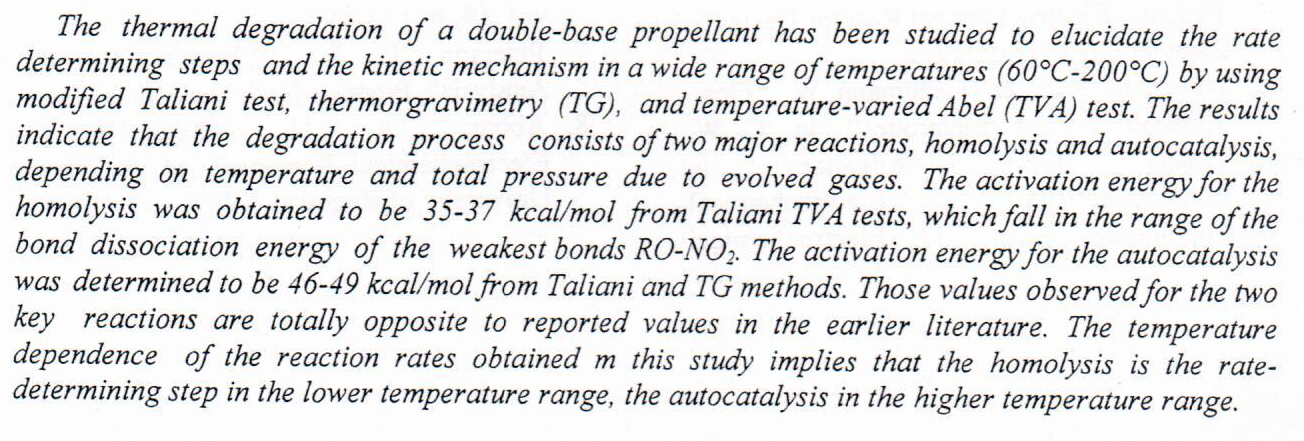
Kinetic Mechanism on Thermal Degradation of a Nitrate Ester Propellant

This paper aims at studying the illocutionary speech acts: direct and indirect to show the most dominant ones in a presidential speech delivered by the USA president. The speech is about the most critical health issue in the world, COVID-19 outbreak. A descriptive qualitative study was conducted by observing the first speech delivered by president Trump concerning coronavirus outbreak and surveying the illocutionary acts: directive, declarative, commissive, expressive, and representative. Searle's (1985) classification of illocutionary speech acts is adopted in the analysis.
What are the main types of the illocutionary speech acts performed by Trump in his speech?; Why does
... Show More (1)
(1)

The purpose of my thesis is to prepare four new ligands (L1-L4) that have been used to prepare a series of metal complexes by reacting them with metal ions: M=(Mn(II), Co(II), Ni(II), Cu(II), Zn(II), Cd(II), Hg(II) Where succinyl chloride was used as a raw material for the preparation of bi-dented ligands (L1-L4) by reacting it with potassium thiocyanate as a first step and then reacting with (2-aminobenzothiazole, Benzylamine, 4-aminoantipyrine, Sulfamethoxazole) respectively as a second step with the use of dry acetone as a solvent, the chemical formula of the four ligands prepared in succession: N1,N4-bis(benzo[d]thiazol-2-ylcarbamothioyl)succinamide (L1) N1,N4-bis(benzylcarbamothioyl)succinami
... Show MoreThe concept of Assemblage appeared obviously in Postdramatic works, where a character or a text may stand as an assemblage of potentialities in the sense that it signifies unidentified subjectivity. Assemblages are constituted essentially of heterogeneous elements yet fused without specific demarcations. In order to enjoy the desired productivity at a "smooth pace," the regularities of political and societal institutionalization are disseminated. To achieve this dissemination, Deleuze-Guattari suggest an unsatiated platform of a "Body without Organs' (BwO), where desire escapes identification. Martin Crimp (b. 1956) defines his off-stage characters in Attempts on Her Life (1997), Anne, or whatever the name is, as a 'BwO', upon which
... Show More
Recommender Systems are tools to understand the huge amount of data available in the internet world. Collaborative filtering (CF) is one of the most knowledge discovery methods used positively in recommendation system. Memory collaborative filtering emphasizes on using facts about present users to predict new things for the target user. Similarity measures are the core operations in collaborative filtering and the prediction accuracy is mostly dependent on similarity calculations. In this study, a combination of weighted parameters and traditional similarity measures are conducted to calculate relationship among users over Movie Lens data set rating matrix. The advantages and disadvantages of each measure are spotted. From the study, a n
... Show More (17)
(2)
(17)
(2)


The adsorption process of reactive blue 49 (RB49) dye and reactive red 195 (RR195) dye from an aqueous solutions was explored using a novel adsorbent produced from the sunflower husks encapsulated with copper oxide nanoparticle (CSFH). Primarily, the features of a CSFH, such as surface morphology, functional groups, and structure, were characterized. It was determined that coating the sunflower husks with copper oxide nanoparticles greatly improved the surface and structural properties related to the adsorption capacity. The adsorption process was successful, with a removal efficiency of 97% for RB49 and 98% for RR195 under optimal operating conditions, contact time of 180 min, pH of 7, agitation speed of 150 rpm, initial dye concentration
... Show More
(26)
In today’s competitive environment, organizational efficiency and sustained growth are crucial for survival. The performance of an organization is intricately connected to strategic planning, prompting firms to gather and leverage competitive information for a competitive advantage. Senior managers, recognizing this, initiate actions accordingly. This study aims to investigate the relationship between foresight, vision, strategic partnerships, motivation, system thinking, and organizational performance. Data, gathered through a self-administered questionnaire from various textile units, were analysed using structural equation modelling (SEM). The findings indicate that sub-constructs of strategic intelligence positively impact organizatio
... Show MoreNew series of metal ions complexes have been prepared from the new ligand 1,5- Dimethyl-4- (5-oxohexan-2- ylideneamino) -2-phenyl- 1H-pyrazol-3 (2H)-one derived from 2,5-hexandione and 4-aminophenazone. Then, its V(IV), Ni(II), Cu(II), Pd(II), Re(V) and Pt(IV) complexes prepared. The compounds have been characterized by FT-IR, UV-Vis, mass and 1H and 13C-NMR spectra, TGA curve, magnetic moment, elemental microanalyses (C.H.N.O.), chloride containing, Atomic absorption and molar conductance. Hyper Chem-8 program has been used to predict structural geometries of compounds in gas phase, the heat of formation, (binding, total and electronic energy) and dipole moment at 298 K.
(5)
Heat transfer around a flat plate fin integrated with piezoelectric actuator used as oscillated fin in laminar flow has been studied experimentally utilizing thermal image camera. This study is performed
for fixed and oscillated single and triple fins. Different substrate-fin models have been tested, using fins of (35mm and 50mm) height, two sets of triple fins of (3mm and 6mm) spacing and three frequencies
applied to piezoelectric actuator (5, 30 and 50HZ). All tests are carried out for (0.5 m/s and 3m/s) in subsonic open type wind tunnel to evaluate temperature distribution, local and average Nusselt number (Nu) along the fin. It is observed, that the heat transfer enhancement with oscillation is significant compared to without o
(1)