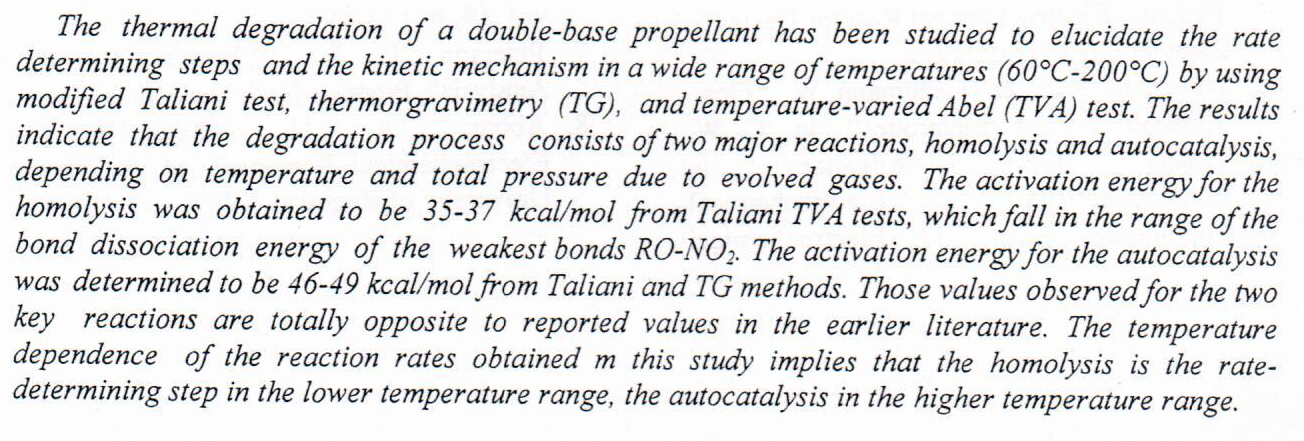
Kinetic Mechanism on Thermal Degradation of a Nitrate Ester Propellant

In this study, Zizphus spina-christi leaf powder was applied for the adsorption of methyl orange. The effect of different operating parameters on the Batch Process adsorption was investigated such as solution pH (2-12), effect of contact time (0-60 min.), initial dye concentration (2-20 mg/L), effect of adsorbent dosage (0-4.5 g) and effect of temperature (20-50ᵒC). The results show a maximum removal rate and adsorption capacity (%R= 23.146, qe = 2.778 mg/g) at pH = 2 and equilibrium was reached at 40 min. The pseudo- second-order kinetics were found to be best fit for the removal process (R2 = 0.997). Different isotherm models (Langmuir, Freundlich, Dubini-Radushkevich,Temkin) were applied in this stud
... Show More (4)
(4)
 (1)
(1)

 (62)
(61)
(62)
(61)
In this research, the kinetic studies of four isoenzymes of Asprtate aminotransferase, which partially purified from the urine of chronic renal failure patients were carried out .The four isoenzymes were obeyed Michaelis-Menton's equation and the optimum concentration of their substrate (Aspartic acid) was (166.5x10⁻³) mole/liter,and their Km values were determined. Four isoenzymesI,II,III,IV have shown an optimum pH at 7.4.The four isoenzymes obeyed Arrhenius equation up to 37º C and their Ea and Q10 constants were determined .
In this work, Pure and Cu: doped titanium dioxide nano-powder was prepared through a solid-state method. the dopant concentration [Cu/TiO2 in atomic percentage (wt%)] is derived from 0 to 7 wt.%. structural properties of the samples performed with XRD revealed all nanopowders are of titanium dioxide having polycrystalline nature. Physical and Morphological studies were conducted using a scanning electronic microscope SEM test instrument to confirm the grain size and texture. The other properties of samples were examined using an optical microscope, Lee's Disc, Shore D hardness instrument, Fourier-transform infrared spectroscopy (FTIR), and Energy-dispersive X-ray spectroscopy (EDX). Results showed that the thermal conductivity
... Show More
(4)
The thermal performance of indirect expansion solar assisted heat pump, IX-SAHP, was investigated experimentally under Iraqi climate. An Indirect-Solar Assisted Heat Pump system was designed, built, instrumented and tested. Experimental tests were conducted by varying the controlling parameters to investigate their effects on the thermal performance of the IX-SAHP such as cooling water flow rate, heating water flow rate, ambient temperature and solar radiation intensity. The investigation covered values of cooling water flow rate of (2, 3, 4, 5 l/min) and heating water flow rate of (2, 3, 4, 5 l/min) under meteorological condition of Baghdad from November 2014 to January 2015.
The results indicated that the performance of the IX-
... Show MoreThe present work aimed to study the efficiency of thermal osmosis process for recovery of water from organic wastewater solution and study the factors affecting the performance of the osmosis cell. The driving force in the thermo osmosis cell is provided by a difference in temperature across the membrane sides between the draw and feed solution. In this research used a cellulose triacetate (CTA), as flat sheet membranes for treatment of organic wastewater under orientation membrane of active layer facing feed solution (FS) and draw solution (DS) is placed against the support layer. The organic materials were phenol, toluene, xylene and BTX (benzene, toluene, and xylene) used as feed solution. The osmotic agent in draw solution was
... Show More
(24)
(15)

Dapagliflozin is a novel sodium-glucose cotransporter type 2 inhibitor. This work aims to develop a new
validated sensitive RP-HPLC coupled with a mass detector method for the determination of dapagliflozin, its
alpha isomer, and starting material in the presence of dapagliflozin major degradation products and an internal
standard (empagliflozin). The separation was achieved on BDS Hypersil column (length of 250mm, internal
diameter of 4.6 mm and 5-μm particle size) at a temperature of 35℃. Water and acetonitrile were used as
mobile phase A and B by gradient mode at a flow rate of 1 mL/min. A wavelength of 224nm was selected to
perform detection using a photo diode array detector. The method met the
(7)
(1)
Roof in the Iraqi houses normally flattening by a concrete panel. This concrete panel has poor thermal properties. The usage of materials with low thermal conductivity and high specific heat gives a good improvements to the thermal properties of the concrete panel, thus, the indoor room temperature improves. A Mathcad program based on a mathematical model employing complex Fourier series built for a single room building. The model input data are the ambient temperature, solar radiation, and sol-air temperature, which have been treated as a periodic function of time. While, the room construction is constant due to their materials made of it, except the roof properties are taken as a variable generated practically from the
... Show More