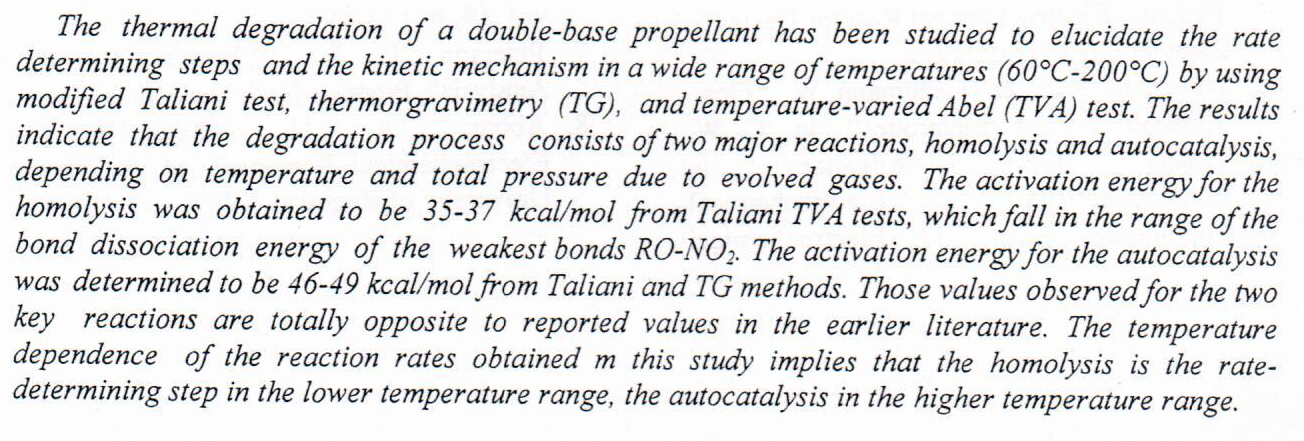
Kinetic Mechanism on Thermal Degradation of a Nitrate Ester Propellant

 (4)
(4)
 (1)
(1)

 (2)
(2)
(2)
(2)

The activity of Alanine aminopeptidase( AAP ) was measured in the urine of healthy and urinary tract cancer patients , the results showed higher activity of (AAP) in patients compared to healthy . AAP was Purified from the urine of healthy and patients with urinary tract cancer by dialysis and gel filtration (Sephadex G – 50) and two isoenzymes of (AAP) were separated from urine by using ion-exchang resin (DEAE – Sephadex A – 50 ) in previous study. The kinetics studies showed that both isoenzymes I and II obeyed Michaelis – Menton equation . with optimal concentration of alanine-4-nitroanilide as substrate for isoenzymes I and II which was (2 x 10⁻³ mol/L ). The two isoenzymes obeyed Arrhenius equation up two 37° C and t
... Show More
Natural Bauxite (BXT) mineral clay was modified with a cationic surfactant (hexadecy ltrimethy lammonium bromide (BXT-HDTMA)) and characterized with different techniques: FTIR spectroscopy, X-ray powder diffraction (XRD) and scanning electron microscopy (SEM). The modified and natural bauxite (BXT) were used as adsorbents for the adsorption of 4- Chlorophenol (4-CP) from aqueous solutions. The adsorption study was carried out at different conditions and parameters: contact time, pH value, adsorbent dosage and ionic strength. The adsorption kinetic (described by a pseudo-first order and a pseudo-second order), equilibrium experimental data (analyzed by Langmuir, Freundlich and Temkin isotherm models) and thermodynamic parameters (change in s
... Show MoreThis study investigates the potential of biogas recovery from used engine oil (UEO) by co-digestion with animals’ manure, including cow dung (CD), poultry manure (PM), and cattle manure (CM). The experimental work was carried out in anaerobic biodigesters at mesophilic conditions (37°C). Two groups of biodigesters were prepared. Each group consisted of 4 digesters. UEO was the main component in the first group of biodigesters with and without inoculum, whereby a mix of UEO and petroleum refinery oily sludge (ROS) was the component in the second group of biodigesters. The results revealed that for UEO-based biodigesters, maximum biogas production was 0.98, 1.23, 1.93, and 0 ml/g VS from UEO±CD, UEO±CM, UEO±PM, and U
... Show More
(1)
(1)
In this study, a low-cost biosorbent, dead mushroom biomass (DMB) granules, was used for investigating the optimum conditions of Pb(II), Cu(II), and Ni(II) biosorption from aqueous solutions. Various physicochemical parameters, such as initial metal ion concentration, equilibrium time, pH value, agitation speed, particles diameter, and adsorbent dosage, were studied. Five mathematical models describing the biosorption equilibrium and isotherm constants were tested to find the maximum uptake capacities: Langmuir, Freundlich, Redlich-Peterson, Sips, and Khan models. The best fit to the Pb(II) and Ni(II) biosorption results was obtained by Langmuir model with maximum uptake capacities of 44.67 and 29.17 mg/g for these two ions, respectively, w
... Show More
(6)
This research aims to study the effect of heat on the efficiency of solar cells of neutrons ranging from card to these cells in the case of dark and light before and after irradiation using the neutron source as well as electrical properties have been studied
The Invar effect in 3D transition metal such as Ni and Mn, were prepared on a series composition of binary Ni1-xMnx system with x=0.3, 0.5, 0.8 by using powder metallurgy technique. In this work, the characterization of structural and thermal properties have been investigated experimentally by X-ray diffraction, thermal expansion coefficient and vibrating sample magnetometer (VSM) techniques. The results show that anonymously negative thermal expansion coefficient are changeable in the structure. The results were explained due to the instability relation between magnetic spins with lattice distortion on some of ferromagnetic metals.
(1)
(10)
(1)
The thermal properties (thermal transfer and thermal expansion coefficient) of the enhanced epoxy resin (MWCNT / x-TiO2) were studied by weight ratios with the values (0%, 3%, 5%, 7% and 10%) and a constant ratio of 3% of MWCNT. The ultrasonic technology was used to prepare the neat and composites which were then poured into Teflon molds according to standard conditions. Thermo-analyzer sensor technology was used to measure thermal transfer (thermal conductivity, thermal flow, thermal diffusion, thermal energy and heat resistance). The thermal conductivity, flow, and thermal conductivity values were increased sequentially by increasing the weight ratio of the filler while the results of stored energy values an
... Show More