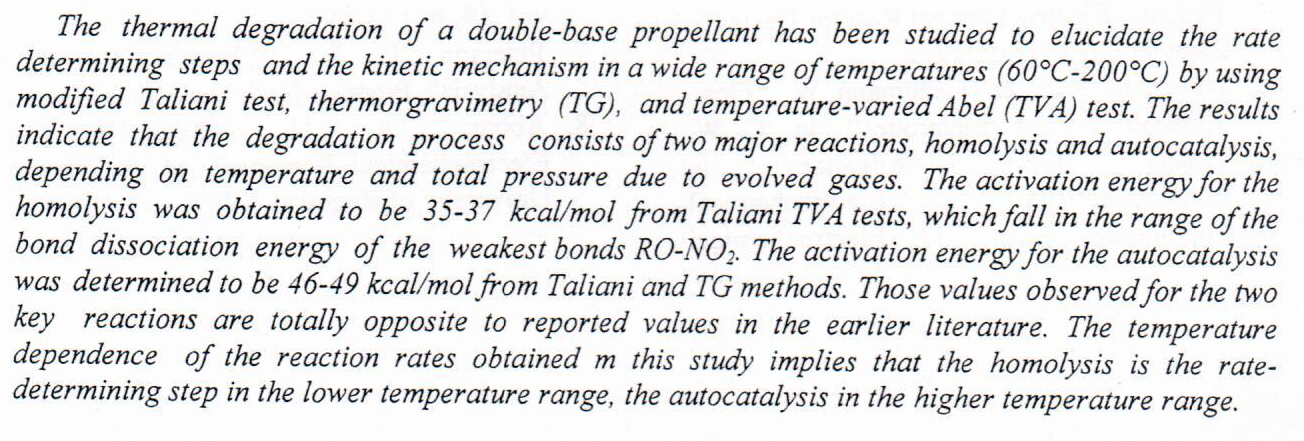
Kinetic Mechanism on Thermal Degradation of a Nitrate Ester Propellant

UV-Vis technique has been used to study the adsorption of para-nitroaniline (PNA) on Iraqi siliceous rocks powder. Adsorption isotherms were investigated, temperature effect on adsorption was calculated, Results showed that the adsorption was an exothermic process and the thermodynamic functions were calculated. The effect of the pH on adsorption was studied and the ionic strength effect on adsorption was studied, It was found that adsorption increases with the presence of sodium chloride ions. The kinetic study of adsorption before equilibrium showed that the adsorption was pseudo first order according to according (Lagergren equation).
The erythrocyte aggregation is an important physiological phenomenon in the circulation of blood. It is a basic characteristic of normal blood that plays a major role in the cardiovascular system, especially in the microcirculation. This study explained the kinetics of single cells rouleaux formation one- dimensional aggregate and three- dimensional aggregate, during simultaneous, and the effect of hematocrit on the process of aggregation and sedimentation. The present study was done on forty one healthy subjects. Laser light is passed through a well mixed sample of blood and the forward scattered light intensities recorded continuously. The samples were prepared with different hematocrit, (10%, 15%, 20%, and 25%). Increasing
... Show More
Humanity's relationship with the environment is a delicate balance. Since the industrial revolution, the world's population has grown at an exponential rate, and this has a major environmental effect. Deforestation, pollution, and global climate change are just a few of the negative consequences of population and technological growth. Particulates, Sulphur dioxide (SO2), and nitrogen oxides (NOx) are the primary pollutants that harm our health. These contaminants may be directly emitted into the atmosphere (primary pollutants) or formed in the atmosphere from primary pollutants reacting (secondary pollutants. Tropospheric ozone is created When water reacts with volatile organic compounds (VOC) and nitrogen oxides (NOx) in the presen
... Show More (6)
(6)
 (5)
(5)

In this study, the effect of the thermal conductivity of phase change material (PCM) on the performance of thermal energy storage has been analyzed numerically. A horizontal concentric shell-and-tube latent heat thermal energy storage system (LHTESS) has been performed during the solidification process. Two types of paraffin wax with different melting temperatures and thermal conductivity were used as a PCM on the shell side, case1=0.265W/m.K and case2=0.311 W/m.K. Water has been used as heat transfer fluid (HTF) flow through in tube side. Ansys fluent has been used to analyze the model by taking into account phase change by the enthalpy method used to deal with phase transition. The numerical simulatio
... Show More
(10)
(11)
(1)

This review discusses precision agriculture techniques that help reduce the effects of soil degradation and improve soil health, based on an analysis of studies published in scientific databases such as Web of Science, Scopus, IEEE Xplore, Google Scholar, and ScienceDirect, with an emphasis on recent field research. The methodology included a qualitative analysis of case studies and application experiments in different areas to evaluate the impact of technologies such as controlled traffic farming (CTF), mechanized guidance (MG), precision fertilization (PF), precision irrigation (PI), conservation tillage (CT), and precision tillage (PT). Research results showed, CT to maintain soil structure and reduce organic matter loss increases soil f
... Show More
(1)
(5)
(5)
Objective: Econazole nitrate (ECZ) is one of the triazole antifungal drugs with poor aqueous solubility and dissolution rate; there is a need for enhancement of solubility. Therefore; inclusion complexation with β cyclodextrin (βCD) was performed. Methods: In this study kneading method and co-evaporation method of preparation of inclusion complex between βCD and ECZ using two molar ratios of βCD. The solubility of these complexes in isotonic saline solution and distilled water was studied. Complexes prepared by kneading method were used for the preparation of different ophthalmic gel formulas using carbomer (CB) and sodium carboxymethylcellulose (sod CMC) as a gelling agent. The release profile and the rheological behaviour of the gel w
... Show More
(8)
This investigation deals with the use of orange peel (OP) waste as adsorbent for removal of nitrate (NO3) from simulated wastewater. Orange peel prepared in two conditions dried at 60C° (OPD) and burning at 500 °C (OPB). The effect of pH: 2-10, contact time: 30- 180 min, sorbent weight: 0.5- 3.0 g were considered. The optimal pH value for NO3 adsorption was found to be 2.0 for both adsorbents. The equilibrium data were analyzed using Langmuir and Freundlich isotherm models. Freundlich model was found to fit the equilibrium data very well with high-correlation coefficient (R2). The adsorption kinetics was found to follow pseudo-second-order rate kinetic model, with a good correlation (R2
... Show More