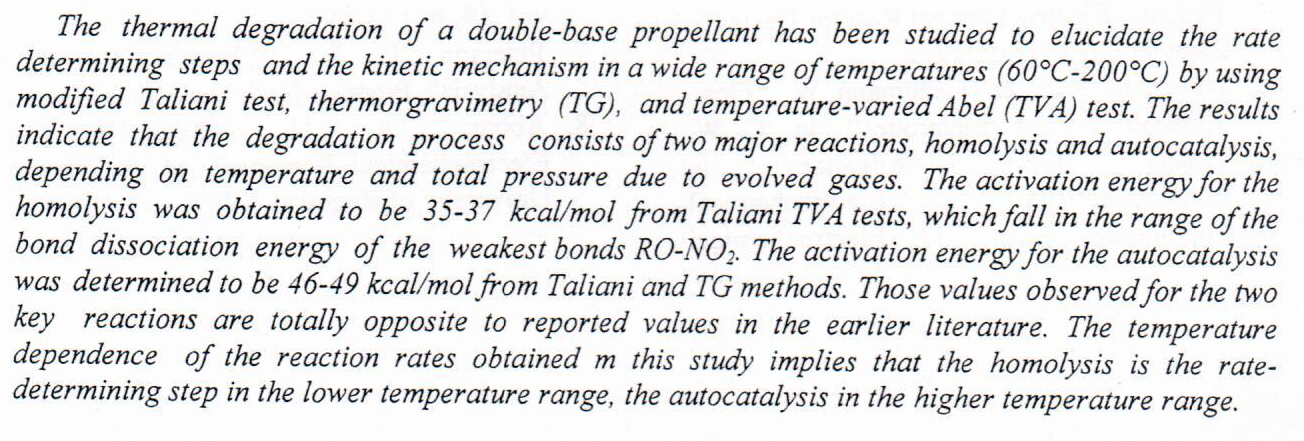
Kinetic Mechanism on Thermal Degradation of a Nitrate Ester Propellant

The use of piezocatalysis with photocatalysis in the degradation of organic pollutants has become an attractive research field due to the enhanced synergistic effect of the two processes. Herein, binary composites of AgBr decorated onto Br-doped g-C3N4 in different weight percentages (AgBr content was varied from 10 wt% to 40 wt%) have been built as heterojunction piezo-photo catalysts with a highly efficient performance. The 20 wt%AgBr/Br-g-C3N4 catalysts showed synergistically improved piezo-photo catalytic decomposition toward Methylene blue (MB) under visible-light and sonication exposure in a simple constructed split-plate airlift contactor, completing 99.7 % degradation of MB within 60 min. The heterogeneous junction established among
... Show More (8)
(8)
 (10)
(10)


Thermal properties of soils are important in buried structures contact problems. Although laboratory is distinctly advantageous in measuring the thermal conductivity of soil under ideal condition, given the ability to simulate relatively large-scale in place of soil bed, the field thermal conductivity of soil is not yet commonly used in many types of research. The use of only a laboratory experiment to estimate thermal conductivity may be the key reason for overestimation or underestimation it. In this paper, an intensive site investigation including field thermal conductivity tests for six different subsoil strata were performed using a thermal probe method (TLS-100) to systematically understanding the effects of field dry density, water c
... Show More
(8)
(3)
 (12)
(11)
(12)
(11)
Thin films of Zinc Selenide ZnSe have been prepared by using thermal evaporation in vacuum technique (10-5Torr) with thickness (1000, 2700, 4000) A0 and change electrode material and deposited on glass substrates with temperature (373K) and study some electrical properties at this temperature . The graphs shows linear relation between current and voltage and the results have shown increases in the value of current and electrical conductivity with increase thickness and change electrode material from Aluminum to Copper
The aim of this work is to produce samples from Iraqi raw materials like Husyniat Bauxite (raw and burnt) and to study the effect of some additives like white Doekhla kaolin clays and alumina on that material properties were using sodium silica as a binding material. Five mixtures were prepared from Bauxite (raw and burnt) and kaolin clays, with an additive of (40) ml from sodium silica and alumina of (2.5, 5, 7.5,10 wt %) percentage as a binding material. the size grading was through sieving. The formation of all specimens was conducted by a measured gradually semi-dry pressing method under a compression force of (10) Tons and humidity ratio ranging from (5-10) % from mixture weight. Drying all specimens was done and then they were burn
... Show MoreIn this study, polymeric coating was developed by incorporating nano graphene in the polymer blend with applications to oil storage tanks. The oil storage tanks samples were brought from the oil Pipeline Company / Doura refinery in Baghdad. The coating polymer was formed with a blend (epoxy resin and repcoat ZR). The proportion of mixing the mixture was 3:1:1 epoxy resin 21.06 gm: repcoat ZR 10.53 gm: hardener 10.53 gm. The blend/graphene was prepared using in stui-polymerization method with different weight percentage 1, 3, 5, and 7 wt % added to blend. The resulting solution was put in a glass tube on a magnetic stirrer for one hour at a temperature of 40 °C. The result of contact angle and wate
... Show More
(2)
(8)
(7)
In this work, a novel single-slope solar distillator of floating perforated absorber inserted with wicks (cotton ribbons), and a stepped distillator are designed and manufactured with the aim of developing the conventional distillator. They are examined experimentally at Baghdad, Iraq (33.3°N Latitude, 44.4°E Longitude) in order to enhance the freshwater productivity and the efficiency of the conventional distillator. Results showed that the daily productivity and efficiency of the stepped distillator are higher than that for conventional solar distillator by 30% and 36.19% respectively. The daily productivity and thermal efficiency for the distillator with the floating absorber are higher than that for the conventional distillator by 16%
... Show More
(11)
Thin films of cadmium sulphoselenide (CdSSe) have been prepared by a thermal evaporation method on glass substrate, and with pressure of 4x10⁻⁵ mbar. The optical constants such as (refractive index n, dielectric constant ?i,r and Extinction coefficient ?) of the deposition films were obtained from the analysis of the experimental recorded transmittance spectral data. The optical band gap of (CdSSe) films is calculate from (?h?)2 vs. photon energy curve. CdSSe films have a direct energy gap, and the values of the energy gap were found to increase when increasing annealing temperature. The band gap of the films varies from 1.68 – 2.39 eV.
The efficiency of internal combustion engines (ICE) is usually about thirty percent of the total energy of the fuel. The residual energy is lost in the exhaust gas, the lubrication, and the cooling water in the radiators. Recently much of the researcher’s efforts have focused on taking advantage of wasted energy of the exhaust gas. Using a thermoelectric generator (TEG) is one of the promising ways. However, TEG depends entirely on the temperature difference, which may be offered by the exhaust muffler. An experimental test has been conducted to study the thermal performance of a different muffler internal design. The researchers resort to the use of lost energy in an ICE using TEG, which is one of the ways to take adv
... Show More
(3)