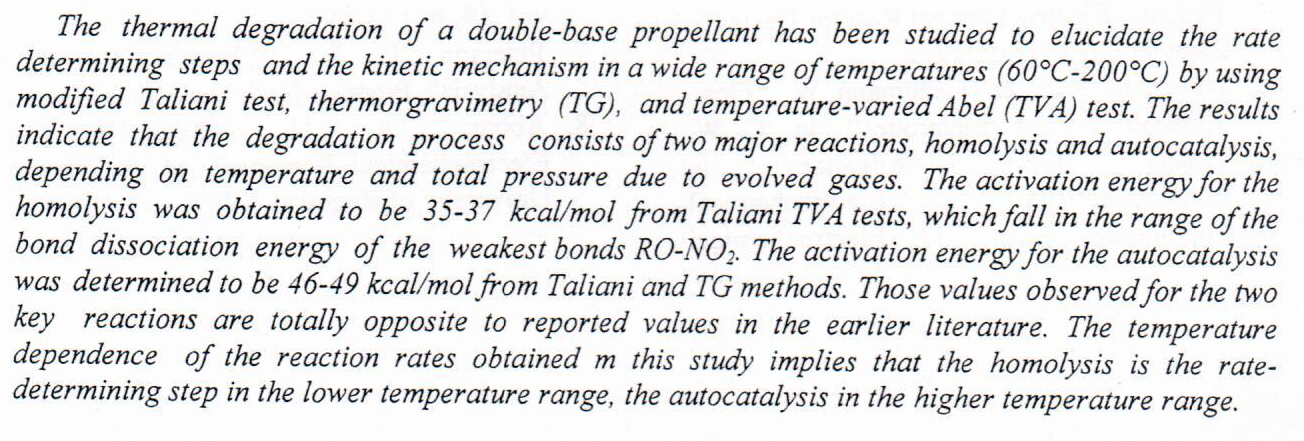
Kinetic Mechanism on Thermal Degradation of a Nitrate Ester Propellant

The study consisted in the development and use of a practical method to detect and
monitor, analyze and produce maps of changes in land use and land cover in the district of
Mahmudiya in Baghdad during the period 1990-2007 using the applications of remote sensing
techniques and with the assisstant of geographic information systems (GIS),as a valuable
contribution to land degradation studies.
This study is based maiuly on the processing on two subsets of landsat5 TM images picked up
in August 1990 and 2007 respectively in order to facilitate comparision and were thengeometrically and radiometrcally calibrated ,to used for digital classification purposes using
maximum liklihoods classification or six spectral bands of
Energy use is second to staffing in building operating costs. Sustainable technology in the energy sector is based on utilizing renewable sources of energy such as solar, wind, glazing systems, insulation. Other areas of focus include heating, ventilation and air conditioning; novel materials and construction methods; improved sensors and monitoring systems; and advanced simulation tools that can help building designers make more energy efficient choices. The objective of this research is studying the effect of insulations on energy consumption of buildings in Iraq and identifying the amount of energy savings from application th
... Show More (1)
(1)

In this work, microbubble dispersed air flotation technique was applied for cadmium ions removal from wastewater aqueous solution. Experiments parameters such as pH (3, 4, 5, and 6), initial Cd(II) ions concentration (40, 80, and 120 mg/l) contact time( 2, 5, 10 , 15, and 20min), and surfactant (10, 20and 40mg/l) were studied in order to optimize the best conditions .The experimental results indicate that microbubbles were quite effective in removing cadmium ions and the anionic surfactant SDS was found to be more efficient than cationic CTAB in flotation process. 92.3% maximum removal efficiency achieved through 15min at pH 5, SDS surfactant concentration 20mg/l, flow rate250 cm3/min and at 40mg/l Cd(II) ions initial co
... Show More
(3)
 (39)
(39)
(39)
(39)

 (9)
(9)
(9)
(9)
The ability of four local fungal isolates for extracellular laccase production has been tested with five grams 1:1(w/v) humidified sawdust as substrate in mineral salt medium. After 21 day of incubation at 25±1 ? C and using one mycelial plug (5mm), higher level of laccase activity (0.15U/ml) and specific activity (15U/mg) were observed by Pleurotus ostreatus in comparison with other fungal isolates. The results of optimum conditions for laccase production from selected isolate showed that, the maximum laccase activity (0.55U/ml) and specific activity (55U/mg) were obtained at moisture ratio 1:3 (w/v), using 3 mycelial plugs (5 mm), after 15 days incubation period at 25±1 ? C. The results of phenol degradation by crud laccase revealed th
... Show More
(2)
In the present study, magnet silica-coated Ag2WO4/Ag2S nanocomposites (FOSOAWAS) were fabricated via a multistep method to address the drawbacks related to single photocatalysts (pure Ag2WO4 and pure Ag2S) and to clarify the significant influence of semiconductor heterojunction on the enhancement of visible-light-driven organic degradation. Different techniques were performed to investigate the elemental composition, morphology, magnetic and photoelectrochemical properties of the fabricated FOSOAWAS photocatalyst. The FOSOAWAS photocatalyst (1 g/L) exhibited excellent photodegradation efficiency (99.5%) against Congo red dye (CR = 20 ppm) after 140 min of visible-light illumination. This result confirmed the ability of the heterojunction be
... Show More
(102)
The catalytic wet air oxidation (CWAO) of phenol has been studied in a trickle bed reactor
using active carbon prepared from date stones as catalyst by ferric and zinc chloride activation (FAC and ZAC). The activated carbons were characterized by measuring their surface area and adsorption capacity besides conventional properties, and then checked for CWAO using a trickle bed reactor operating at different conditions (i.e. pH, gas flow rate, LHSV, temperature and oxygen partial pressure). The results showed that the active carbon (FAC and ZAC), without any active metal supported, gives the highest phenol conversion. The reaction network proposed account
... Show More
(1)
In this study, polymeric coating was developed by incorporating nano graphene in the polymer blend with applications to oil storage tanks. The oil storage tanks samples were brought from the oil Pipeline Company / Doura refinery in Baghdad. The coating polymer was formed with a blend (epoxy resin and repcoat ZR). The proportion of mixing the mixture was 3:1:1 epoxy resin 21.06 gm: repcoat ZR 10.53 gm: hardener 10.53 gm. The blend/graphene was prepared using in stui-polymerization method with different weight percentage 1, 3, 5, and 7 wt % added to blend. The resulting solution was put in a glass tube on a magnetic stirrer for one hour at a temperature of 40 °C. The result of contact angle and water absorption the best ratio of 3wt
... Show More
(2)
This paper presents a comparison study on thermal performance conic cut twist tape inserts in laminar flow of nanofluids through a constant heat fluxed tube. Three tape configurations, namely, quadrant cut twisted tape (QCT), parabolic half cut twisted tape (PCT), and triangular cut twisted (VCT) of twist ratio= 2.93 and cut depth= 0.5 cm were used with 1% and 2% volume concentration of SiO2/water and TiO
... Show More
(9)
(7)