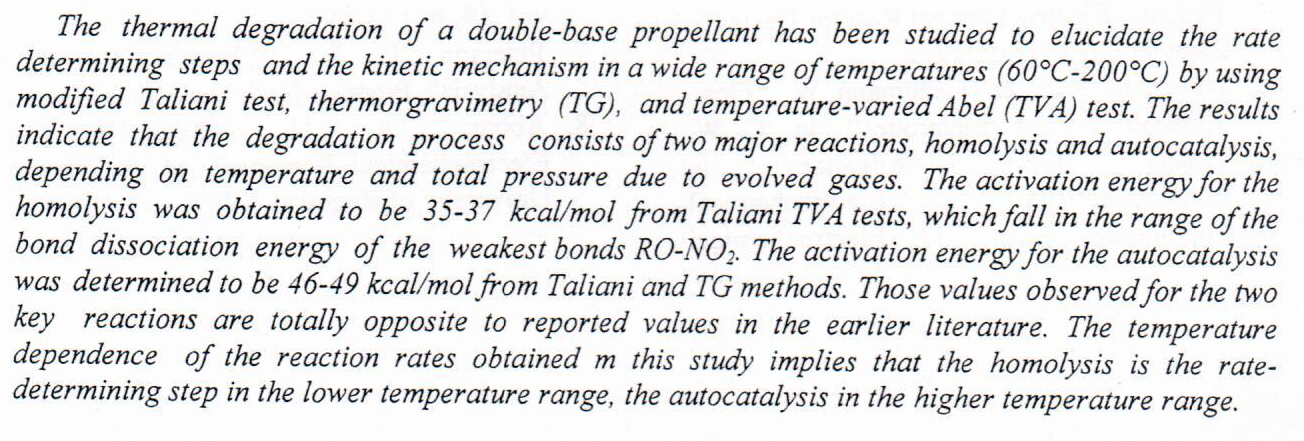
Kinetic Mechanism on Thermal Degradation of a Nitrate Ester Propellant

In this paper, we used two monomers, 3,3',4,4'-benzophenone tetracarboxylic dianhydride (BTDA) and m,m'-diaminobenzophenone (m, m’-DABP), to produce polyamide acid and then converted it to polyimide (PI). The effects of phosphoric acid (H3PO4) molarity (1, 2, and 3 M) on the structural, thermal, mechanical, and electrical characteristics of the polyimides/polyaniline (PI/PANI) nanocomposites were studied. Two sharp reflection peaks were developed by the addition of PANI to PI. When 3 M H3PO4 is added, the crystalline sharp peak loses some of its intensity. The complex formation of PI/PANI-H3PO4 was confi
... Show More (19)
(19)
 (16)
(16)


 (39)
(40)
(62)
(71)
(39)
(40)
(62)
(71)
Low-temperature stratification, high-volumetric storage capacity, and less-complicated material processing make phase-changing materials (PCMs) very suitable candidates for solar energy storage applications. However, their poor heat diffusivities and suboptimal containment designs severely limit their decent storage capabilities. In these systems, the arrangement of tubes conveying the heat transport fluid (HTF) plays a crucial role in heat communication between the PCM and HTF during phase transition. This study investigates a helical coil tube-and-shell thermal storage system integrated with a novel central return tube to enhance heat transfer effectiveness. Three-dimensional computational fluid dynamics simulations compare the proposed d
... Show More
(12)
(13)
(3)
This study focused on the synthesis of novel polymers incorporating the 1,3,4-oxadiazole ring. Four polymers were specifically prepared by blending polymers (6-9) with polyvinyl alcohol (PVA) in defined ratios, resulting in the formation of blended polymers (10-13). The synthesized polymers were characterized using Fourier Transform Infrared (FTIR) spectroscopy and proton nuclear magnetic resonance (1H-NMR). The results showed that the structure aligned with the proposed synthetic polymers. Furthermore, the physical and thermal properties were studied using scanning electron microscopy (SEM), thermogravimetric analysis (TGA) and Differential Scanning Calorimetry (DSC). Additionally, the biological activity was examined against two s
... Show More
This study focused on the synthesis of novel polymers incorporating the 1,3,4-oxadiazole ring. Four polymers were specifically prepared by blending polymers (6-9) with polyvinyl alcohol (PVA) in defined ratios, resulting in the formation of blended polymers (10-13). The synthesized polymers were characterized using Fourier Transform Infrared (FTIR) spectroscopy and proton nuclear magnetic resonance (1H-NMR). The results showed that the structure aligned with the proposed synthetic polymers. Furthermore, the physical and thermal properties were studied using scanning electron microscopy (SEM), thermogravimetric analysis (TGA) and Differential Scanning Calorimetry (DSC). Additionally, the biological activity was examined against two s
... Show More
Three-dimensional cavity was investigated numerical in the current study filled with porous medium from a saturated fluid. The problem configuration consists of two insulated bottom and right wall and left vertical wall maintained at constant temperatures at variable locations, using two discretized heaters. The porous cavity fluid motion was represented by the momentum equation generalized model. The present investigation thermophysical parameters included the local thermal equilibrium condition. The isotherms and streamlines was used to examine energy transport and momentum. The meaning of changing parameters on the established average Nusselt number, temperature and velocity distribution are highlighted and discussed.
(2)
In this study, genetic algorithm was used to predict the reaction kinetics of Iraqi heavy naphtha catalytic reforming process located in Al-Doura refinery in Baghdad. One-dimensional steady state model was derived to describe commercial catalytic reforming unit consisting of four catalytic reforming reactors in series process.
The experimental information (Reformate composition and output temperature) for each four reactors collected at different operating conditions was used to predict the parameters of the proposed kinetic model. The kinetic model involving 24 components, 1 to 11 carbon atoms for paraffins and 6 to 11 carbon atom for naphthenes and aromatics with 71 reactions. The pre-exponential Arrhenius constants and a
... Show More