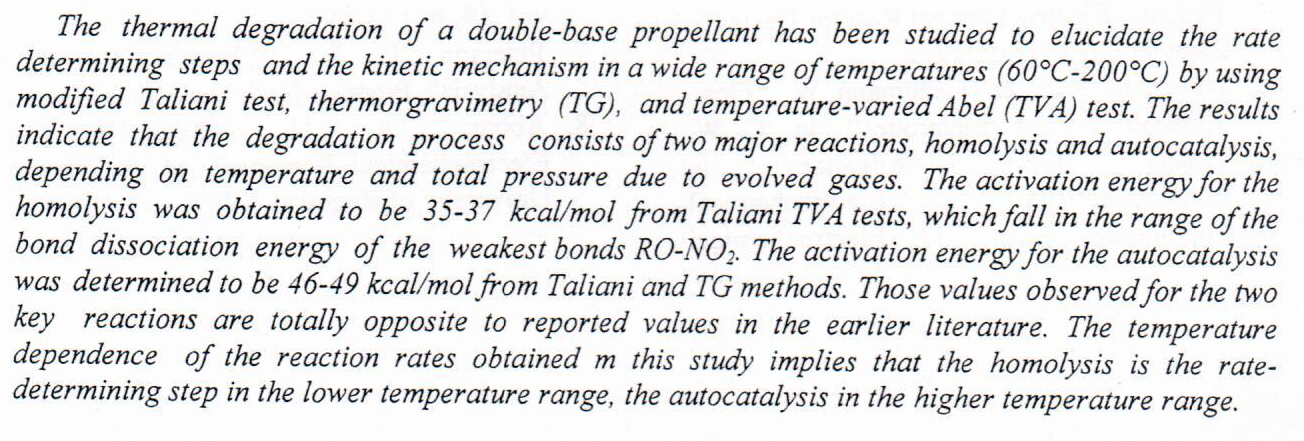
Kinetic Mechanism on Thermal Degradation of a Nitrate Ester Propellant

 (7)
(7)
 (1)
(1)


Influence of combined square nozzle with helical tape inserted in a constant heat flux tube on heat transfer enhancement for turbulent airflow for Reynolds number ranging from 7000 to 14500 were investigated experimentally. Three different pitch ratios for square nozzle (PR = 5.8, 7.7 and 11.6) according to three different numbers of square nozzle (N = 3, 4 and 5) and constant pitch ratios for helical tape were used. The results observed that the Nusselt number and friction factor for combination with winglets were found to be up to 33.8 % and 21.4 %, respectively higher than nozzle alone for pitch ratio PR=5.8. The maximum value of thermal performance for using combination with winglets was about 1.351 for pitch ratio= 5.8. Nusselt numb
... Show More
In this study, high-performance solid polymer electrolytes (SPEs) with different compositions were investigated for next-generation lithium-based energy storage and flexible electronics technology applications. The SPE films were prepared by the solution casting method using hydroxypropyl methylcellulose (HPMC), polyethylene glycol (PEG), and lithium sulfate (Li2SO4 ). The obtained films were flexible and transparent, hence suitable for structural, optical, electrical, and thermal characterizations. The XRD pattern of HPMC indicated a broad peak at 2 theta approximate to 20 degrees, while the films HPMC/PEG- Li2SO4 showed sharp peaks assigned to the crystalline nature of Li2SO4 . Fourier-transform infrared (FTIR) spectra confirmed O-H vibra
... Show More
(3)
This research aims at studying each of the cold and hot thermal wavelengths affecting
Iraq for a minimum climatic course of 11 years beginning from 1992 till 2002. Three stations
were selected including the parts of Iraq surface: Mosul, Baghdad and Basrah.
The wave days were also connected with the related climatic elements represented by
the wind direction and speeds and the relative humidity. It was shown that Iraq is affected by
the rates of hot thermal wave lengths greatly compared to the rates of cold wavelengths. The
results suggested that the highest rate of hot and cold wavelengths recorded over Basra station
was (3.5) days for the cold and (5) days for the hot. While the lowest rates was at Mosul
station
The purpose of this paper is to present an approach to compute accurately the distributions of the frictional heat generated, contact pressure and thermal stresses at any instant during the sliding period (heating phase) of the single-disc friction clutch system works in the dry condition and the complex interaction among them.
Numerical work was achieved using the developed elastic and thermal finite element models (axisymmetric models) to simulate the engagement of the single-disc friction clutch system.
(15)
(15)

In the oil industry, the processing of vacuum residue has an important economic and environmental benefit. This work aims to produce industrial petroleum coke with light fuel fractions (gasoline, kerosene , gas oil) as the main product and de asphalted oil (DAO) as a side production from treatment secondary product matter of vacuum residue. Vacuum residue was produced from the bottom of vacuum distillation unit of the crude oil. Experimentally, the study investigated the effect of the thermal conversion process on (vacuum residue) as a raw material at temperature reaches to 500 °C, pressure 20 atm. and residence time for about 3 hours. The first step of this treatment is constructing a carbon steel batch re
... Show More
(3)
The Iraqi houses flattening the roof by a concrete panel, and because of the panels on the top directly exposed to the solar radiation become unbearably hot and cold during the summer and winter. The traditional concrete panel components are cement, sand, and aggregate, which have a poor thermal property. The usage of materials with low thermal conductivity with no negative reflects on its mechanical properties gives good improvements to the thermal properties of the concrete panel. The practical part of this work was built on a multi-stage mixing plan. In the first stage the mixing ratio based on the ratios of the sand to cement. The second stage mixing ratios based on replacing the coarse aggregate quantities with the
... Show More
ABSTRACT Wound is damage or disruption to the normal anatomical structure and function. Carrageenan is sulphated polysaccharide found in Gigartina, Chondrus and Eucheuma species in the red algal family. Having anticancer, anti-inflammatory and renewal of tissues. Our study aimed to detect the role of kappa carrageenan in the burned skin wound repair. Skin burn were performed in the right and left cheek of 20 male rats (aged 7-8 weeks weighing 300-350 g). Burned skin rats were categorized into two equal groups. Burned areas of right side were treated with a local application of 1 ml of kappa carrageenan solution once daily (treatment group) and the left side receive no treatment (control group). After 5, and 10 days, 5 rats from each
... Show MoreThis research studies the effect of adding micro, nano and hybrid by ratio (1:1) of (Al2O3,TiO2) to epoxy resin on thermal conductivity before and after immersion in HCl acid for (14 day) with normality (0.3 N) at weight fraction (0.02, 0.04, 0.06, 0.08) and thickness (6mm). The results of thermal conductivity reveled that epoxy reinforced by (Al2O3) and mixture (TiO2+Al2O3) increases with increasing the weight fraction, but the thermal conductivity (k) a values for micro and Nano (TiO2) decrease with increasing the weight fraction of reinforced, while the immersion in acidic solution (HCl) that the (k) values after immersion more than the value in before immersion.
(1)
In this study the thermal conductivity of the epoxy composites were characterized as function of volume fraction, particle size of fillers and the time of immersion(30,60,90)days in water .Composites plates were prepared by incorporating (bi-directional) (0º-90º) glass fiber and silicon carbide (SiC) particles of (0.1,0.5,1)mm as particle size at (10%,20%,30%,40%) percent volume in epoxy matrix.
The composites shows slightly increase of the thermal conductivity with increasing volume fraction, particle size and increase with increasing the days of immersion in water. The maximum thermal conductivity (0.51W/m.K) was obtained before the immersion in water at 90 days for epoxy reinforcement by bi-directional glass fiber and SiC particl