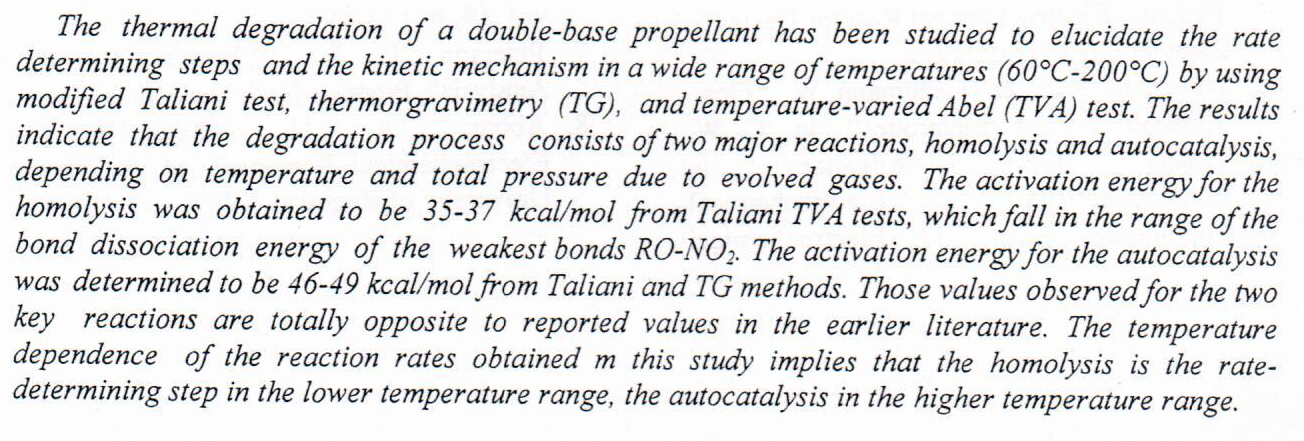
Kinetic Mechanism on Thermal Degradation of a Nitrate Ester Propellant

The hydroisomerization of n-decane was studied on SAPO-11 catalyst. Catalyst of 0.25wt.%Pt/SAPO-11 was prepared locally and used in the present work. The hydroconversion performed in a continuous fixed-bed laboratory reaction unit. Experiments of n-decane isomerization were performed in a temperature range of 200 to 275°C,LHSV range of 0.5-2 h-1, and hydrogen to decane mole ratio of 2.1-8.2. The results show that the n-decane conversion increases with increasing temperature and decreasing LHSV , the maximum conversion 56.77 % was achieved at temperature 275°C and LHSV of 0.5 h-1. The kinetic of n-decane isomerization was also studied and the reaction was first order. The kinetic analysis also showed that the
... Show More (2)
(2)

 (17)
(16)
(17)
(16)

 (21)
(23)
(21)
(23)
This article deals with the impact of including transverse ribs within the absorber tube of the concentrated linear Fresnel collector (CLFRC) system with a secondary compound parabolic collector (CPC) on thermal and flow performance coefficients. The enhancement rates of heat transfer due to varying governing parameters were compared and analyzed parametrically at Reynolds numbers in the range 5,000–13,000, employing water as the heat transfer fluid. Simulations were performed to solve the governing equations using the finite volume method (FVM) under various boundary conditions. For all Reynolds numbers, the average Nusselt number in the circular tube in the CLFRC system with ribs was found to be larger than that of the plain abs
... Show More
(8)
(8)
Thermomechanical analysis (TMA) and differential scanning calorimetry (DSC) are used to investigate the effect of molding and annealing of polyester on the behavior of thermal expansion and crystallization since these factors play role in the reprocessing or recycling of the polymer. The dynamic mode of the TMA provides enhanced characterization information about the polyester since it separates the transitions into reversible and irreversible signals, and also reveals the progress of the amorphous regions as the polyester loses strength with the increasing temperature approaching melting. Slow cooling after annealing brings crystallization that may be attributed to molecular chain straightening due to orientation.
(128)
(125)
(165)
(161)
The earth-air heat exchanger (EHX) has a promising potential to passively save the energy consumption of traditional air conditioning systems while maintaining a high degree of indoor comfort. The use of EHX systems for air conditioning in commercial and industrial settings offers several environmental benefits and is capable of operating in both standalone and hybrid modes. This study tests the performance and effectiveness of an EHX design in a sandy soil area in Baghdad, Iraq. The area has a climate of the subtropical semi-humid type. Ambient air temperatures and soil temperatures were recorded throughout the months of 2021. During the months of January and June, the temperatures of the inlet and outflow air at varying air veloci
... Show More
(17)
(13)
Furfural is one of the one of pollutants in refinery industrial wastewaters. In this study advanced oxidation process using UV/H2O2 was investigated for furfural degradation in synthetic wastewater. The results from the experimental work showed that the degradation of furfural decreases as its concentration increases, reaching 100% at 50mg/l furfural concentration and increasing the concentration of H2O2 from 250 to 500 mg/l increased furfural removal from 40 to 60%.The degradation of furfural reached 100% after 90 min exposure time using two UV lamps, where it reached 60% using one lamp after 240 min exposure time. The rate of furfural degradation k increased at the pH and initial concentratio
... Show MoreA design for a photovoltaic-thermal (PVT) assembly with a water-cooled heat sink was planned, constructed, and experimentally evaluated in the climatic conditions of the southern region of Iraq during the summertime. The water-cooled heat sink was applied to thermally manage the PV cells, in order to boost the electrical output of the PVT system. A set of temperature sensors was installed to monitor the water intake, exit, and cell temperatures. The climatic parameters including the wind velocity, atmospheric pressure, and solar irradiation were also monitored on a daily basis. The effects of solar irradiation on the average PV temperature, electrical power, and overall electrical-thermal efficiency were investigated. The findings i
... Show More
(41)
(37)