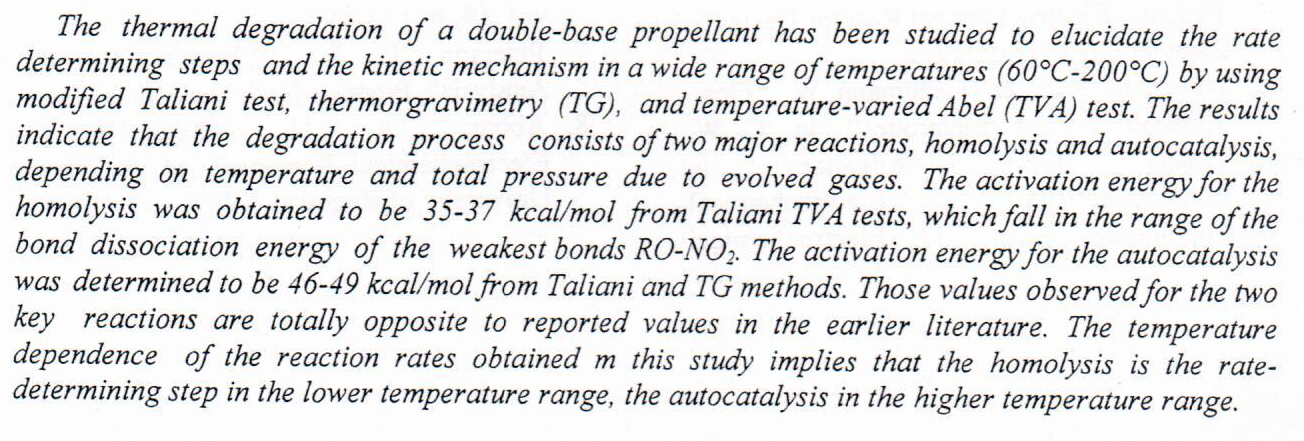
Kinetic Mechanism on Thermal Degradation of a Nitrate Ester Propellant

This paper describes the synthesis of ?- Fe2O3 nanoparticles by sol-gel route using carboxylic acid(2-hydroxy benzoic acid) as gelatin media and its photo activity for degradation of cibacron red dye . Hematite samples are synthesized at different temperatures: 400, 500, 600, 700, 800 and 900 ?C at 700 ?C the ?-Fe2O3 nanoparticles are formed with particle size 71.93 nm. The nanoparticles are characterized by XRD , SEM, AFM and FTIR . The 0.046 g /l of the catalyst sample shows high photo activity at 3x10⁻⁵M dye concentration in acidic medium at pH 3.
 (2)
(2)
 (3)
(3)


This paper presents a computer simulation model of a thermally activated roof (TAR) to cool a room using cool water from a wet cooling tower. Modeling was achieved using a simplified 1-D resistance-capacitance thermal network (RC model) for an infinite slab. Heat transfer from the cooling pipe network was treated as 2-D heat flow. Only a limited number of nodes were required to obtain reliable results. The use of 6th order RC-thermal model produced a set of ordinary differential equations that were solved using MATLAB - R2012a. The computer program was written to cover all possible initial conditions, material properties, TAR system geometry and hourly solar radiation. The cool water supply was considered time
... Show More
(8)
(8)

Four new copolymers were synthesized from reaction of bis acid monomer 3-((4-carboxyphenyl) diazenyl)-5-chloro-2-hydroxybenzoic acid with five diacidhydrazide in presence of poly phosphoric acid. The resulted monomers and copolymers have been characterized by FT-IR, 1H-NMR, 13C-NMR spectroscopy as well as EIMs technique. The number averages of molecular weights of the copolymers are between 4822 and 9144, and their polydispersity indexes are between 1.02 and 2.15. All the copolymers show good thermal stability with the temperatures higher than 305.86 C when losing 10% weight under nitrogen. The cyclic voltammetry (CV) measurement and the electrochemical band gaps (Eg) of these copolymers are found below 2.00 ev.
Wellbore stability is considered as one of the most challenges during drilling wells due to the
reactivity of shale with drilling fluids. During drilling wells in North Rumaila, Tanuma shale is
represented as one of the most abnormal formations. Sloughing, caving, and cementing problems
as a result of the drilling fluid interaction with the formation are considered as the most important
problem during drilling wells. In this study, an attempt to solve this problem was done, by
improving the shale stability by adding additives to the drilling fluid. Water-based mud (WBM)
and polymer mud were used with different additives. Three concentrations 0.5, 1, 5 and 10 wt. %
for five types of additives (CaCl2, NaCl, Na2S
This paper is concerned with finding solutions to free-boundary inverse coefficient problems. Mathematically, we handle a one-dimensional non-homogeneous heat equation subject to initial and boundary conditions as well as non-localized integral observations of zeroth and first-order heat momentum. The direct problem is solved for the temperature distribution and the non-localized integral measurements using the Crank–Nicolson finite difference method. The inverse problem is solved by simultaneously finding the temperature distribution, the time-dependent free-boundary function indicating the location of the moving interface, and the time-wise thermal diffusivity or advection velocities. We reformulate the inverse problem as a non-
... Show More
(4)
(4)
(2)
Phase change materials are known to be good in use in latent heat thermal energy storage (LHTES) systems, but one of their drawbacks is the slow melting and solidification processes. So that, in this work, enhancing heat transfer of phase change material is studied experimentally for in charging and discharging processes by the addition of high thermal conductive material such as copper in the form of brushes, which were added in both PCM and air sides. The additions of brushes have been carried out with different void fractions (97%, 94% and 90%) and the effect of four different air velocities was tested. The results indicate that the minimum brush void fraction gave the maximum heat transfer in PCM and reduced the time
... Show MoreThermal conductivity measurement was done for specimens of Polystyrene/ titanium dioxide, Polycarbonate/ titanium dioxide and Polymethylmetha acrylate/ titanium dioxide composites for weight ratio of 1.9/ 0.1 and 1.8/ 0.2 wt% for different thickness of the samples. The experimental results show that the thermal conductivity is increased with the increasing of thickness of layers and with the weight ratio of TiO2
تتضمن إزالة الكبريت إزالة مركبات الكبريت العضوية من زيوت الوقود. في هذه الدراسة، تم استخدام تقنية البلازما اللاحرارية وتقنية البلازما بمساعدة بيروكسيد الهيدروجين لاكسدة الوقود المحتوي على مركبات من benzothiophene و dibenzothiophene. تم إجراء تفاعل الأكسدة باستخدام منظومة dielectric barrier discharge لتوليد بلازما غير حرارية. النتائج أظهرت ان تقنية البلازما ومزيج من البلازما مع بيروكسيد الهيدروجين معًا لأكسدة BT و DBT. تتبعان pseudo-
... Show More
(7)
(3)