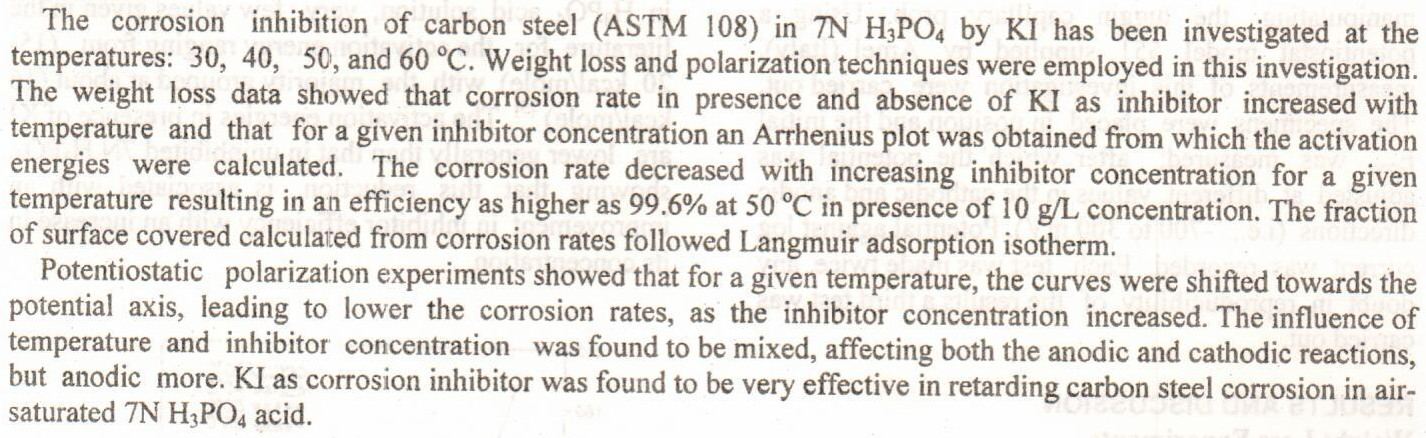
The Influence of Temperature on Corrosion Inhibition of Carbon Steel in Air-Saturated 7NH3PO4 by Potassium Iodide

This article presents the simultaneous adsorption of bimetal Cu2+ and Zn2+ from an aqueous solution using activated carbon synthesized from a plum seed precursor by sulfuric acid and microwave activation: plum seeds chemically activated by 45% (w/w) sulfuric acid with 2:1 ratio for 4 h, then carbonized for 2 h at 700 °C and the product obtained activated in a microwave oven for 20 min at 700 W for final of activation. Plum seeds and activated carbon produced were characterized in terms of their physical and chemical composition using Brunauer–Emmett–Teller measurements, field emission scanning electr
... Show More (2)
(2)
 (1)
(1)



Pharmaceuticals have been widely remaining contaminants in wastewater, and diclofenac is the most common pharmaceutical pollutant. Therefore, the removal of diclofenac from aqueous solutions using activated carbon produced by pyrocarbonic acid and microwaves was investigated in this research. Apricot seed powder and pyrophosphoric acid (45 wt%) were selected as raw material and activator respectively, and microwave irradiation technique was used to prepare the activated carbon. The raw material was impregnated in pyrophosphoric acid at 80◦C with an impregnation ratio of 1: 3 (apricot seeds to phosphoric acid), the impregnation time was 4 h, whereas the power of the microwave was 700 watts with a radiation time of 20 min. A series o
... Show More
(19)
Accurate description of thermodynamic, structural, and electronic properties for bulk and surfaces of ceria (CeO2) necessitates the inclusion of the Hubbard parameter (U) in the density functional theory (DFT) calculations to precisely account for the strongly correlated 4f electrons. Such treatment is a daunting task when attempting to draw a potential energy surface for CeO2-catalyzed reaction. This is due to the inconsistent change in thermo-kinetics parameters of the reaction in reference to the variation in the U values. As an illustrative example, we investigate herein the discrepancy in activation and reaction energies for steps underlying the partial and full hydrogenation of acetylene over the CeO2(111) surface. Overall, we find th
... Show More
(1)
(1)
Increasing the variety of products that are being designed with sculptured surfaces, efficient machining of these surfaces has become more important in many manufacturing industries. The objective of the present work is the investigation of milling parameters for the sculptured surfacesthat effecting of surface roughness during machining of Al-alloy. The machining operation implemented on C-TEK CNC milling machine. The influence of the selected variables on the chosen characteristics have been accomplished using Taguchi design approach, also ANOVA had been utilized to evaluate the contributionsof each parameter on proc
... Show MoreThe influence of sensing element length of no-core fiber strain sensor has been studied and experimentally demonstrated, four different lengths of 125 μm diameter no-core fiber is fused between two standard single-mode fibers and bi-directionally strained, the highest obtained sensitivity was around 16.37 pm με -1 which was exhibited in the shortest no-core fiber segment, to the best of our knowledge this is the first study of the influence of no-core fiber strain sensors length on sensor sensitivity. The proposed sensor can be used in many opto-mechanical applications such as, structural health monitoring, aerospace vehicles and airplane components monitoring.
Iraqi provinces suffer many of the environmental problems, appear explained these problems in the city of Basra, Basra, the largest province and is among Iraq's provinces in the annexation of oil fields, which is experiencing an oil production operations of large, it suffers from the burning of gas associated with oil extraction resulting in the emission severe gas process including toxic hydrogen sulfide gas (h2S) and oxides of carbon, sulfur and nitrogen in addition to the release of toxic metal elements such as mercury, arsenic, vanadium, which caused the man many serious diseases. , And perhaps one of the most important of these problems are worsening air quality and increasing cases of air pollution and the deterioration of the qual
... Show MoreInSb alloy was prepared then InSb:Bi films have been prepared successfully by thermal evaporation technique on glass substrate at Ts=423K. The variation of activation energies(Ea1,Ea2)of d.c conductivity with annealing temperature (303, 373, 423, 473, 523 and 573)K were measured, it is found that its values increases with increasing annealing temperature. To show the type of the films, the Hall and thermoelectric power were measured. The activation energy of the thermoelectric power is much smaller than for d.c conductivity and increases with increasing annealing temperature .The mobility and carrier concentration has been measured also.