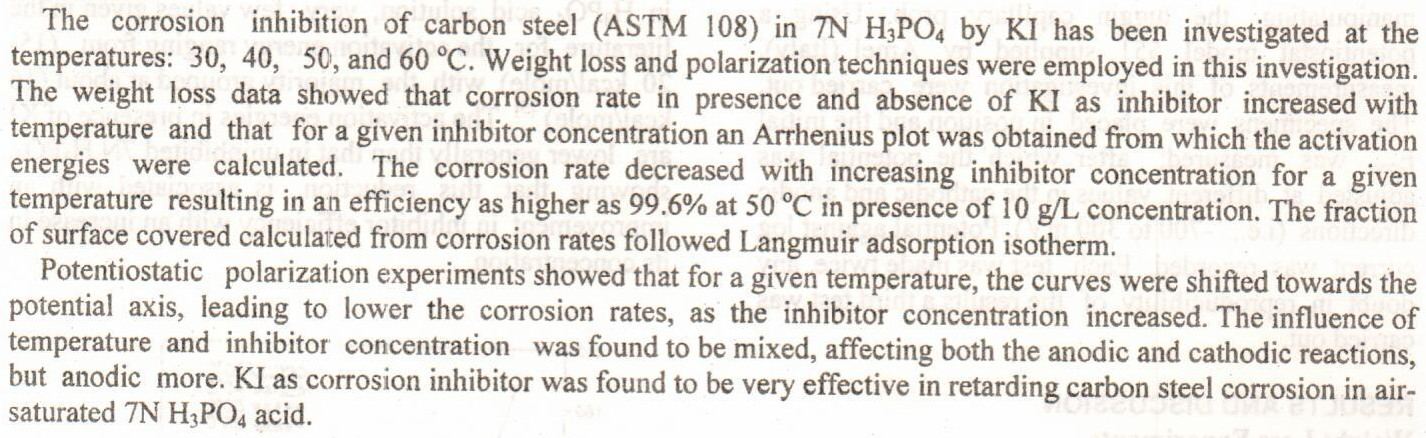
The Influence of Temperature on Corrosion Inhibition of Carbon Steel in Air-Saturated 7NH3PO4 by Potassium Iodide

This research deals with the effects of welding variables using MIG/MAG spot by using Argon (Ar) gas and CO2 to show their effect on the mechanical characteristics and microstructure of low alloy steel type DIN15Mo3 and determine the optimum condition for the process of welding ; current & time. The results show the possibility of using CO2 and also Ar in low alloy steel welding with a little decrease in the shear force of not more than 13% for 4mm thickness and time 2sec. The shear force increased when using Ar instead of CO2 to be , The shear force reach 36KN when using Ar at 2mm thickness time of 8 sec and current of 220 Amp. , when used CO2 instead of Ar d
... Show MoreAbstract
Machining residual stresses correlate very closely with the cutting parameters and the tool geometries. This research work aims to investigate the effect of cutting speed, feed rate and depth of cut on the surface residual stress of steel AISI 1045 after face milling operation. After each milling test, the residual stress on the surface of the workpiece was measured by using X-ray diffraction technique. Design of Experiment (DOE) software was employed using the response surface methodology (RSM) technique with a central composite rotatable design to build a mathematical model to determine the relationship between the input variables and the response. The results showed that both
... Show More (13)
(13)
 (8)
(8)



been taken at room temperature down to liquid nitrogen temperature (77K). Polar and nonpolar solvents have been used to study the solvent effect on the absorption and fluorescence spectra of solute molecules. Some of the spectroscopic parameters have been determined as functions of solvent polarity and temperature. The results indicate that the band width FWHM increases with increasing the solvent polarity and temperature, while the peak emission cross section decreases with increasing of solvent polarity and decreases with increasing the temperatures. Clear vibrational structure spectra of benzoanthracene molecules have been observed in Nonane and Hexane solvents at 77K.
Nano gamma alumina was prepared by double hydrolysis process using aluminum nitrate nano hydrate and sodium aluminate as an aluminum source, hydroxyle poly acid and CTAB (cetyltrimethylammonium bromide) as templates. Different crystallization temperatures (120, 140, 160, and 180) 0C and calcinations temperatures (500, 550, 600, and 650) 0C were applied. All the batches were prepared at PH equals to 9. XRD diffraction technique and infrared Fourier transform spectroscopy were used to investigate the phase formation and the optical properties of the nano gamma alumina. N2 adsorption-desorption (BET) was used to measure the surface area and pore volume of the prepared nano alumina, the particle size and the
... Show MoreA polycrystalline CdTe film has been prepared by thermal evaporation technique on glass substrate at substrate temperature 423 K with 1.0 m thicknesses. The film was heated at various annealing temperature under vacuum (Ta =473, 523 and K). Some of physical properties of prepared films such as structural and optical properties were investigated. The patterns of X-ray diffraction analysis showed that the structure of CdTe powder and all films were polycrystalline and consist of a mixture of cubic and hexagonal phases and preferred orientation at (111) direction.
The optical measurements showed that un annealed and annealed CdTe films had direct energy gap (Eg). The Eg increased with increasing Ta. The refractive index and the real p
Free cement refractory concrete is a type of refractory concrete with replacing alumina cement by bonding materials such as white kaolin, red kaolin and fumed silica. The free cement refractory concrete used in many applications like Petrochemicals, iron furnaces and cement production industries. The research clarifies the effect of steel fibers with two types crimped steel fibers and hooked steel
fibers with percentages 0.5%, 1% and 1.5% by volume from weight of bauxite aggregates. The additions of steel fibers with two types gave good properties in high temperatures where the specimens keep the dimension without failure and the properties made the best. the percentage of increasing for thermal conductivity was 44% for 1.5% crimped
(6)
Abstract
Experimental work from Magnetic Abrasive Finishing (MAF) tests was carried out design parameters (amplitude, and number of cycle which are formed the shape of electromagnetic pole), and technological parameters (current, cutting speed, working gap, and finishing time) all have an influence on the mechanical properties of the surface layer in MAF process. This research has made to study the effect of design and technological parameters on the surface roughness (Ra), micro hardness (Hv) and material removal (MR) in working zone. A set of experimental tests has been planned using response surface methodology according to Taguchi matrix (36) with three levels and six factors
... Show MoreThis work aimed to use effective, low-cost, available, and natural adsorbents like eggshells for removal of hazardous organic dye result from widely number of industries and study the influence of different eggshell particle size (75, 150) Mm. The adsorbent was characterized by SEM, EDX, BET and FTIR . The initial pH of dye solutions varying from 4 to 10 , the initial concentrations of methyl violet (MV) 2B range (20-80) mg/L, dosage range (0.5-10) g, contact time (30-180) min, and particles size of the adsorbent (75, 150) Mm were selected to be studied. Two adsorption isotherms models have been used to fit the experimental data. Langmuir and Freunlich models were found to more represent the experiments with high
... Show MoreImproving the permanent deformation resistance of asphalt pavements is a vital challenge. Nanomaterials have emerged as promising additives due to their ability to enhance the binder stiffness and elasticity. This study evaluated the influence of five nanomaterials, namely Nano-Silica (NS), Nano-Alumina (NA), Nano-Zinc (NZ), Nano-Titanium (NT), and Carbon Nanotubes (CNTs) incorporated into a base asphalt binder at varying dosages, with up to 10% for NS, NA, and NT, and up to 5% for NZ and CNT. Fifteen modified binders were assessed using the Multiple Stress Creep Recovery (MSCR) test to obtain non-recoverable creep compliance (Jnr), while the corresponding hot mix asphalt samples underwent repeated load testing and rut depth predict
... Show More
(2)