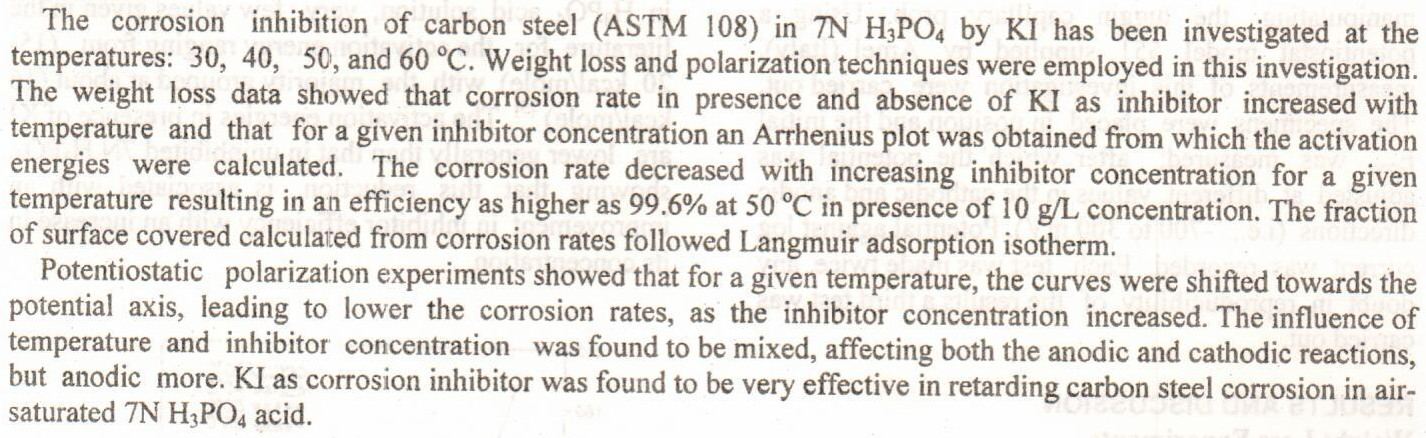
The Influence of Temperature on Corrosion Inhibition of Carbon Steel in Air-Saturated 7NH3PO4 by Potassium Iodide




Radiotherapy is medical use of ionizing radiation, and commonly applied to the cancerous tumor because of its ability to control cell growth. The amount of radiation used in photon radiation therapy called dose (measured in grey unit), which depend on the type and stage of cancer being treated. In our work, we studied the dose distribution given to the tumor at different depths (zero-20 cm) treated with different field size (4×4- 23×23 cm). Results show that the deeper treated area has less dose rate at the same beam quality and quantity. Also it has been noted increasing in the field increasing in the depth dose at the same depth even if the radiation energy is constant. Increasing in radiation dose attributed to the scattere
... Show MoreThe behavior corrosion inhibition of aluminum alloy (Al6061) in acidic (0.1 M HCl) and saline (3.5% NaCl) solutions was investigated in the absence and the presence of expired diclofenac sodium drug (DSD) as a corrosion inhibitor. The influence of temperature and was studied using electrochemical techniques. In addition, scanning electron microscopy (SEM) was used to study the surface morphology. The results showed that DSD acted as a powerful inhibitor in acidic solutions, while a moderate influence was observed with saline one. Maximum inhibition efficiency was 99.99 and 83.32% in acidic and saline solutions at 150 ppm of DSD, respectively. Corrosion current density that obtained using electrochemical technique was increased with temperat
... Show More (47)
(47)
 (42)
(2)
(42)
(2)
This work consists of a numerical simulation to predict the velocity and temperature distributions, and an experimental work to visualize the air flow in a room model. The numerical work is based on non-isothermal, incompressible, three dimensional, k turbulence model, and solved using a computational fluid dynamic (CFD) approach, involving finite volume technique to solve continuity, momentum and energy equations, that governs the room’s turbulent flow domain. The experimental study was performed using (1/5) scaled room model of the actual dimensions of the room to simulate room air flow and visualize the flow pattern using smoke generated from burnt herbs and collected in a smoke generator to delivered through
... Show More
In present work examined the oxidation desulfurization in batch system for model fuels with 2250 ppm sulfur content using air as the oxidant and ZnO/AC composite prepared by thermal co-precipitation method. Different factors were studied such as composite loading 1, 1.5 and 2.5 g, temperature 25 oC, 30 oC and 40 oC and reaction time 30, 45 and 60 minutes. The optimum condition is obtained by using Tauguchi experiential design for oxidation desulfurization of model fuel. the highest percent sulfur removal is about 33 at optimum conditions. The kinetic and effect of internal mass transfer were studied for oxidation desulfurization of model fuel, also an empirical kinetic model was calculated for model fuels
... Show More
(1)
One of the most important parameters determining structural members' durability and strength is the fire flame's influence and hazard. Some engineers have advocated using advanced analytical models to predict fire spread impact within a compartment and considering finite element models of structural components to estimate the temperatures within a component using heat transfer analysis. This paper presented a numerical simulation for a reinforced concrete beam’s structural response in a case containing Water Absorbing Polymer Spheres (WAPS) subjected to fire flame effect. The commercial finite element package ABAQUS was considered. The relevant geometrical and material parameters of the reinforced concrete beam model a
... Show More
(3)
One of the most important parameters determining structural members' durability and strength is the fire flame's influence and hazard. Some engineers have advocated using advanced analytical models to predict fire spread impact within a compartment and considering finite element models of structural components to estimate the temperatures within a component using heat transfer analysis. This paper presented a numerical simulation for a reinforced concrete beam’s structural response in a case containing Water Absorbing Polymer Spheres (WAPS) subjected to fire flame effect. The commercial finite element package ABAQUS was considered. The relevant geometrical and material parameters of the reinforced concrete beam model at elevated t
... Show More