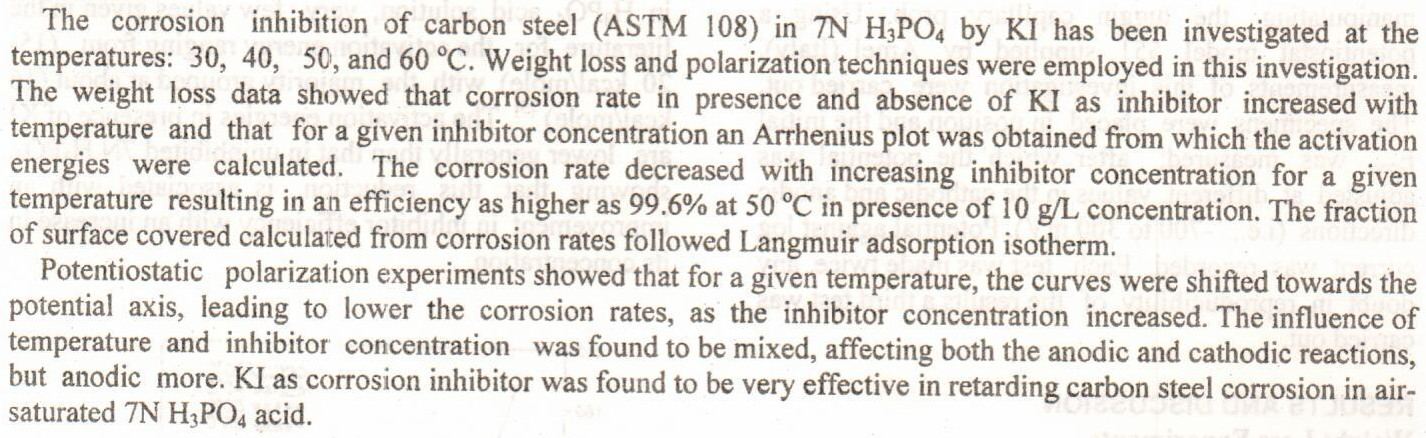
The Influence of Temperature on Corrosion Inhibition of Carbon Steel in Air-Saturated 7NH3PO4 by Potassium Iodide

Aeromonas hydrophila have been isolated as a cause of a cute gastroenteritis in 23 (5.6%) of 410 patients. Other bacterial enteropathogens have been isolated from 387 patients with diarrhea, were 19 different strains. A. hydrophila occurred more commonly in children with acute diarrhea, the results showed that 18(78.26%) isolates of A. hydrophila found in children under 10 years old ,distributed to 10(43.47%) in male and 8(34.78%) in female ,and in adults with diarrhea 5 (21.73%). In the other hand, we noticed frequency of isolation was higher in male 14(60.86%) when compared with 9(39.14%) in female. Six strains of A. hydrophila have been observed to have bacteriocin activity against 12 of 23 different A. hydrophila ,as well as Staphy
... Show More
This work was conducted to study the treatment of industrial waste water, and more particularly those in the General Company of Electrical Industries.This waste water, has zinc ion with maximum concentration in solution of 90 ppm.
The reuse of such effluent can be made possible via appropriate treatments, such as chemical coagulation, Na2S is used as coagulant.
The parameters that influenced the waste water treatment are: temperature, pH, dose of coagulant and settling time.
It was found that the best condition for zinc removal, within the range of operation used ,were a temperature of 20C a pH value of 13 , a coagulant dose of 15 g Na2S /400ml solution and a settling time of 7 days. Under these conditions the zinc concentrat


 (1)
(1)
An experimental program was conducted to determine the residual of composite Steel Beams-Reinforced Concrete (SB-RC) deck floors fabricated from a rolled steel beam topped with a reinforced concrete slab, exposed to high temperatures (fire flame) of 300, 500, and 700ºC for 1 hour, and then allowed to cool down by leaving them in the lab condition to return to the ambient temperature. The burning results showed that, by exposing them to a fire flame of up to 300ºC, no serious permanent deflection occurred. It was also noticed that the specimen recovered 93% of 19.2 mm of the deflection caused by burning. The recovered deflection of burned composite SB-RC deck floor at 500ºC was 40% of 77.9 mm of the deflection caused by burning with a res
... Show More
(80)
 (82)
(82)
High smoke emissions, nitrogen oxide and particulate matter typically produced by diesel engines. Diminishing the exhausted emissions without doing any significant changes in their mechanical configuration is a challenging subject. Thus, adding hydrogen to the traditional fuel would be the best practical choice to ameliorate diesel engines performance and reduce emissions. The air hydrogen mixer is an essential part of converting the diesel engine to work under dual fuel mode (hydrogen-diesel) without any engine modification. In this study, the Air-hydrogen mixer is developed to get a homogenous mixture for hydrogen with air and a stoichiometric air-fuel ratio according to the speed of the engine. The mixer depends on the balance between th
... Show More
(4)
(3)
The physical substance at high energy level with specific circumstances; tend to behave harsh and complicated, meanwhile, sustaining equilibrium or non-equilibrium thermodynamic of the system. Measurement of the temperature by ordinary techniques in these cases is not applicable at all. Likewise, there is a need to apply mathematical models in numerous critical applications to measure the temperature accurately at an atomic level of the matter. Those mathematical models follow statistical rules with different distribution approaches of quantities energy of the system. However, these approaches have functional effects at microscopic and macroscopic levels of that system. Therefore, this research study represents an innovative of a wi
... Show More
This study investigates the implementation of Taguchi design in the estimation of minimum corrosion rate of mild-steel in cooling tower that uses saline solution of different concentration. The experiments were set on the basis of Taguchi’s L16 orthogonal array. The runs were carried out under different condition such as inlet concentration of saline solution, temperature, and flowrate. The Signal-to- Noise ratio and ANOVA analysis were used to define the impact of cooling tower working conditions on the corrosion rate. A regression had been modelled and optimized to identify the optimum level for the working parameters that had been founded to be 13%NaCl, 35ᴼC, and 1 l/min. Also a confirmation run to establish the p
... Show More
(7)
Hydrophobic silica aerogels were successfully preparation by an ambient pressure drying method from sodium silicate (Na2SiO3) with different pH values (5, 6, 7, 8, 9 and 10). In this study, acidic HCl (1M), a basic NH4OH (1M) were selected as a catalyst to perform the surface modification in a TMCS (trimethylchlorosilane) solution. The surface chemical modification of the aerogels was assured by the Fourier transform infrared (FTIR) spectroscopic studies. Other physical properties, such as pore volume and pore size and specific surface area were determined by Brunauer-Emmett- Teller (BET) method. The effect of pH values on the bulk density of aerogel. The sol–gel parameter pH value in the sol, have marked effects on the physical proper
... Show More