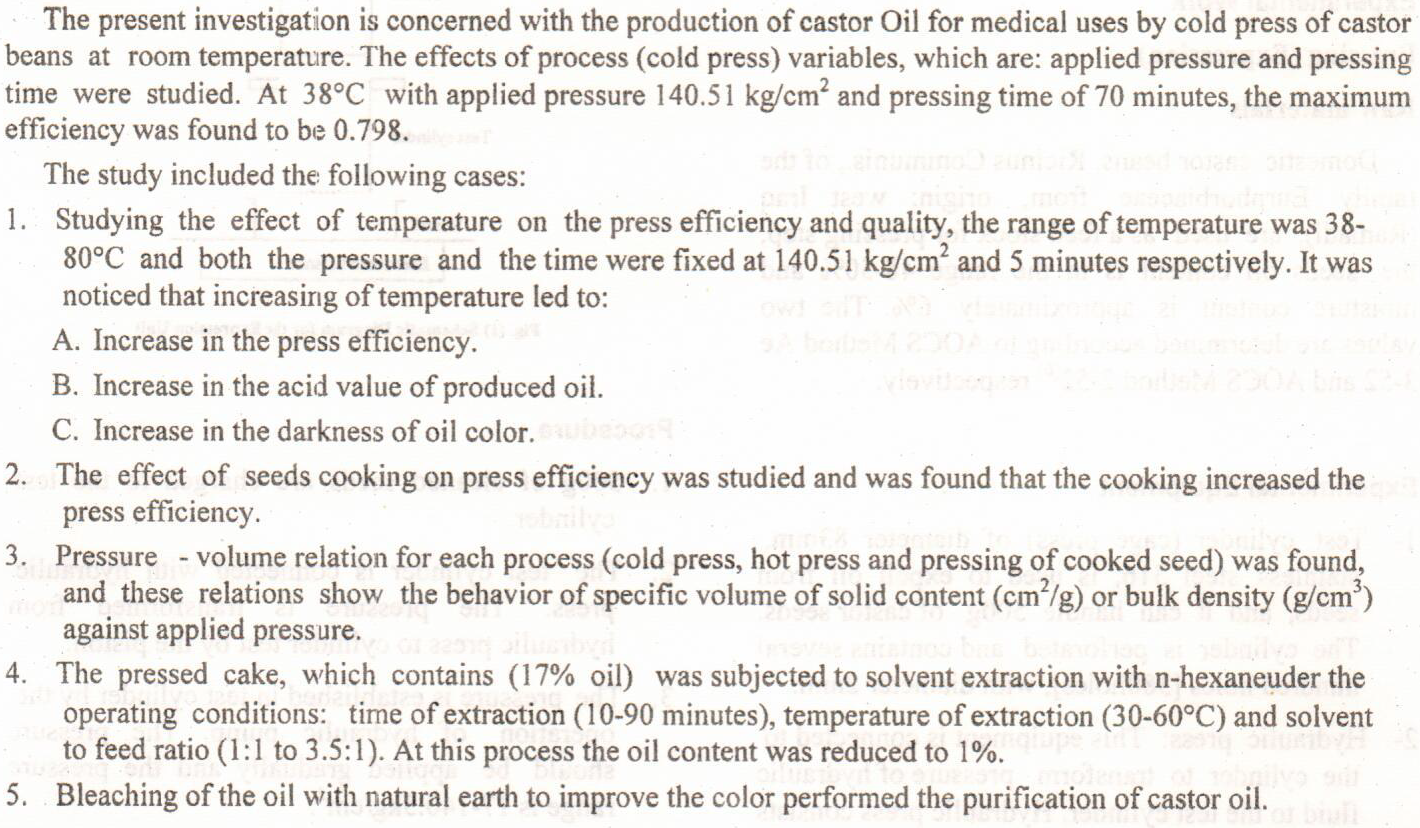
Production of Castor Oil for Medical Uses

Drilling with casing (DWC) can be considered as a modern drilling technique in which both of drilling and casing operations done in the same time by using the casing to transfer the hydraulic and mechanical power to the bit instead of traditional drilling string. To overcome oil well control, minimizing the total cost through enhancing drilling efficiency, drilling with casing was proposed as an enabling technology.
Two surface sections (17 1/2 - and 12 1/4- inch) were drilled successfully in Rumaila oil field with casing strings which reached 655m and 1524m measured depths respectively.
By using DWC technique, the total drill/case phase time was reduced up to 20% comparing to conventional
... Show MoreOil from Brassca campestris (local variety) was extracted with hexane using Soxhlet. The extracted oil was characterized and its antimicrobial activity was determined as well. The content of extracted oil was 40% with 0.5% of volatile oil .Oil was immiscible with polar solvent such as ethanol, acetone and water, while it was easily miscible with chloroform due to its hydrophobicity. The result of organoleptic tests revealed that the oil is clear yellow in color and odorless with acceptable taste. The oil was stable at 4 -25 C? for a month. Refractive index (RI) of oil was 1.4723 with density of 0.914, [both at 4-25 C?]. Boiling point 386 C?. Infra red spectroscopy (IR) indicated the presence of different chemical groups (C=C
... Show More
|
Background: Essential oils extracted from plants have been widely used in antimicrobial activity, particularly the Callistemon viminalis, with a high number of essential oils extracted. Objectives: To identify the chemical composition of essential oil derived from Callistemon viminalis and evaluates its antimicrobial activity against selected bacterial and fungal strains. Subjects and methods: During the study, the antimicrobial activity of different selected essential oils on some bacteria (Escherichia coli, Pseudomonas aeruginosa, Salmonella enteritidis, Staphylococcus aureus, and Streptococcus pneumonia) and fungus (Candida albicans) was evalua |
 (2)
(2)
 (1)
(1)
 (12)
(9)
(12)
(9)

For the most reliable and reproducible results for calibration or general testing purposes of two immiscible liquids, such as water in engine oil, good emulsification is vital. This study explores the impact of emulsion quality on the Fourier transform infrared (FT-IR) spectroscopy calibration standards for measuring water contamination in used or in-service engine oil, in an attempt to strengthen the specific guidelines of ASTM International standards for sample preparation. By using different emulsification techniques and readily available laboratory equipment, this work is an attempt to establish the ideal sample preparation technique for reliability, repeatability, and reproducibility for FT-IR analysis while still considering t
... Show More
(12)
(11)
The Gas Assisted Gravity Drainage (GAGD) process has become one of the most important processes to enhance oil recovery in both secondary and tertiary recovery stages and through immiscible and miscible modes. Its advantages came from the ability to provide gravity-stable oil displacement for improving oil recovery, when compared with conventional gas injection methods such as Continuous Gas Injection (CGI) and Water – Alternative Gas (WAG). Vertical injectors for CO2 gas were placed at the top of the reservoir to form a gas cap which drives the oil towards the horizontal oil producing wells which are located above the oil-water-contact. The GAGD process was developed and tested in vertical wells to increase oil r
... Show More
(8)
(5)
The study aims at showing the effect of basil oil on the sensory properties of the laboratory biscuits. the results show the sensory valuation before and after the storage. the (A4) equation exceeds 15% of T exchange (3 , 4 , 5 g. basil 19 , 55 g . fats )in most of the studied sensuous qualities. Then, the (A5) equation of 20% exchange percentage (4.60g. basil oil + 18.40g. fats). Then, the (A3) equation of 10% exchange percentage (2.30g. basil oil + 20.70g. fats). Then the (A2) equation of 5% exchange percentage (1.5g. basil oil + 21.85g. fats). Finally, the control equation (A1) received the lower value of sensuous evaluation and general acceptance. Abstract differences also appeared at denotation level 0.05 between the (A2)
... Show More
The antimicrobial activity of ginger extracts ( cold-water, hot-water, ethanolic and essential oil ) against some of pathogenic bacteria ( Escherichia coli , Salmonella sp , Klebsiella sp , Serratia marcescens, Vibrio cholerae , Staphylococcus aureus , Streptococcus sp) was investigated using Disc diffusion method , and the results were compared with the antimicrobial activity of 12 antibiotics on the same bacteria . The results showed that the ginger extracts were more effective on gram-positive bacteria than gram-negative . V. cholerae and S. marcescens,were the most resistant bacteria to the extracts used , while highest inhibition was noticed against Streptococcus sp (28 mm) . The ethanolic extract showed the broadest antibacterial ac
... Show More
(7)