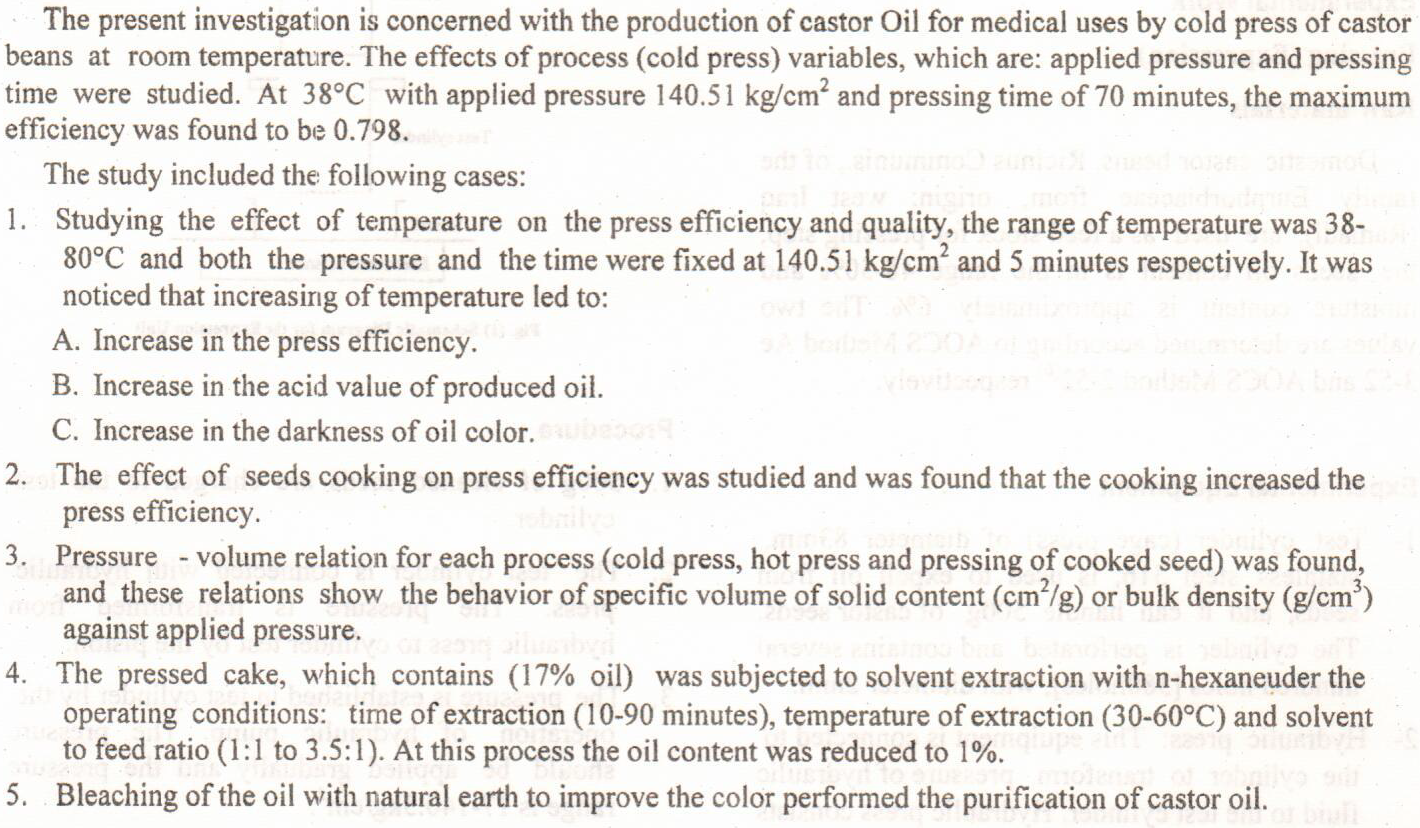
Production of Castor Oil for Medical Uses

In this study, oxidative desulfurization of dibenzothiophene (DBT) with H2O2 as an oxidant was studied, whereas the catalyst used was zirconium oxide supported on Activated carbon (AC). Zirconium oxide (ZrO2) was impregnated over prepared activated carbon (AC) and characterized by various techniques such as XRD, FTIR, BET, SEM, and EDX. This composite was used as a heterogeneous catalyst for oxidation desulfurization of simulated oil. The results of this study showed that ZrO2/AC composite exhibited significant catalytic activity and stability, effectively lowering sulfur content under mild conditions. Factors such as reaction temperature (30, 40, 50, 60°C), time (5, 10, 15,20,30,60, 80 100 min), catalyst dose (0.3, 0.5,
... Show More
Naturally occurring radioactive materials (NORM) contaminated sites at Al-Rumaila Iraqi oil fields have been characterized as a part of soil remediation project. Activity of radium isotopes in contaminated soil have been determined using gamma spectrometer High Purity Germanium detector (HPGe) and found to be very high for Al-Markezia, Al-Qurainat degassing stations and storage area at Khadhir Almay region. The activity concentration of samples ranges from 6474.11±563.8 Bq/kg to 1232.5±60.9 Bq/kg with mean value of 3853.3 Bq/kg for 226Ra, 843.59±8.39 Bq/kg to 302.2±9.2 Bq/kg with mean value of 572.9 Bq/kg for 232Th and 294.31±18.56 Bq/kg to 156.64±18.1 Bq/kg with mean value of 225.5 for 40K. S
... Show MoreSadi formation is one of the main productive formations in some of Iraqi oil fields. This formation is characterized by its low permeability values leading to low production rates that could be obtained by the natural flow.
Thus, Sadi formation in Halfaya oil field has been selected to study the success of both of "Acid fracturing" and "Hydraulic fracturing" treatments to increase the production rate in this reservoir.
In acid fracturing, four different scenarios have been selected to verify the effect of the injected fluid acid type, concentration and their effect on the damage severity along the entire reservoir.
The reservoir damage severity has been taken as "Shallow–Medium– Sever
... Show MorePermeability is one of the essential petrophysical properties of rocks, reflecting the rock's ability to pass fluids. It is considered the basis for building any model to predict well deliverability. Yamama formation carbonate rocks are distinguished by sedimentary cycles that separate formation into reservoir units and insulating layers, a very complex porous system caused by secondary porosity due to substitute and dissolution processes. Those factors create permeability variables and vary significantly. Three ways used for permeability calculation, the firstly was the classical method, which only related the permeability to the porosity, resulting in a weak relationship. Secondly, the flow zone indicator (FZI) was divided reservoir into
... Show More (9)
(9)
 (4)
(4)

Binary mixtures of three heavy oil-stocks had been subjected to density measurments. The data had been aquired on the volumetric behaviour of these systems. The heavy oil-stocks used were of good varity, namely 40 stock , 60 stock, and 150 stock, 40 stock is the lightest one with the API gravity 33.7 while 60 stock is middle type and 150 stock is heavy one, with API gravity 27.7 and 23.8 respectively. Stocks with Kerosene or Xylene for non-ideal mixtures for which excess volume can be positive or negative. Mixture of heavy-oil stocks with paraffinic spike (Kerosene) show negative excess volume. While, aromatic rings results a lower positive excess volume, as shown in Xylene when blending with 40 stock and 60 stock but a negati
... Show MoreThe Mishrif reservoir (Cenomanian - Turonian) in the Z, H, B and N oilfields in southern Iraq was investigated to clarify how nickel, vanadium, asphaltene, NSO and sulfur content affect the crude oil quality. The GC-Mass and ICP-MS analyses were used to provide fruitful hydrocarbon results. Classification of crude oil based on API gravity broadly indicates the oil's density and general properties. Typically, lighter crude oils are easier to refine, yield higher percentages of valuable products such as gasoline and diesel, and have a higher market value. Heavier crude oils require more processing and may yield more residual products, such as heavy fuel oil and asphalt. The Mishrif crude oil was classified as a medium sour crude oil c
... Show More
(11)
(2)
Results of the current study demonstratedthat out of eighty-three isolatesof Pseudomonas aeruginosa,only twenty-five isolateswere resistant to five different antibiotics (of different classes) that were consequentlyconsideredmultidrug resistant isolates.These isolates developed variable susceptibility toward Eucalyptuscamaldulensisleavesoil (ECO). GC-MS analysis of ECOrevealed that the aromatic oil eugenol is the major constituent.However, the most frequent MIC was 0.39 µg/ml, while the lowest frequent MIC was 3.125 µg/ml.Moreover, this oil at ½ MIC (0.195µg/ml) increased the gene expression of exoU. Itis concluded from the outcomes of the studythat ECOmay cause severe damagewhen used to treat infections caused by P. aeruginosa.
... Show More
(1)
The petroleum sector has a significant influence on the development of multiphase detection sensor techniques; to separate the crude oil from water, the crude oil tank is used. In this paper, a measuring system using a simple and low cost two parallel plate capacitance sensor is designed and implemented based on a Micro controlled embedded system plus PC to automatically identify the (gas/oil) and (oil/water) dynamic multi-interface in the crude oil tank. The Permittivity differences of two-phase liquids are used to determine the interface of them by measuring the relative changes of the sensor’s capacitance when passes through the liquid’s interface. The experiment results to determine the liquid’s interface is sa
... Show More
The extraction of Eucalyptus oil from Iraqi Eucalyptus Camadulensis leaves was studded using water distillation methods. The amount of Eucalyptus oil has been determined in a variety of extraction temperature and agitation speed. The effect of water to Eucalyptus leaves (solvent to solid) ratio and particle size of Eucalyptus leaves has been studied in order to evaluate the amount of Eucalyptus oil. The optimum experimental condition for the Eucalyptus oil extraction was established as follows: 100 C extraction temperature, 200 rpm agitation speed; 0.5 cm leave particle size and 6: 1 ml: g amount of water to eucalyptus leaves Ratio.
IMPLICATION OF GEOMECHANICAL EVALUATION ON TIGHT RESERVOIR DEVELOPMENT / SADI RESERVOIR HALFAYA OIL FIELD