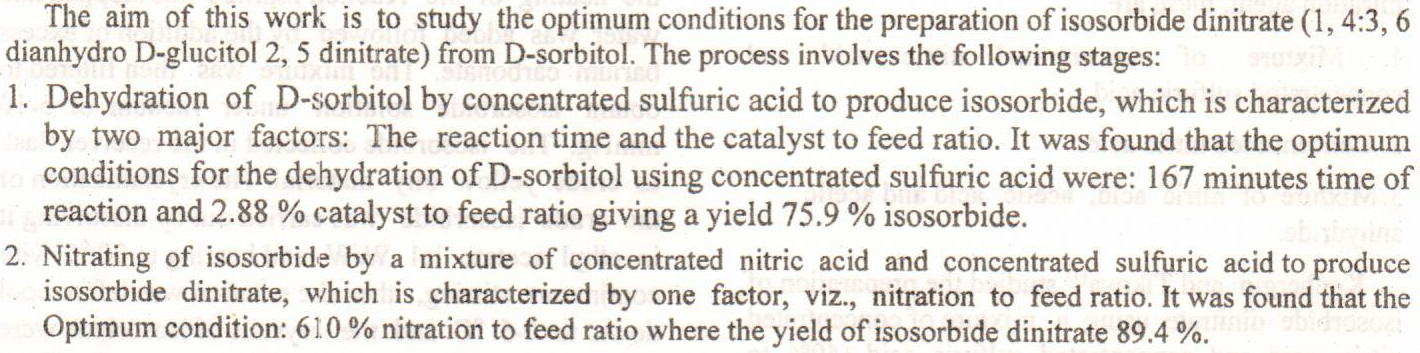
The Preparation of Isosorbide Dinitrate

 (21)
(21)
 (15)
(15)

 (21)
(15)
(21)
(15)
The purpose of my thesis is to synthesis two new bidentate ligands which were used to prepare series of metal complexes by reacting the ligands with (M+2 = Mn, Co, Ni, Cu, Cd and Hg) Succinyl chloride was used as starting material to synthesis two bidentate ligands (L1) and (L2) by reaction it with 4-chloroaniline (L1) and (4-aminoacetophenone) (L2) in dichloromethane as a solvent, that are: (L1) = N1,N4-bis (4-chloro phenyl ) succinamide (L2) =N1,N4-bis(4-acetylphenyl)succinamide The new ligands were characterize by using spectroscopic study (Fourier-transform infrared spectroscopy (FT-IR), electronic spectra ( UV-Vis) ,nuclear magnetic resonance(1H,13C-NMR), Mass spectra
... Show More
(10)
(7)
 (5)
(11)
(11)
(5)
(11)
(11)
In this paper, silicon carbonitried thin films were prepared by the method of photolysis of the silane (SiH4) and ethylene (C2H4) gases, with and without ammonia gas (NH3), which is represented by the ratio between the (PNH3) and (PSiH4 + PC2H4 + PNH3), (which assign by the letter X), X has the values (0, 0.13, 0.33). This method carried out by using TEA-CO2 laser, on glass substrate at (375 oC), deposition rate (0.416-0.833) nm/pulse thin film thickness of (500-1000) nm. The optical properties of the films were studied by using Absorbance and Transmittance spectrums in wavelength range of (400-1100) nm, the results showed that the electronic transitions is indirect and the energy gap for the SiCN films increase with increasing of nitrog
... Show MoreAqueous root extract has been used to examine the green production of silver nanoparticles (AgNPs) by reducing the Ag+ ions in a silver nitrate solution. UV-Vis spectroscopy, X-ray diffraction, field emission scanning electron microscopy, and Fourier transform infrared spectroscopy (FTIR) were used to analyze the produced AgNPs. The AgNPs that were created had a maximum absorbance at 416 nm, were spherical in form, polydispersed in nature, and were 685 nm in size.The AgNPs demonstrated antibacterial efficacy against Escherichia coli and Staphylococcus. The dengue vector Aedes aegypti's second instar larvae were very susceptible to the AgNPs' powerful larvicidal action.
(5)
Poly (viny1 alcohol) (PVA) of 72000 g mol -1 molar mass was cross linked through cold cast esterification with different mol % of MA and EDTA (10 % , 20 % and 30 % ), and two different mol % mixture of MA l EDTA (20 %/5% and 20%/10% .
Background: Many types of instruments and techniques are used in the instrumentation of the root canal system. These instruments and techniques may extrude debris beyond the apical foramen and may cause post-instrumentation complications. The aim of this study was to evaluate the amount of apically extruded debris resulted by using 4 types of nickel-titanium instruments (WaveOne, TRUShape 3D conforming files, Hyflex CM, and One Shape files) during endodontic instrumentation. Materials and methods: Forty freshly extracted human mandibular second premolar with straight canals and a single apex were collected for this study. All teeth were cut to similar lengths. Pre-weighted glass vials were used as collecting containers. Samples were randoml
... Show More
(3)