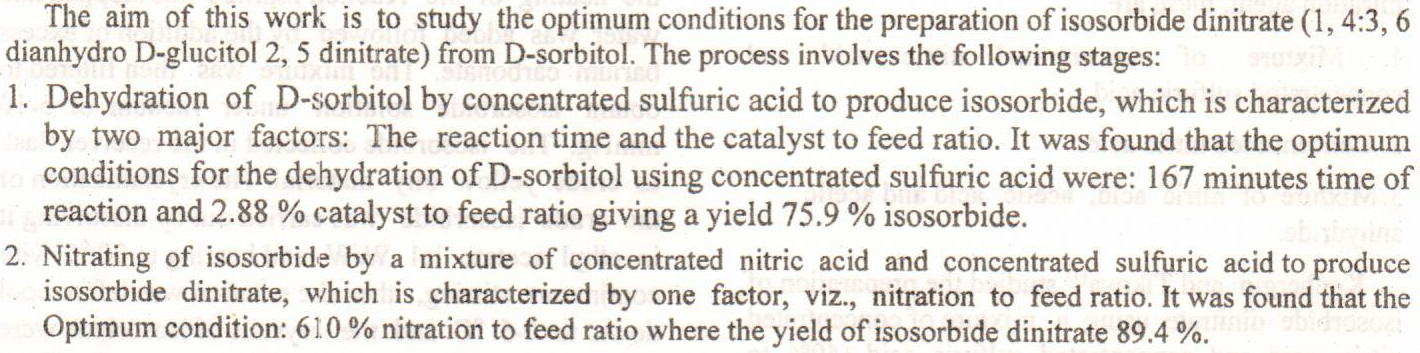
The Preparation of Isosorbide Dinitrate

Many complexes of 3,5-dimethyl-1H-pyrazol-1-yl phenyl methanone with Cr(III), Co(II), Ni(II), Cu(II) and Cd(II) were synthesized and characterized by FT-IR, UV/visible spectra, elemental analysis, room temperature magnetic susceptibility and molar conductivity. Cd(II) complex was expected to have tetrahedral structure while all the other complexes were expected to have an octahedral structure.

New azo ligand 2-((4-formyl-3-hydroxynaphthalen-2-yl) diazenyl) benzoic acid (H2L) was synthesized from the reaction of 2-aminobenzoic acid and2-hydroxy-1-naphthaldehyde. Monomeric complexes of this ligand, of general formulae [MII(L)(H2O)] with (MII = Mn, Co, Ni, Cu, Zn, Pd, Cd and Hg ) were reported. The compounds were isolated and characterized in solid state by using 1H-NMR, FT-IR, UV–Vis and mass spectral studies, elemental microanalysis, metal content, magnetic moment measurements, molar conductance and chloride containing. These studies revealed tetrahedral geometries for all complexes except PdII complex is Square planar. The study of complexes formation via molar ratio of (M:L) as (1:1). Theoretical treatments of compounds in gas
... Show More (1)
(1)
 (3)
(3)


Titanium dioxide nanorods have been prepared by sol-gel template
method. The structural and surface morphology of the TiO2 nanorods was
investigated by X-ray diffraction (XRD) and atomic force microscopy
(AFM), it was found that the nanorods produced were anatase TiO2 phase.
The photocatalytic activity of the TiO2 nanorods was evaluated by the
photo degradation of methyl orange (MO). The relatively higher
degradation efficiency for MO (D%=78.2) was obtained after 6h of exposed
to UV irradiation.
(1)
ATTAPULGITE clay was modified in this study by the graphene oxide sheets and the clay was diagnosed before and after modification using several techniques (Fourier-transform infrared spectroscopy FT-IR, X-ray powder diffraction XRD, Scanning electron microscope SEM , energy dispersive spectroscopy EDX ) ,The surface of the attapulgite clay (before (Ata) after modification by graphene oxide (Ata-GO) ) was applied to adsorption of the Alizarin dye from its water solutions through the application of several kinetic models (pseudo first-order model , pseudo second -order model , intraparticle diffusion model ),It was found that the practical results follow pseudo second -order model. The process of modification on the surface of the mud has imp
... Show MoreThis study aimed to develop an oral drug delivery system for gastro-retentive sustained drug release of baclofen by using a 3D printed capsular device since baclofen has a short half-life of 2.5 to 4 hours and has a narrow absorption window. Firstly sustained-release tablets of baclofen were formulated through the hot-melt extrusion of various thermoplastic polymers and direct compression of the extrudate, then a capsular device was designed and 3D printed to contain two air pockets to enable floating of the device and has four windows for drug release.
3D printing of the capsular device was done by an FDM printer using biodegradable PLA filament, and the sustained release tablets were inserted into the device to allow the medici
... Show More
(3)
The preparation of composite metal oxide to attain high efficiency in removing phenol from wastewater has a great concern. In the present study, the focus would be on adopting antimony-tin oxide coating onto graphite substrates instead of titanium; besides the effect of SbCl3 concentration on the SnO2-Sb2O3 composite would be examined. The performance of this composite electrode as the working electrode in the removal of phenol by sonoelectrochemical oxidation will be studied. The antimony-tin dioxide composite electrode was prepared by cathodic deposition with SnCl2 . 2H2O solution in a mixture of HNO3 and NaNO3, with different concentrations of SbCl3. The SnO2-Sb2O3 deposit layer’s structure and morphology were examined and the 4 g/l Sb
... Show More
(4)
(3)
One of the important units in Sharq Dijla Water Treatment Plant (WTP) first and second extensions are the alum solution preparation and dosing unit. The existing operation of this unit accomplished manually starting from unloading the powder alum in the preparation basin and ending by controlling the alum dosage addition through the dosing pumps to the flash mix chambers. Because of the modern trend of monitoring and control the automatic operation of WTPs due to the great benefits that could be gain from optimum equipment operation, reducing the operating costs and human errors. This study deals with how to transform the conventional operation to an automatic monitoring and controlling system depending on a Programmable
... Show More
(42)
(38)
In this study, manganese dioxide (MnO₂) nanoparticles (NPs) were synthesized via the hydrothermal method and utilized for the adsorption of Janus green dye (JG) from aqueous solutions. The effects of MnO₂ NPs on kinetics and diffusion were also analyzed. The synthesized NPs were characterized by scanning electron microscopy (SEM), X-ray diffraction (XRD), energy-dispersive X-ray analysis (EDX), and Fourier-transform infrared spectroscopy (FT-IR), with XRD confirming the nanoparticle size of 6.23 nm. The adsorption kinetics were investigated using three models: pseudo-first-order (PFO), pseudo-second-order (PSO), and the intraparticle diffusion model. The PSO model provided the best fit (R² = 0.999), indicating that the adsorpti
... Show More
(1)