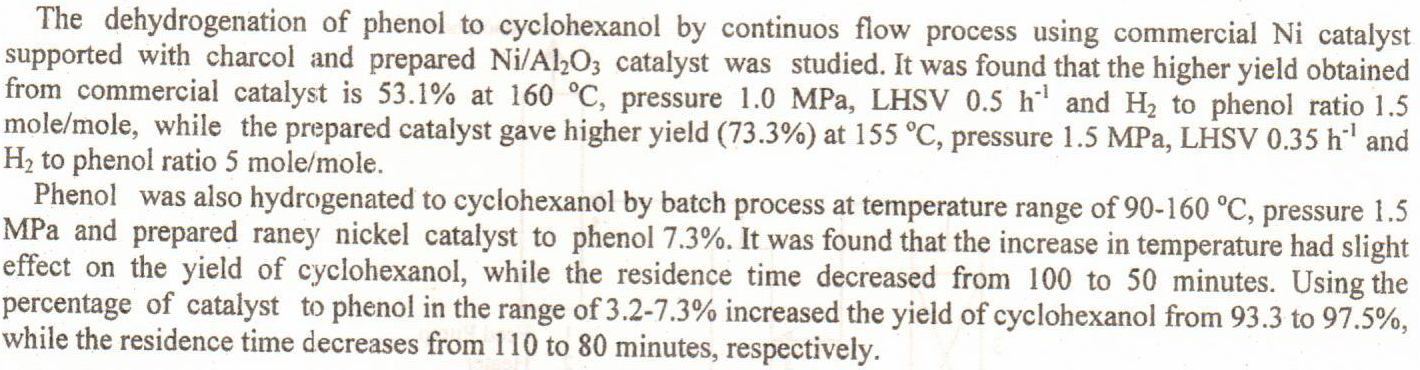
Batch and Continuous Process of Cyclohexanol Production

Production of fatty acid esters (biodiesel) from oleic acid and 2-ethylhexanol using sulfated zirconia as solid catalyst for the production of biodiesel was investigated in this work.
The parameters studied were temperature of reaction (100 to 130°C), molar ratio of alcohol to free fatty acid (1:1 to 3:1), concentration of catalyst (0.5 to 3%wt), mixing speed (500 to 900 rpm) and types of sulfated zirconia (i.e modified, commercial, prepared catalyst according to literature and reused catalyst). The results show the best conversion to biodiesel was 97.74% at conditions of 130°C, 3:1, 2wt% and 650 rpm using modified catalyst respectively. Also, modified c
... Show MoreOrthophoto provides a significant alternative capability for the presentation of architectural or archaeological applications. Although orthophoto production from airphotography of high or lower altitudes is considered to be typical, the close range applications for the large-scale survey of statue or art masterpiece or any kind of monuments still contain a lot of interesting issues to be investigated.
In this paper a test was carried out for the production of large scale orthophoto of highly curved surface, using a statue constructed of some kind of stones. In this test we use stereo photographs to produce the orthophoto in stead of single photo and DTM, by applying the DLT mathematical relationship as base formula in differenti
... Show MoreThis research include building mathematical models for aggregating planning and shorting planning by using integer programming technique for planning master production scheduling in order to control on the operating production for manufacturing companies to achieve their objectives of increasing the efficiency of utilizing resources and reduce storage and improving customers service through deliver in the actual dates and reducing delays.

The efficient exploitation of production inventory systems is of significant importance in the modern industrial reality. This paper explores the effect of such a system on dynamic behaviour of a system when the control is provided synergistically by a method called synergetic control (SC). The mathematical model of the system is first constructed and SC introduced to improve the responsiveness of the system when the time-varying demand condition is taken into account. To cope with the problem of unavailability of the systems' state signals and to estimate the demand, the extended state observer (ESO) is introduced. Moreover, mountain gazelle optimizer (MGO) is employed to tune the adjustable design parameters of the SC and the ESO based on
... Show More
Biodiesel as an attractive energy source; a low-cost and green synthesis technique was utilized for biodiesel preparation via waste cooking oil methanolysis using waste snail shell derived catalyst. The present work aimed to investigate the production of biodiesel fuel from waste materials. The catalyst was greenly synthesized from waste snail shells throughout a calcination process at different calcination time of 2–4 h and temperature of 750–950 ◦C. The catalyst samples were characterized using X-Ray Diffraction (XRD), Brunauer-Emmett-Teller (BET), Energy Dispersive X-ray (EDX), and Fourier Transform Infrared (FT-IR). The reaction variables varying in the range of 10:1–30:1 M ratio of MeOH: oil, 3–11 wt% catalyst loading, 50–
... Show More (22)
(22)
 (26)
(26)

In addition to the primary treatment, biological treatment is used to reduce inorganic and organic components in the wastewater. The separation of biomass from treated wastewater is usually important to meet the effluent disposal requirements, so the MBBR system has been one of the most important modern technologies that use plastic tankers to transport biomass with wastewater, which works in pure biofilm, at low concentrations of suspended solids. However, biological treatment has been developed using the active sludge mixing process with MBBR. Turbo4bio was established as a sustainable and cost-effective solution for wastewater treatment plants in the early 1990s and ran on minimal sludge, and is easy to maintain. This
... Show More
(1)
Abstract
This study aimed to identify the business risks using the approach of the client strategy analysis in order to improve the efficiency and effectiveness of the audit process. A study of business risks and their impact on the efficiency and effectiveness of the audit process has been performed to establish a cognitive framework of the main objective of this study, in which the descriptive analytical method has been adopted. A survey questionnaire has been developed and distributed to the targeted group of audit firms which have profession license from the Auditors Association in the Gaza Strip (63 offices). A hundred questionnaires have been distributed to the study sample of which, a total of 84 where answered and
... Show More
(1)
(17)
(16)
Reverse Osmosis (RO) has already proved its worth as an efficient treatment method in chemical and environmental engineering applications. Various successful RO attempts for the rejection of organic and highly toxic pollutants from wastewater can be found in the literature over the last decade. Dimethylphenol is classified as a high-toxic organic compound found ubiquitously in wastewater. It poses a real threat to humans and the environment even at low concentration. In this paper, a model based framework was developed for the simulation and optimisation of RO process for the removal of dimethylphenol from wastewater. We incorporated our earlier developed and validated process model into the Species Conserving Genetic Algorithm (SCG
... Show More
(16)
(13)