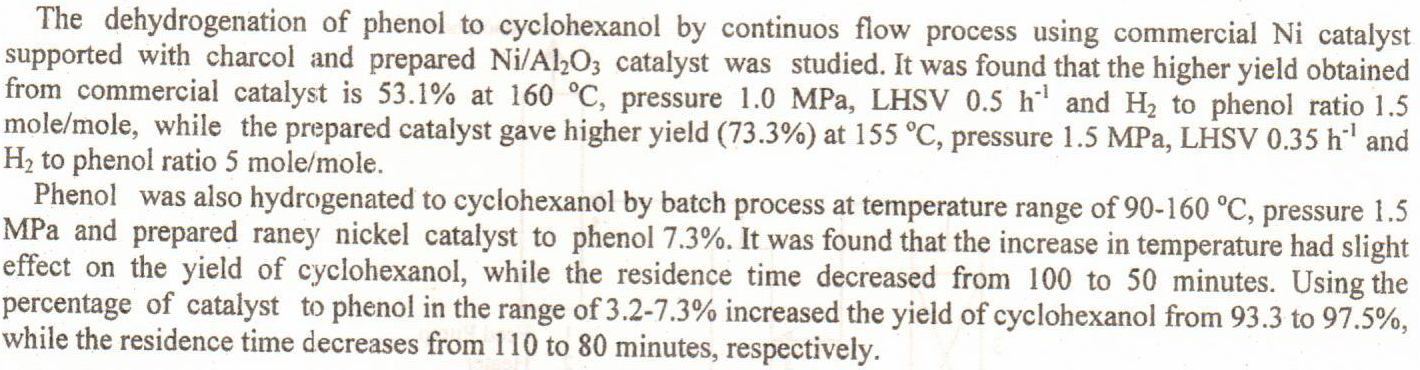
Batch and Continuous Process of Cyclohexanol Production

The catalytic cracking of three feeds of extract lubricating oil, that produced as a by-product from the process of furfural extraction of lubricating oil base stock in AL-Dura refinery at different operating condition, were carried out at a fixed bed laboratory reactor. The initial boiling point for these feeds was 140 ºC for sample (1), 86 ºC for sample (2) and 80 ºC for sample (3). The catalytic cracking processes were carried out at temperature range 325-400 ºC and initially at atmospheric pressure after 30 minutes over 9.88 % HY-zeolite catalyst load. The comparison between the conversion at different operating conditions of catalytic cracking processes indicates that a high yield was obtained at 375°C, according to gasoline pr
... Show MoreToxic substances have been released into water supplies in recent decades because of fast industrialization and population growth. Fenton electrochemical process has been addressed to treat wastewater which is very popular because of its high efficiency and straightforward design. One of the advanced oxidation processes (AOPs) is electro-Fenton (EF) process, and electrode material significantly affects its performance. Nickel foam was chosen as the source of electro-generated hydrogen peroxide (H2O2) due to its good characteristics. In the present study, the main goals were to explore the effects of operation parameters (FeSO4 concentration, current density, and electrolysis time) on the catalytic performance that was optimized by r
... Show More (6)
(6)

Toxic substances have been released into water supplies in recent decades because of fast industrialization and population growth. Fenton electrochemical process has been addressed to treat wastewater which is very popular because of its high efficiency and straightforward design. One of the advanced oxidation processes (AOPs) is electro-Fenton (EF) process, and electrode material significantly affects its performance. Nickel foam was chosen as the source of electro-generated hydrogen peroxide (H2O2) due to its good characteristics. In the present study, the main goals were to explore the effects of operation parameters (FeSO4 concentration, current density, and electrolysis time) on the catalytic perform
... Show More
(6)
Decolorization of red azo dye (Cibacron Red FN-R) from synthetic wastewater has been investigated as a function of solar advanced oxidation process. The photocatalytic activity using ZnO as a photocatalysis has been estimated. Different parameters affected the removal efficiency, including pH of the solution, initial dye concentration and H2O2 concentration were evaluated to find out the optimum value of these parameters. The results proved that the optimal pH value was 8 and the most efficient H2O2 concentration was 100mg/L. Toxicity reduction percent for effluent solution was also monitored to assess the degradation process. This treatment method was able to strongly reduce the color and toxicity of reactive red dye-238 to about (99 an
... Show More (1)
(1)
(1)
(1)

Fifty-Four paddy samples, 45 soil samples, and nine irrigation water samples of some paddy fields at Alfurat Alawsat Area, Iraq were collected to investigate the microbial quality including total count bacteria (TCB), molds and yeast, total coliform (TC), and E. coli bacteria. Paddy samples were processed at the laboratory level to produce rice at 32 and 36 whiteness, and the microbial quality of the produced rice was conducted too. The results showed that all irrigation water samples were overpassed the FDA limit for E. coli. All paddy samples were exceeded the good limit of TCB, but no sample exceeded the acceptable limit. Most paddy samples were exceeded the FDA limit for molds and yeast, and few paddy samples exc
... Show More
(1)
A nano manganese dioxide (MnO2) was electrodeposited galvanostatically onto a carbon fiber (CF) surface using the simple method of anodic electrodeposition. The composite electrode was characterized by field emission scanning electron microscopy (FESEM), and X-ray diffraction (XRD). Very few studies investigated the efficiency of this electrode for heavy metals removal, especially chromium. The electrosorption properties of the nano MnO2/CF electrode were examined by removing Cr(VI) ions from aqueous solutions. NaCl concentration, pH, and cell voltage were studied and optimized using the Box-Behnken design (BDD) to investigate their effects and interactions on the electrosorption process. The results showed that the
... Show More
(14)
(11)

This study aimed to obtain a local isolation of Aspergillus niger and then studied its ability to produce citric acid from raw materials available locally using solid state fermentation. Six local isolates were collected from different sources including some samples of the damaged fruits such as grapefruit, oranges and sindi. Wheat bran was used as a raw material or as culture medium for the production of citric acid from the collected isolates. The conditions for citric acid production were determined by humidity percentage of 1: 1 (water: culture medium), temperature of 28 C, pH 4 and inoculum dose with 5× 10⁶ spore/ml and for 3 days of incubation. The orange was the best model for citric acid production with a concentration of 12.8 mg/m
... Show More
(4)
(2)
This research aims were to evaluate management of broiler production projects in Baghdad province via using the criteria of management, included production index and economic figure (PI and EF) that specified to those projects. in addition to criteria of economic efficiency also applied (INME) index number of management efficiency, in order to the research requirements, data were obtained based on a questionnaire prepared for this purpose, which was collected by personal interview of (60) projects of the broiler production projects from (516) projects representing 11.6% of the research community in Baghdad province in 2016. The results show that mean of PI and EF was (338). The increase in these two criteria is generally due to co
... Show More
Production of fatty acid esters (biodiesel) from oleic acid and 2-ethylhexanol using sulfated zirconia as solid catalyst for the production of biodiesel was investigated in this work.
The parameters studied were temperature of reaction (100 to 130°C), molar ratio of alcohol to free fatty acid (1:1 to 3:1), concentration of catalyst (0.5 to 3%wt), mixing speed (500 to 900 rpm) and types of sulfated zirconia (i.e modified, commercial, prepared catalyst according to literature and reused catalyst). The results show the best conversion to biodiesel was 97.74% at conditions of 130°C, 3:1, 2wt% and 650 rpm using modified catalyst respectively. Also, modified c
... Show More