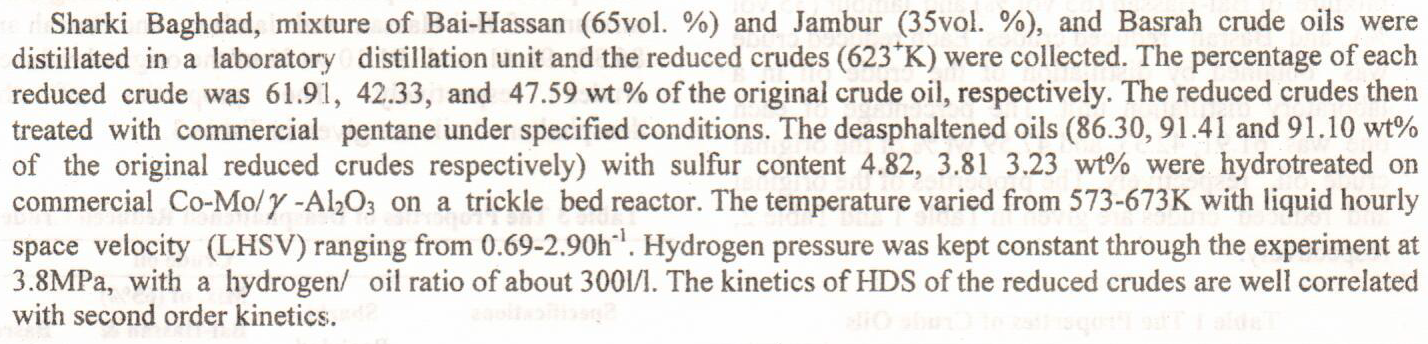
Production of Low Sulfur Fuel Oil from Different Iraqi Residues Crudes

Within connected speech, RP speakers tend to shorten stressed long vowels end diphthongs in pre. Forties consonants in the same syllable on the basis of complementary Distribution, i.e., the phonological environment decides the influence of the forties plosives and fricatives, as far as they are in find position preceded by stressed long vowels and diphthongs, or particular voiced consonants plus vowels. The Iraqi learners, then, face.
The Sadi reservoir is one of the largest and most important unconventional tight oil reservoirs in southern Iraq. However, it suffers from low production rates, necessitating many development strategies that require a correct and reliable characterization of reservoir fluid properties. Whilst these properties are originally obtained from laboratory experiments, measurement errors often occur despite rigorous workflows, which negatively affect the calculation of reservoir fluid properties. This study utilizes the fluid thermodynamics characterization program (PVTp) to generate a reliable model for determining the oil properties of Sadi reservoir. A methodology was developed to simulate fluid thermodynamic tests, including Differ
... Show More
The faujasite type Y zeolite catalyst was prepared from locally available kaolin. For prepared faujasite type NaY zeolite X-ray, FT-IR, BET pore volume and surface area, and silica/ alumina were determined. The Xray and FT-IR show the compatibility of prepared catalyst with the general structure of standard zeolite Y. BET test shows that the surface area and pore volume of prepared catalyst were 360 m2 /g and 0.39 cm3 /g respectively.
The prepared faujasite type NaY zeolite modified by exchanging sodium ion with ammonium ion using ammonium nitrate and then ammonium ion converted to hydrogen ion. The maximum sodium ion exchange with ammonium ion was 53.6%. The catalytic activity of prepared faujasite type NaY, NaNH4Y and NaHY zeolites
The reserve estimation process is continuous during the life of the field due to risk and inaccuracy that are considered an endemic problem thereby must be studied. Furthermore, the truth and properly defined hydrocarbon content can be identified just only at the field depletion. As a result, reserve estimation challenge is a function of time and available data. Reserve estimation can be divided into five types: analogy, volumetric, decline curve analysis, material balance and reservoir simulation, each of them differs from another to the kind of data required. The choice of the suitable and appropriate method relies on reservoir maturity, heterogeneity in the reservoir and data acquisition required. In this research, three types of rese
... Show More (2)
(2)
In order to reduce hydrostatic pressure in oil wells and produce oil from dead oil wells, laboratory rig was constructed, by injecting LPG through pipe containing mixture of two to one part of East Baghdad crude oil and water. The used pressure of injection was 2.0 bar, which results the hydrostatic pressure reduction around 246 to 222 mbar and flow rate of 34.5 liter/hr fluid (oil-water), at 220 cm injection depth. Effects of other operating parameters were also studied on the behavior of two phase flow and on the production of oil from dead oil wells.
Nasryia oil field is located about 38 Km to the north-west of Nasryia city. The field was discovered in 1975 after doing seismic by Iraqi national oil company. Mishrif formation is a carbonate rock (Limestone and Dolomite) and its thickness reach to 170m. The main reservoir is the lower Mishrif (MB) layer which has medium permeability (3.5-100) md and good porosity (10-25) %. Form well logging interpretation, it has been confirmed the rock type of Mishrif formation as carbonate rock. A ten meter shale layer is separating the MA from MB layer. Environmental corrections had been applied on well logs to use the corrected one in the analysis. The combination of Neutron-Density porosity has been chosen for interpretation as it is c
... Show More
(1)
 (9)
(7)
(9)
(7)


One of the most important problems in the oil production process and when its continuous flow, is emulsified oil (w/o emulsion), which in turn causes many problems, from the production line to the extended pipelines that are then transported to the oil refining process. It was observed that the nanomaterial (SiO2) supported the separation process by adding it to the emulsion sample and showed a high separation rate with the demulsifiers (RB6000) and (sebamax) where the percentage of separation was greater than (90 and 80 )% respectively, and less than that when dealing with (Sodium dodecyl sulfate and Diethylene glycol), the percentage of separation was (60% and 50%) respectively.
The high proportion
... Show More
(1)

