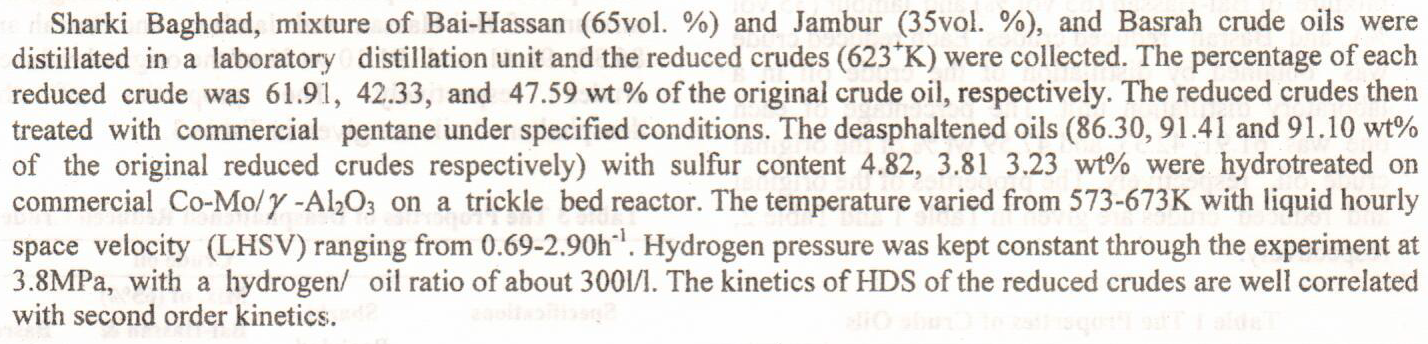
Production of Low Sulfur Fuel Oil from Different Iraqi Residues Crudes

This study aims to observe the effect of melatonin implantation and exposure to different light colors and their interaction on productive in local Iraqi chicken. This study was conducted at the poultry farm of the Department of Animal Production/College of Agriculture/University of Baghdad/Abu Ghraib, on 252 birds (180 females and 72 males). The birds were divided into three sections (white, red and green) each section contains two lines, one of which has been planted melatonin under the skin of the neck of birds and the other has not been planted hormone. The results of the study showed significant improvement in productive traits such as egg proportion rate, egg weight, cumulative eggs number, egg mass and feed conversion rate. That the
... Show More (3)
(3)

Anaerobic digestion (AD) is the most common process for dealing with primary and secondary wastewater sludge. In the present work, four pre-treatment methods (ultrasonic, chemical, thermal, and thermo-chemical) are investigated in Al-Rustumya Wastewater Treatment plant in order to find their effect on biogas production and volatile solid removal efficiency during anaerobic digestion.
Two frequencies of ultrasonic wave were used 30 KHz and 50 KHz during the pre-treatment. Sodium hydroxide was added in different amounts to give three pH values of 9, 10 and 11 in chemical pre-treating processes. The sludge was heated at 60oC and 80oC through thermal pre-treatment experiment. Also, the sludge was treated thermo-chemically at 80 oC and pH
In order to reduce the losses due to evaporation in the stored crude oil and minimizing the decrease in °API many affecting parameters were studied (i.e. Different storage system, namely batch system with different types of storage tanks under different temperatures and:or different pressures). Continuous circulation storage system was also studied. It was found that increasing pressure of the inert gas from 1 bar to 8 bar over the surface of the crude oil will decrease the percentage losses due to evaporation by (0.016%) and decrease the change of °API by (0.9) during 96 hours storage time. Similarly using covering by surfactant (potassium oleate) or using polymer (polyurethane foam) decreases the percentage evaporation losses compare
... Show MoreFormation of emulsions during oil production is a costly problem, and decreased water content in emulsions leads to increases productivity and reduces the potential for pipeline corrosion and equipment used. The chemical demulsification process of crude oil emulsions is one of the methods used for reducing water content. The demulsifier presence causes the film layer between water droplets and the crude oil emulsion that to become unstable, leading to the accelerated of water coalescence. This research was performed to study the performance of a chemical demulsifier Chimec2439 (commercial) a blend of non-ionic oil-soluble surfactants. The crude oils used in these experiments were Basrah and Kirkuk Iraqi crude oil. These
... Show More (7)
(7)

The efficient behavior of a low-concentrating photovoltaic-thermal system with a micro-jet channel (LCPV/T-JET) and booster mirror reflector is experimentally evaluated here. Micro-jets promote the thermal management of PV solar cells by implementing jet water as active cooling, which is still in the early stages of development. The booster mirror reflector concentrates solar irradiance into solar cells and improves the thermal, electrical, and combined efficiencies of the LCPV/T-JET system. The LCPV/T-JET system was tested under ambient weather conditions in the city of Bangi, Selangor, Malaysia, and all data was recorded between 10:00 a.m. and 4:00 p.m. Parametric studies were conducted to compare the performance of the LCPV/T-JET system
... Show More
(27)
(25)

This study investigates the phonotactics of English obstruent clusters in the word-final position from a markedness theory perspective among Iraqi EFL College Students whose native language, Arabic, prefers only two-member word-final obstruent cluster as a maximum. The markedness of clusters is measured depending on Iraqi EFL College Students’ utilization of the simplification strategies. This study tries to answer whether or not word-final obstruent clusters are marked or unmarked for Iraqi EFL College Students, and whether or not the markedness of the obstruent cluster increases as to its length. In order to answer these questions, a test has been distributed among 60 Iraqi EFL Fourth-Year College students, Department of English, Colleg
... Show MoreA simple and novel membraneless paper-based microfluidic fuel cell was presented in this study. The occurrence of laminar flow was employed to ensure no mixing of the fuel and oxidant fluids along the bath of reaction. The acidic wastewater was used as a fuel. It was an air-breathing cell, so air and tab water were used as oxidants. Both the fuel and tab water flowed continuously under gravity. Whatman filter paper was used for preparation of the fuel cell channel and two carbon fibre electrodes were used and firmed on the edges of the cell. The performance of the cell was examined over three consecutive days. The results indicated that the present cell has the potential to generate electric power, but an extensive study is required to harv
... Show More
(4)
(3)
The present study investigated the impact of fuel kind on the emitted emissions at the idling period. Three types of available fuels in Iraq were tested. The tests conducted on ordinary gasoline with an octane number of 82, premium gasoline with an octane number of 92, and M20 (consist of 20% methanol and 80% regular gasoline). The 2 liters Mercedes-Benz engine was used in the experiments.
The results showed that engine operation at idle speed emits high levels of CO, CO2, HC, NOx and noise. The produced emission levels depend highly on fuel type. The premium gasoline (ON=92) represents the lower emissions level except for noise at all idling speed. Adding methanol to ordinary gasoline (ON=82) showed high levels of emi
... Show More
(4)
The Al Mishraq site has been the subject of many scientific studies for the period before and
after the fire in 2003. Five visits to the site were conducted twice in 2003 for general fact-finding, twice
in 2004, and once in 2005 for detailed sampling and monitoring. Desk-based research and laboratory analysis of soil and water samples results indicate that surface water and groundwater pollution from Al Mishraq site was significant at the time of its operation. The primary pollution source was the superheated water injection process, while the principal receptor is the River Tigris. Now that the plant is idle, this source is absent. Following the June 2003 sulphur fire, initial investigations indicate that short damage to
vegeta
