Preferred Language
Articles
/
joe-5
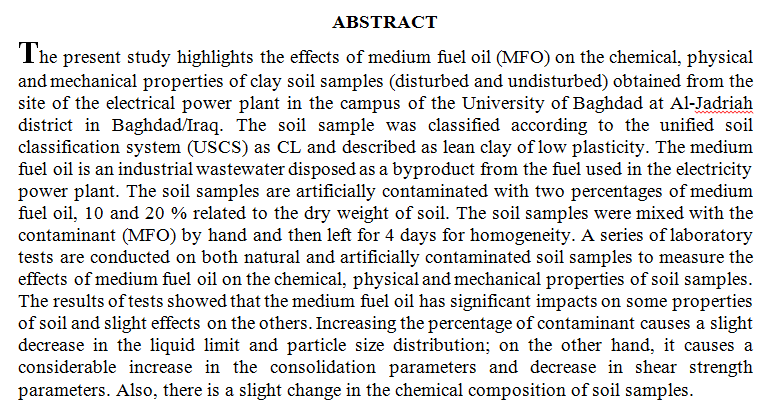
Effects of Fuel Oil on the Geotechnical Properties of Clay Soil
...Show More Authors

View Publication Preview PDF
Quick Preview PDF
Publication Date
Mon Jan 01 2018
Journal Name
Indian Journal Of Public Health Research & Development
Effects of Silver Nanoparticles on Biofilms of <i>Streptococcus</i> Spps
...Show More Authors

Today technology using nanoparticle when treatment pathogentic microorganism and we focused on this here. It was found that the species of streptococcus used in present study were sensitive to erythromycin. In present study focusing biofilm formation by Streptococcus spp was evaluated. Species S. mutans was found that highest amount of biofilm compare with the other species. The aim of report effect (SNPs) on ability of biofilm form different species of streptococcus. The anti-biofilm effect of SNPs was in concentration dependent manner. The highest effect of SNP against biofilm formation was found the concentration 160 μg/ml, while the lowest effect was found the lowest used concentration (80 μg/ml) of SNPs. In vivo study revealed that s

... Show More
View Publication
Scopus (3)
Scopus Crossref
Publication Date
Tue Jun 01 2021
Journal Name
Baghdad Science Journal
Effect of SnO2/In2O3 Atomic Ratio on the Structural and Optical Properties of ITO Thin Filmsof SnO2:In2O3 Thin Film Composite Ratio on Structural and Optical Properties
...Show More Authors

In this work, the effect of atomic ratio on structural and optical properties of SnO2/In2O3 thin films prepared by pulsed laser deposition technique under vacuum and annealed at 573K in air has been studied.  Atomic ratios from 0 to 100% have been used. X-ray diffraction analysis has been utilized to study the effect of atomic ratios on the phase change using XRD analyzer and the crystalline size and the lattice strain using Williamson-Hall relationship. It has been found that the ratio of 50% has the lowest crystallite size, which corresponds to the highest strain in the lattice. The energy gap has increased as the atomic ratio of indium oxide increased.

View Publication Preview PDF
Scopus (1)
Crossref (1)
Scopus Clarivate Crossref
Publication Date
Mon Feb 16 2026
Journal Name
Journal Of Baghdad College Of Dentistry
An Evaluation of Olive Oil as a Separating Medium and Its Effect on Some Mechanical Properties of Processed Acrylic Resin Denture Base (A Comparative Study). Part Two
...Show More Authors

Background: During acrylic resin processing, the mold must be separated from the surface of the gypsum to prevent liquid resin from penetrating into the gypsum, and water from the gypsum seeping into the acrylic resin. For many years, tin foil was the most acceptable separating medium, and because it's difficult to apply, a tin-foil substitute is used. In this study, olive oil is used as an alternative to tin foil separating medium for first time, and evaluating its effect as a separating medium on some mechanical properties such as (indentation hardness and transverse strength) of acrylic resins denture base comparing it with those processed using tin-foil and tin foil substitute such as (cold mold seal) separating medium. Materials and M

... Show More
View Publication Preview PDF
Publication Date
Wed Jun 24 2020
Journal Name
Journal Of Engineering
Using Steel Slag for Stabilizing Clayey Soil in Sulaimani City-Iraq
...Show More Authors

The clayey soils have the capability to swell and shrink with the variation in moisture content. Soil stabilization is a well-known technique, which is implemented to improve the geotechnical properties of soils. The massive quantities of waste materials are resulting from modern industry methods create disposal hazards in addition to environmental problems. The steel industry has a waste that can be used with low strength and weak engineering properties soils. This study is carried out to evaluate the effect of steel slag (SS) as a by-product of the geotechnical properties of clayey soil. A series of laboratory tests were conducted on natural and stabilized soils. SS was added by 0, 2.5, 5, 10, 15, and 20% to the soil.

... Show More
View Publication Preview PDF
Crossref (11)
Crossref
Publication Date
Sun Mar 20 2016
Journal Name
Al-mustansiriyah Journal Of Scienc
Histological and cytogenetic effects of Acetamiprid on male albino mice
...Show More Authors

View Publication
Publication Date
Wed Mar 10 2021
Journal Name
Baghdad Science Journal
toxic and accumulation effects of cadmium and lead on microeystis
...Show More Authors

The study included a statement toxicity of some heavy metals individually and collectively and the existence of plant nutrients in the center Agirenk bluish green moss growth and Askhaddm biomass as an indicator of the study, in addition to portability moss on the accumulation of the metal

View Publication Preview PDF
Publication Date
Sun Sep 06 2009
Journal Name
Baghdad Science Journal
Effects of lead and Zenic on Scenedesmus quadricaudaVar. longispina algae
...Show More Authors

The study includs,effect of concentration of Lead 0.2 ,0.3 , 0.5, 5 , 10 mg/L and Zinc 0.1,0.5 , 2 , 4 , 8 mg/L lonely or to gether on growth green algae( Scenedesmus quadricauda var . longispina) according to the total qauntity for the cells and the adsorption of the algae to the zn,pb concentration .growth curve and dubbling time growth were calculated with or without there heavy metals . Results shows that there are significant differences (P<0.01) for growth curve and the control. (7.5201 cell /h)and with dubbling times (9.87 cell/h). The heavy metals(Pb, Zn). shows antagonistic effect when both used in media.

View Publication Preview PDF
Crossref
Publication Date
Sun Dec 04 2016
Journal Name
Baghdad Science Journal
Haematological and Genotoxic effects of cadmium chloride on Mesopotamichthys sharpeyi
...Show More Authors

The present study investigated Haematological changes in Mesopotamichthys sharpeyi, as well as determination genotoxic effects of cadmium chloride on bunni fish by using 120 fingerlings, fish were distributed randomly into four treatments in addition to control group. Fish in first group treated (T1) with cadmium 0.093mg/L with changing water and added cadmium continuously, fish in the second group treated (T2) with cadmium 0.093mg/L with changing water without adding cadmium, third treatment (T3) with cadmium 0.046mg/L with changing water and adding cadmium continuously, and fourth treatment (T4) with cadmium 0.046mg/L with changing water without adding cadmium. Results of blood picture in T1 and T3 showed a significant reduction in red bl

... Show More
View Publication Preview PDF
Crossref (1)
Crossref
Publication Date
Wed Jan 01 2014
Journal Name
International Journal Of Recent Scientific Research
Tamsulosin hudrochloride (flomax) effects on fertility of albino male mice
...Show More Authors

Aim: To evaluate the side effects of Tamsulosin hydrochloride in fertility of experimental rats. Materials and methods: three groups of mice were used. First and second groups were injected [intraperitoneal (I.P.)] daily for 42 with 8 and 16 µg /kg mouse body weight (kg.b.wt) of Tamsulosin hydrochloride, respectively. Third group was injected with PBS (control). Several biological and histopathological studies were conducted on rat groups. Results: Significant decrease in number, motility and viability of epididymal sperm post injection with 16 µg /kg.b.wt, while injection with 8 µg /kg.b.wt reduced significantly, percentage of viability of sperm as compared with the control group. High percentage of abnormal sperm was observed in mice t

... Show More
Publication Date
Tue Sep 01 2015
Journal Name
Iosr Journal Of Agriculture And Veterinary Science
Biological and physiological effects of Metarhizium anisopliae on Culex quinquefasciatus.
...Show More Authors

The results of studying the effects of M. anisopiliae spores on mosquito, C. quinquefasciatus showed a biological effects represented by immature mortality. The mortality increased proportionally with the concentrations of fungal spores, which reached (at high concentration 2×10¹¹ spores / ml), to 86.6, 56.6% in first and late instar larvae, respectively. An important to mention that cumulative death rate was significantly associated with the time, which reached to 56% at 7 day after treatment. In addition, M. anisopiliae had a long period permanence in aquatic habitats; in which the residual effects stay 30 days in aquatic habitats after treatment at laboratory conditions. Interestingly, the long period exposure of fungal spores (30 minut

... Show More
View Publication Preview PDF