Preferred Language
Articles
/
joe-5
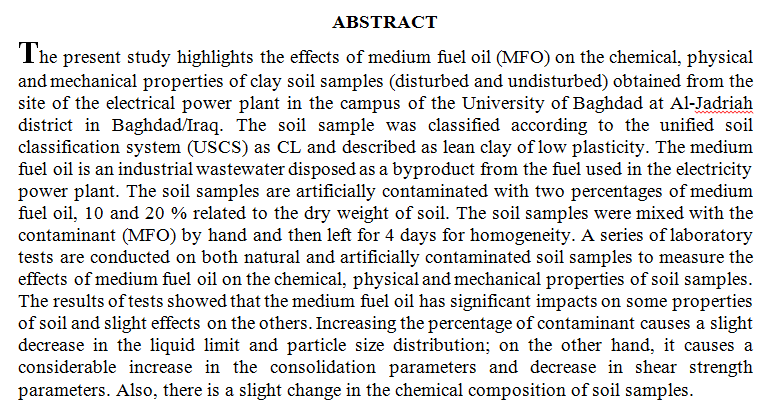
Effects of Fuel Oil on the Geotechnical Properties of Clay Soil
...Show More Authors

View Publication Preview PDF
Quick Preview PDF
Publication Date
Wed Aug 28 2019
Journal Name
Journal Of Engineering
Predicting Wetting Patterns in Soil from a Single Subsurface Drip Irrigation System
...Show More Authors

Soil wetted pattern from a subsurface drip plays great importance in the design of subsurface drip irrigation (SDI) system for delivering the required water directly to the roots of the plant. An equation to estimate the dimensions of the wetted area in soil are taking into account water uptake by roots is simulated numerically using HYDRUS (2D/3D) software. In this paper, three soil textures namely loamy sand, sandy loam, and loam soil were used with three different types of crops tomato, pepper, and cucumber, respectively, and different values of drip discharge, drip depth, and initial soil moisture content were proposed. The soil wetting patterns were obtained at every thirty minutes for a total time of irrigation equ

... Show More
View Publication Preview PDF
Crossref (10)
Crossref
Publication Date
Fri Jan 01 2016
Journal Name
Pure And Applied Mathematics Journal
Memory Effects in Diffusion Like Equation Via Haar Wavelets
...Show More Authors

View Publication
Crossref (2)
Crossref
Publication Date
Wed Mar 25 2020
Journal Name
2nd International Conference On Materials Engineering & Science (iconmeas 2019)
Foundation relative stiffness effects in sand under static loading
...Show More Authors

In the geotechnical engineering applications, precise understandings are yet to be established on the effects of a foundation stiffness on its bearing capacity and settlement. The modern foundation construction uses the new available construction materials that totally change the relative stiffness of the footing structures-soil interactions such as waste material and landfill area of more residential purposes. Conventional bearing capacity equations were dealt with common rigid footing and thus cannot be used for reduced foundation rigidity. Therefore, this study investigates the effects of foundation relative stiffness on its load-displacement behaviour and the soil deformation field using compression test of a strip smooth footings on su

... Show More
View Publication
Scopus (4)
Crossref (3)
Scopus Crossref
Publication Date
Thu Feb 07 2019
Journal Name
Journal Of The College Of Education For Women
Family violence: Causes and its effects - Analytical social study
...Show More Authors

The aim of this study is to investigate the main causes of the family violence and its
social effects.
The study reveals that main factors causes of the violence are interaction between
multi-factors.
The study shows that the poverty, low educational level, house crowded, large family
size, all of these variables causes of the violence, and then causes of family disorganization
and juvenile delinquency.
The study contain of three sections:
First: Focused on the causes of the violence.
Second: The interaction between multi factors.
Third: Social effects of family violence.

View Publication Preview PDF
Publication Date
Thu Aug 11 2016
Journal Name
Advanced Materials
Contact Resistance Effects in Highly Doped Organic Electrochemical Transistors
...Show More Authors

View Publication
Scopus (57)
Crossref (58)
Scopus Clarivate Crossref
Publication Date
Mon Jan 01 2018
Journal Name
Engineering And Technology Journal
Kinetic Study and Determination of Some Insecticides in Soil Samples by Ultrasonic Extraction Followed by Gradient HPLC
...Show More Authors

Ultrasonic Extraction method followed by gradient HPLC was carried out for the simultaneous determination of four insecticides are [imidacloprid (Imi), thiamethoxam (Thi), indoxacarb (Ind) and abamectin (Aba)] used to combat the major insect pests in Iraq, whitefly, Dubas Bug, worms fruits as well as to combat the spiders – dream respectively in eco-soil samples. The extraction recovery was in the range of 99.77 to 109.1 %. The dissipation kinetics and residual levels of these insecticides in soil sample was studied under field ecosystem. The half-life of the mix insecticides was determined. The half-life was in range of 0.38 to 4.06 days with the soil samples were brought from the Agricultural Land called Nahrawan located in th

... Show More
Publication Date
Sun Jun 07 2015
Journal Name
Baghdad Science Journal
Bioremediation of Nickel and Lead contaminated soil by Vica faba L. plant and AM fungi Glomus mosseae
...Show More Authors

This study is conducted to determine the activity of plant Vica faba and two isolated from arbuscular mycorrhizae fungi (A,B) in bioremediation of soil pollution by Nickel and Lead elements in north and south of Baghdad city. The results showed that the average of soil pollution by Nickel and Lead elements in north of Baghdad was less than the average of soil pollution in the south of Baghdad which recorded 29.0,9.0PPm and 42.0, 25.0PPm respectively. The results show that the isolate A from the polluted soil is more active from isolate B which isolate from unpolluted soil for bioremediation. Vica faba recorded more in accumulate the Lead element in shoot system which was 19.65PPm and in root system was 27.2PPm and for Nickel element 24.65

... Show More
View Publication Preview PDF
Crossref
Publication Date
Thu Mar 22 2018
Journal Name
Environmental Toxicology And Chemistry
Fate, uptake, and distribution of nanoencapsulated pesticides in soil–earthworm systems and implications for environmental risk assessment
...Show More Authors
Abstract<sec><label></label><p>Nanopesticides are novel plant protection products offering numerous benefits. Because nanoparticles behave differently from dissolved chemicals, the environmental risks of these materials could differ from conventional pesticides. We used soil–earthworm systems to compare the fate and uptake of analytical‐grade bifenthrin to that of bifenthrin in traditional and nanoencapsulated formulations. Apparent sorption coefficients for bifenthrin were up to 3.8 times lower in the nano treatments than in the non‐nano treatments, whereas dissipation half‐lives of the nano treatments were up to 2 times longer. Earthworms in the nano treatments accumulated approximately 50% more b</p></sec> ... Show More
View Publication
Scopus (36)
Crossref (35)
Scopus Clarivate Crossref
Publication Date
Tue Jan 01 2013
Journal Name
Advances In Physics Theories And Applications
Analysis and Assessment of Essential Toxic Heavy Metals, PH and EC in Ishaqi River and Adjacent Soil
...Show More Authors

This research was conducted to determine content levels of heavy metal pollution. Samples taken from Ishaqi River bank and adjacent agricultural soils area, in ten sites, distributed along 48 km of the Ishaqi River, north Baghdad. The evaluated metals were Zinc, Copper, Manganese, Iron, Cobalt, Nickel, Chromium, Cadmium, Vanadium and Lead. PH and Electric Conductivity (EC) were measured to evaluate the acidity and (EC). Results showed that most site were contaminated with metals evaluated. Among these metals, Zn, Mn, Fe and Ni were consistently higher in all the samples (both river bank and adjacent soil) followed by PB, CU, V, Cd, Co and Cr. The level concentrations of river bank were almost higher than that of adjacent soil. As will be re

... Show More
Preview PDF
Publication Date
Fri Jan 01 2016
Journal Name
Journal Of Pharmaceutical, Biological And Chemical Sciences
Antagonistic activity of Rhizospheric bacteria and Arbuscular Mycorrhiza isolated from Iraqi soil against fungal pathogen Macrophomina phaseolina
...Show More Authors

The antagonism of the rhizospheric bacteria toward pathogenic fungi Macrophomina phaseolina was investigated. Ten soil samples were collected from the rhizospheric zone around Cowpea root (Vignaunguiculata L.). These samples were used as the source of Arbuscular Mycorrhizal fungi (AMF) and rhizobacterial isolates. Twenty-five bacteria were isolated and evaluated as an antagonistic agent against pathogenic fungi. M. phaseolina was isolated from infected roots of Cowpea and used as a pathogen. Twenty-five bacteria were isolated and evaluated as an antagonistic agent against pathogenic fungi. M. phaseolina was isolated from infected roots of Cowpea and used as a pathogen. The synergistic effect between A. siccitolerans and (AMF) Glomusmosseae,

... Show More
Scopus (3)
Scopus