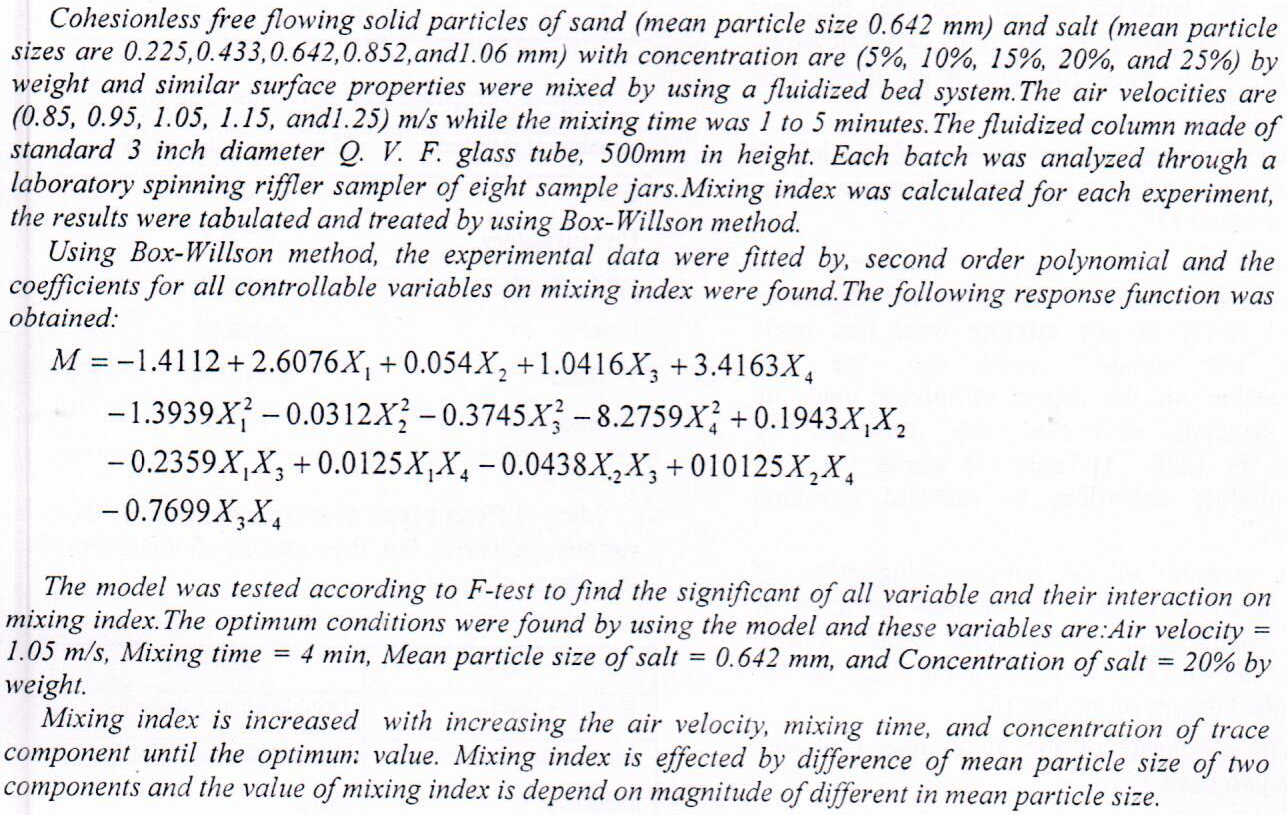
Performance of Mixing Granules Solid Materials by Fluidization

This research utilized natural asphalt (NA) deposits from sulfur springs in western Iraq. Laboratory tests were conducted to evaluate the performance of an asphalt mixture incorporating NA and verify its suitability for local pavement applications. To achieve this, a combination of two types of NA, namely soft SNA and hard HNA, was blended to create a binder known as Type HSNA. The resulting HSNA exhibited a penetration grade that adhered to Iraqi specifications. Various percentages of NA (20%, 40%, 60%, and 80%) were added to petroleum asphalt. The findings revealed enhanced physical properties of HSNA, which also satisfied the requirements outlined in the Iraqi specifications for asphalt cement. Consequently, HSNA can serve as an
... Show More (17)
(17)
 (8)
(8)


The durability of asphalt pavement is associated with the properties and performance of the binder. This work-study intended to understand the impact of blending Styrene-Butadiene-Styrene (SBS) to conventional asphalt concrete mixtures and calculating the Optimum Asphalt Content (OAC) for conventional mixture also; compare the performance between SBS modified with the conventional mixture. Two different kinds of asphalt penetration grades, A.C. (40-50) and A.C. (60-70), were improved with 2.5 and 3.5% SBS polymer, respectively. Marshall properties were determined in this work. Optimum Asphalt Content (OAC) was 4.93 and 5.1% by weight of mixture for A.C. (40-50) and (60-70), respectively. Marshall properties results show an increasem
... Show More
(18)
(11)

Sensitive information of any multimedia must be encrypted before transmission. The dual chaotic algorithm is a good option to encrypt sensitive information by using different parameters and different initial conditions for two chaotic maps. A dual chaotic framework creates a complex chaotic trajectory to prevent the illegal use of information from eavesdroppers. Limited precisions of a single chaotic map cause a degradation in the dynamical behavior of the communication system. To overcome this degradation issue in, a novel form of dual chaos map algorithm is analyzed. To maintain the stability of the dynamical system, the Lyapunov Exponent (LE) is determined for the single and dual maps. In this paper, the LE of the single and dual maps
... Show More
(5)
(1)
(15)
(11)
This research utilized natural asphalt (NA) deposits from sulfur springs in western Iraq. Laboratory tests were conducted to evaluate the performance of an asphalt mixture incorporating NA and verify its suitability for local pavement applications. To achieve this, a combination of two types of NA, namely soft SNA and hard HNA, was blended to create a binder known as Type HSNA. The resulting HSNA exhibited a penetration grade that adhered to Iraqi specifications. Various percentages of NA (20%, 40%, 60%, and 80%) were added to petroleum asphalt. The findings revealed enhanced physical properties of HSNA, which also satisfied the requirements outlined in the Iraqi specifications for asphalt cement.
Consequently, HS
... Show More
(17)
(8)
Abstract
This current research aims to make theoretical frame for the thoughts and principle knowledge for high performance work system ،also trying to know the role that high performance work system practices which is (Effective staffing، comprehensive training، providing work career، and employee participation) play to enhance the organization effectiveness ، although knowing the principles of high performance work system which is: (Shared Information، Knowledge Development Performance and Reward linkage Egalitarianism)and its effect on the organizations. As well as defining the special concept of High performance wo
... Show More
Silver-bismuth iodide (ABI) ternary semiconductors, such as AgBi2I7, AgBiI4, Ag2BiI5, and Ag3BiI6, have emerged as promising lead-free light absorbers for photovoltaic applications due to their favorable optoelectronic properties. Despite recent advances that have improved power conversion efficiencies from ∼1% to over 5%, ABI-based solar cells still show substantial open-circuit voltage (VOC) losses of up to ∼1 V, which significantly hinder the device performance. These losses have been experimentally attributed to the non-radiative recombination originating from intrinsic defects, however, theoretical understanding of these defect mechanisms remains limited. Here, using density functional theory calculations, we systematical
... Show More
(2)
(2)
Been in this gravel study the effect of Alchgag fast neutrons emitted by the source on the electrical properties of silicon solar cells monounsaturated crystal at a constant rate of neutron flow rate of a wide range of neutron flow speed ranges for periods of time ranging from 2-10 hours
(24)